
Line-O-Type 1935
Filed under its printed name. The masthead reads The Line-o-type; the source database catalogues it as Line’s Hobby No. 2.
1935
Winter 1935
Winter 1935 (catalogued as Line’s Hobby No. 2)
The Line-o-type · Francis and Helen Line
So many friends answered the first Line-o-type that Francis had to write a second letter to reply. It has mailbag news, talk of Sinclairism and the Townsend Plan, Guiterman’s Chinese and Hindu verses, and Mojave Desert sketches.
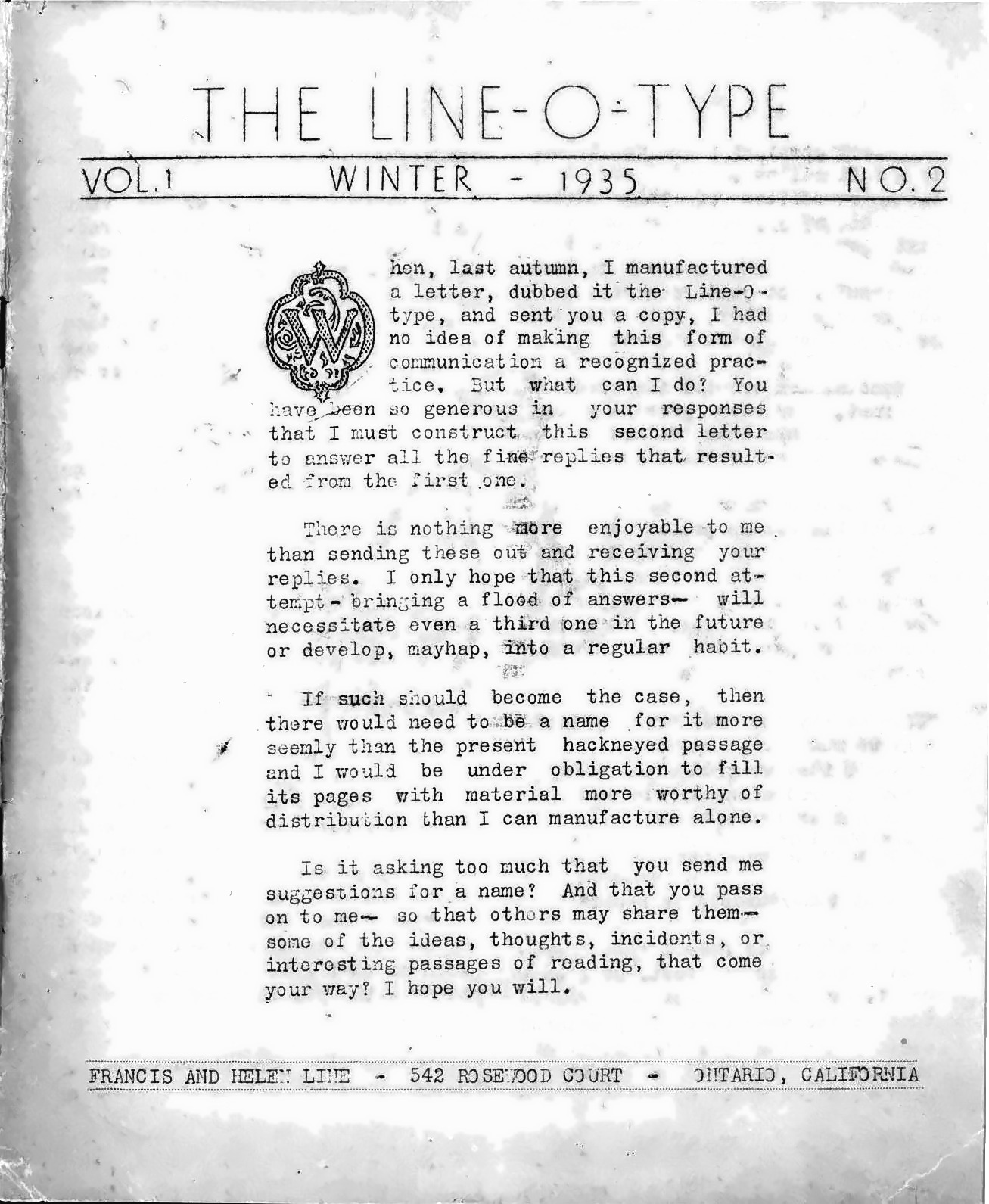
THE LINE-O-TYPE · VOL. 1 · WINTER 1935 · NO. 2
FRANCIS AND HELEN LINE · 542 ROSEWOOD COURT · ONTARIO, CALIFORNIA
When, last autumn, I manufactured a letter, dubbed it the Line-O-type, and sent you a copy, I had no idea of making this form of communication a recognized practice. But what can I do? You have been so generous in your responses that I must construct this second letter to answer all the fine replies that resulted from the first one.
There is nothing more enjoyable to me than sending these out and receiving your replies. I only hope that this second attempt—bringing a flood of answers—will necessitate even a third one in the future or develop, mayhap, into a regular habit.
If such should become the case, then there would need to be a name for it more seemly than the present hackneyed passage and I would be under obligation to fill its pages with material more worthy of distribution than I can manufacture alone.
Is it asking too much that you send me suggestions for a name? And that you pass on to me—so that others may share them—some of the ideas, thoughts, incidents, or interesting passages of reading, that come your way? I hope you will.
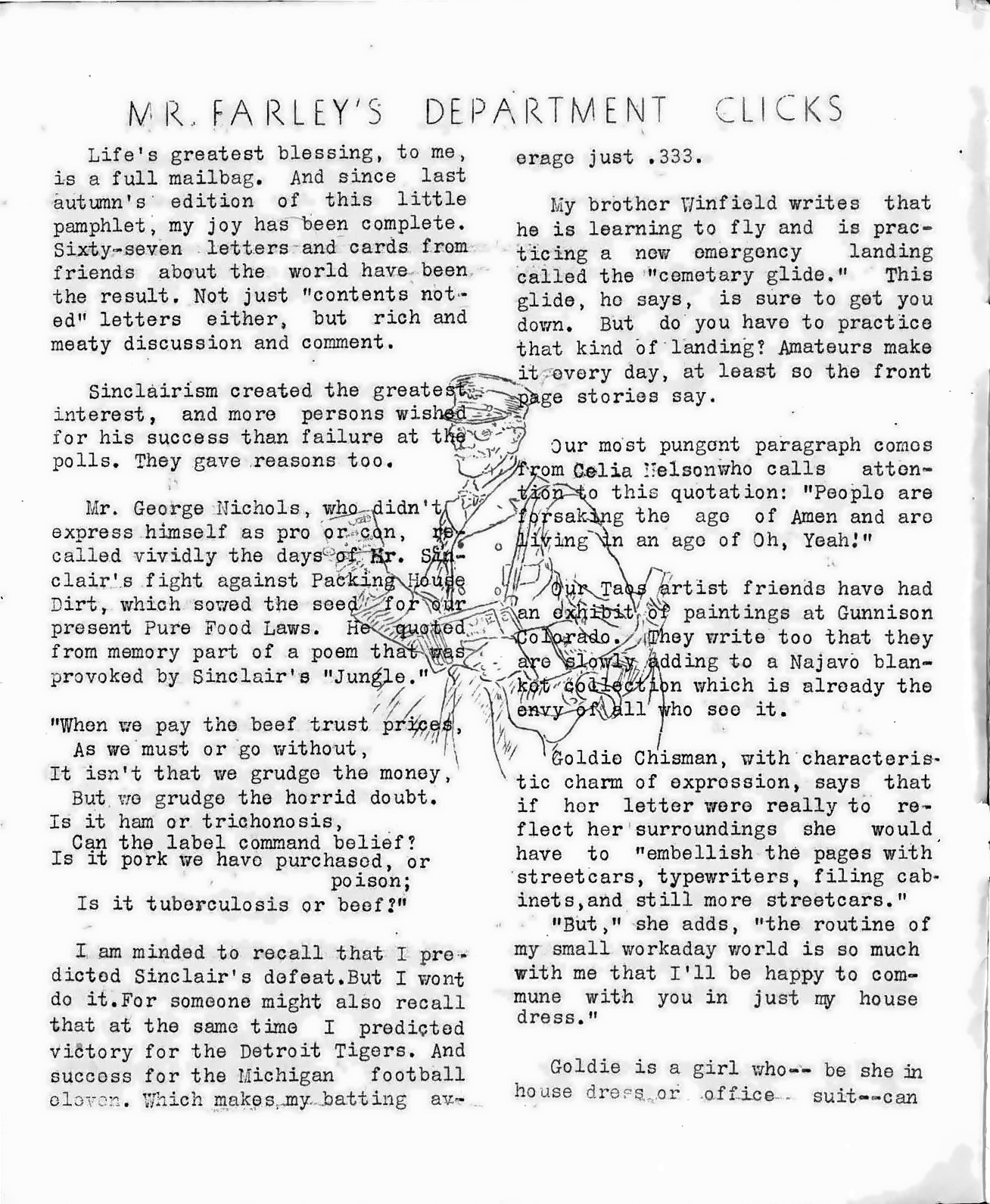
MR. FARLEY’S DEPARTMENT CLICKS
Life’s greatest blessing, to me, is a full mailbag. And since last autumn’s edition of this little pamphlet, my joy has been complete. Sixty-seven letters and cards from friends about the world have been the result. Not just “contents noted” letters either, but rich and meaty discussion and comment.
Sinclairism created the greatest interest, and more persons wished for his success than failure at the polls. They gave reasons too.
Mr. George Nichols, who didn’t express himself as pro or con, recalled vividly the days of Mr. Sinclair’s fight against Packing House Dirt, which sowed the seed for our present Pure Food Laws. He quoted from memory part of a poem that was provoked by Sinclair’s “Jungle.”
"When we pay the beef trust prices,
As we must or go without,
It isn't that we grudge the money,
But we grudge the horrid doubt.
Is it ham or trichonosis,
Can the label command belief?
Is it pork we have purchased, or poison;
Is it tuberculosis or beef?"
I am minded to recall that I predicted Sinclair’s defeat. But I wont do it. For someone might also recall that at the same time I predicted victory for the Detroit Tigers. And success for the Michigan football eleven. Which makes my batting average just .333.
My brother Winfield writes that he is learning to fly and is practicing a new emergency landing called the “cemetary glide.” This glide, he says, is sure to get you down. But do you have to practice that kind of landing? Amateurs make it every day, at least so the front page stories say.
Our most pungent paragraph comes from Celia Nelson who calls attention to this quotation: “People are forsaking the age of Amen and are living in an age of Oh, Yeah!”
Our Taos artist friends have had an exhibit of paintings at Gunnison Colorado. They write too that they are slowly adding to a Najavo blanket collection which is already the envy of all who see it.
Goldie Chisman, with characteristic charm of expression, says that if her letter were really to reflect her surroundings she would have to “embellish the pages with streetcars, typewriters, filing cabinets, and still more streetcars.” “But,” she adds, “the routine of my small workaday world is so much with me that I’ll be happy to commune with you in just my house dress.”
Goldie is a girl who—be she in house dress or office suit—can transform routine into poetry.
Ruth and Lewis Nooney, of Plainwell, Mich.; the Caverlys of Howell; Gus and Celia Nelson of Detroit, and the Moores of Youngs Point, Canada, have about the healthiest looking sons (at least by the pictures) that we have seen recently. This bigger and better sons movement sponsored by Mussolini must be spreading to America. At all events, these folk can appreciate the Chinese proverb:
"The Earth is glad of Clouds above the Grain;
The Home is glad of Babes that laugh and run.
When God is pleased, He sends reviving Rain.
When God is greatly pleased, He sends a Son."
All of which does not imply for a minute that we would not rather have a daughter any day.
Charlie Line’s four fine daughters of Palmer, Mass., by the way, are all in or near high school, and Helen Line Case’s two youngsters—boy and girl—are keeping her happy and busy.
Andersen’s three boys, we hear, are doing big things in the Four H club; Squire Burt’s son is director of the finest Junior College band in California, at Bakersfield.
We learn, too, that Howard Neitzert had an air trip to Latin America for his law firm, that Mrs. Steele, aged 83, journeyed by plane to Frisco, that Miss Courson and Miss Hull are off to Chicago, that the Jewells and the Howes went back to Howell for visits, and that Thelma Hamilton Hutton’s husband has gone to accept a fellowship with the Mayo doctors.
As for news of our own doings we have just finished harvesting the orange crop (about ten bushels) from the trees in our yard; and we had a little trip to our mountain cabin, where a foot of snow greeted us. The weather was below zero. And our radiator proceeded to freeze.
We took Barbara to a man-eating lion act at the Los Angeles zoo yesterday, and for the rest of the day she talked about the “big kitties” that wrestled the trainer.
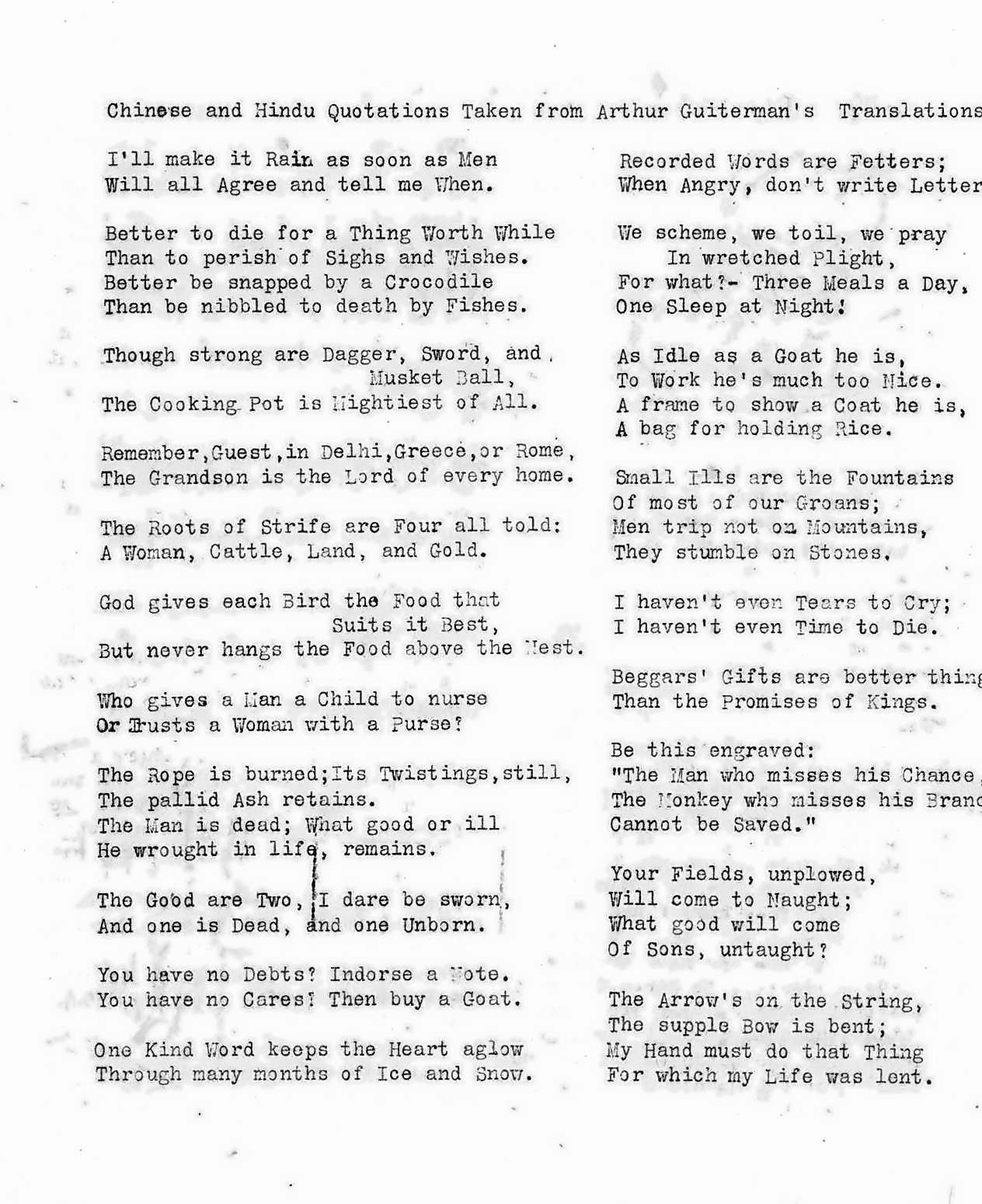
Chinese and Hindu Quotations Taken from Arthur Guiterman’s Translations
I'll make it Rain as soon as Men
Will all Agree and tell me When.
Better to die for a Thing Worth While
Than to perish of Sighs and Wishes.
Better be snapped by a Crocodile
Than be nibbled to death by Fishes.
Though strong are Dagger, Sword, and Musket Ball,
The Cooking Pot is Mightiest of All.
Remember, Guest, in Delhi, Greece, or Rome,
The Grandson is the Lord of every home.
The Roots of Strife are Four all told:
A Woman, Cattle, Land, and Gold.
God gives each Bird the Food that Suits it Best,
But never hangs the Food above the Nest.
Who gives a Man a Child to nurse
Or Trusts a Woman with a Purse?
The Rope is burned; Its Twistings, still,
The pallid Ash retains.
The Man is dead; What good or ill
He wrought in life, remains.
The Good are Two, I dare be sworn,
And one is Dead, and one Unborn.
You have no Debts? Indorse a Note.
You have no Cares! Then buy a Goat.
One Kind Word keeps the Heart aglow
Through many months of Ice and Snow.
Recorded Words are Fetters;
When Angry, don't write Letters.
We scheme, we toil, we pray
In wretched Plight,
For what?—Three Meals a Day,
One Sleep at Night!
As Idle as a Goat he is,
To Work he's much too Nice.
A frame to show a Coat he is,
A bag for holding Rice.
Small Ills are the Fountains
Of most of our Groans;
Men trip not on Mountains,
They stumble on Stones.
I haven't even Tears to Cry;
I haven't even Time to Die.
Beggars' Gifts are better things
Than the Promises of Kings.
Be this engraved:
"The Man who misses his Chance,
The Monkey who misses his Branch
Cannot be Saved."
Your Fields, unplowed,
Will come to Naught;
What good will come
Of Sons, untaught?
The Arrow's on the String,
The supple Bow is bent;
My Hand must do that Thing
For which my Life was lent.
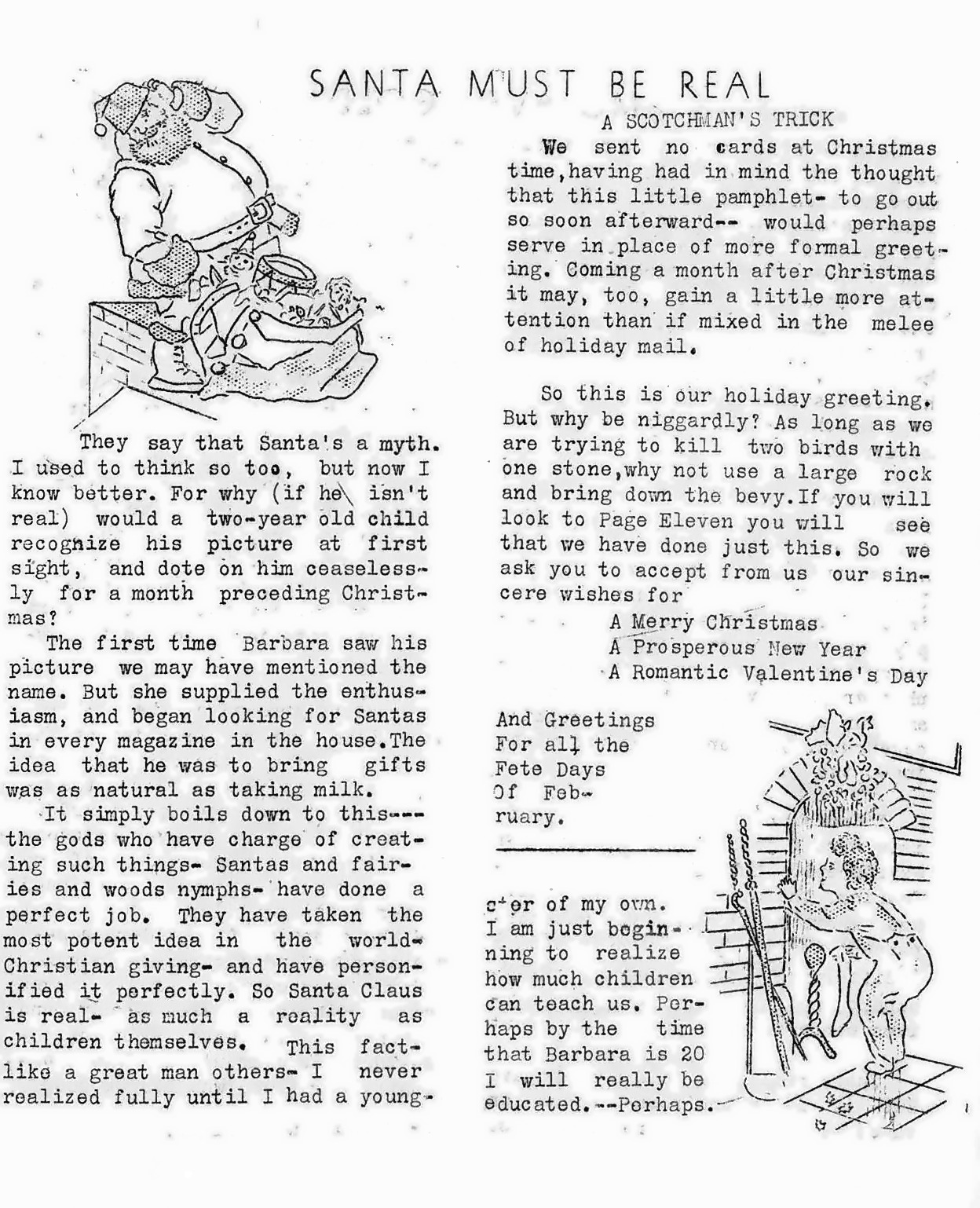
SANTA MUST BE REAL
There is nothing more enjoyable to me than sending these out and receiving your replies.
They say that Santa’s a myth. I used to think so too, but now I know better. For why (if he isn’t real) would a two-year old child recognize his picture at first sight, and dote on him ceaselessly for a month preceding Christmas?
The first time Barbara saw his picture we may have mentioned the name. But she supplied the enthusiasm, and began looking for Santas in every magazine in the house. The idea that he was to bring gifts was as natural as taking milk.
It simply boils down to this—-the gods who have charge of creating such things—Santas and fairies and woods nymphs—have done a perfect job. They have taken the most potent idea in the world—Christian giving—and have personified it perfectly. So Santa Claus is real—as much a reality as children themselves. This fact—like a great many others—I never realized fully until I had a youngster of my own. I am just beginning to realize how much children can teach us. Perhaps by the time that Barbara is 20 I will really be educated.—Perhaps.
A SCOTCHMAN’S TRICK
We sent no cards at Christmas time, having had in mind the thought that this little pamphlet—to go out so soon afterward—would perhaps serve in place of more formal greeting. Coming a month after Christmas it may, too, gain a little more attention than if mixed in the melee of holiday mail.
So this is our holiday greeting. But why be niggardly? As long as we are trying to kill two birds with one stone, why not use a large rock and bring down the bevy. If you will look to Page Eleven you will see that we have done just this. So we ask you to accept from us our sincere wishes for
A Merry Christmas
A Prosperous New Year
A Romantic Valentine's Day
And Greetings
For all the
Fete Days
Of February.
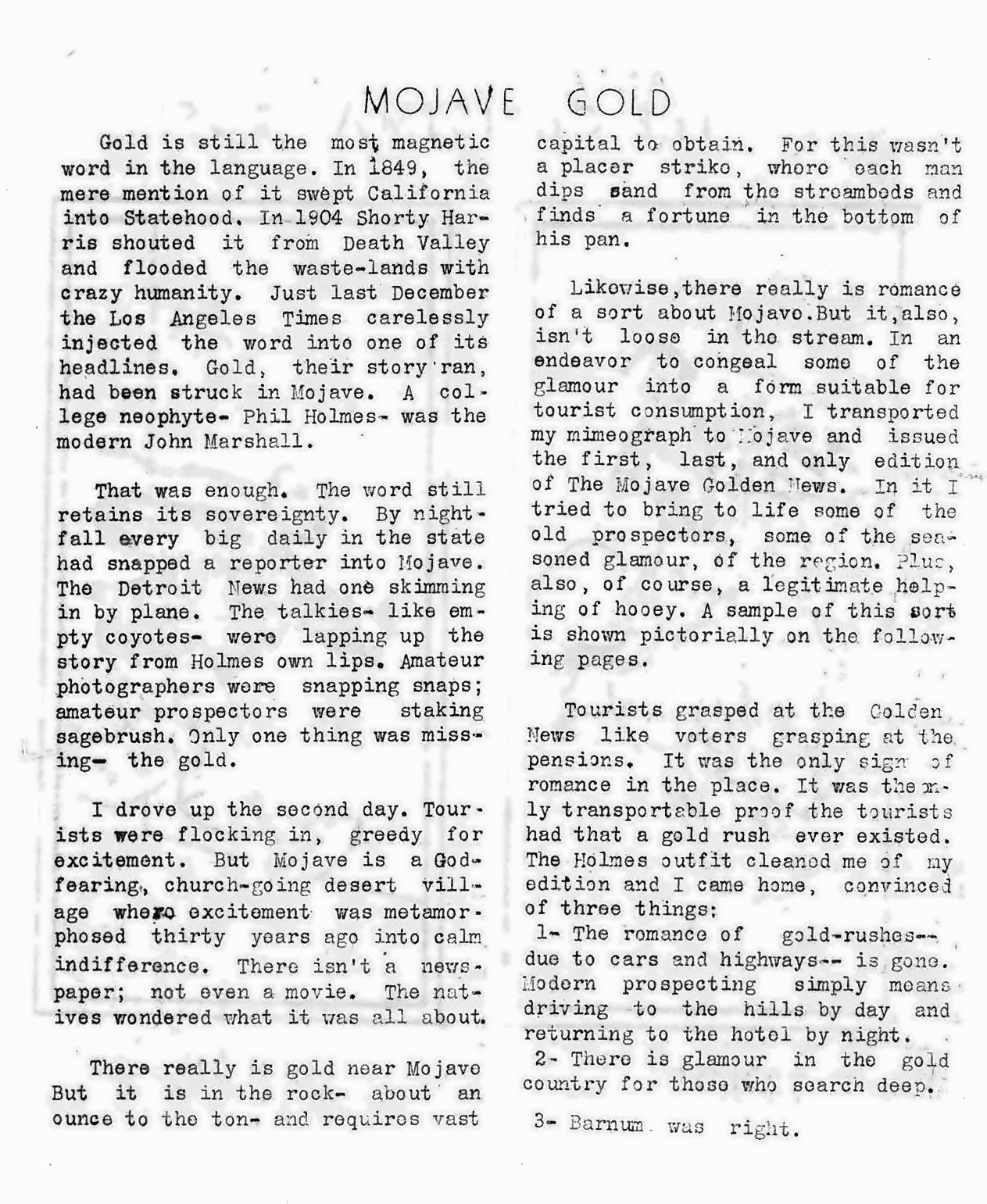
MOJAVE GOLD
Gold is still the most magnetic word in the language. In 1849, the mere mention of it swept California into Statehood. In 1904 Shorty Harris shouted it from Death Valley and flooded the waste-lands with crazy humanity. Just last December the Los Angeles Times carelessly injected the word into one of its headlines. Gold, their story ran, had been struck in Mojave. A college neophyte—Phil Holmes—was the modern John Marshall.
That was enough. The word still retains its sovereignty. By nightfall every big daily in the state had snapped a reporter into Mojave. The Detroit News had one skimming in by plane. The talkies—like empty coyotes—were lapping up the story from Holmes own lips. Amateur photographers were snapping snaps; amateur prospectors were staking sagebrush. Only one thing was missing—the gold.
I drove up the second day. Tourists were flocking in, greedy for excitement. But Mojave is a God-fearing, church-going desert village where excitement was metamorphosed thirty years ago into calm indifference. There isn’t a newspaper; not even a movie. The natives wondered what it was all about.
There really is gold near Mojave. But it is in the rock—about an ounce to the ton—and requires vast capital to obtain. For this wasn’t a placer strike, where each man dips sand from the streambeds and finds a fortune in the bottom of his pan.
Likewise, there really is romance of a sort about Mojave. But it, also, isn’t loose in the stream. In an endeavor to congeal some of the glamour into a form suitable for tourist consumption, I transported my mimeograph to Mojave and issued the first, last, and only edition of The Mojave Golden News. In it I tried to bring to life some of the old prospectors, some of the seasoned glamour, of the region. Plus, also, of course, a legitimate helping of hooey. A sample of this sort is shown pictorially on the following pages.
Tourists grasped at the Golden News like voters grasping at the pensions. It was the only sign of romance in the place. It was the only transportable proof the tourists had that a gold rush ever existed. The Holmes outfit cleaned me of my edition and I came home, convinced of three things:
1—The romance of gold-rushes—due to cars and highways—is gone. Modern prospecting simply means driving to the hills by day and returning to the hotel by night.
2—There is glamour in the gold country for those who search deep.
3—Barnum was right.
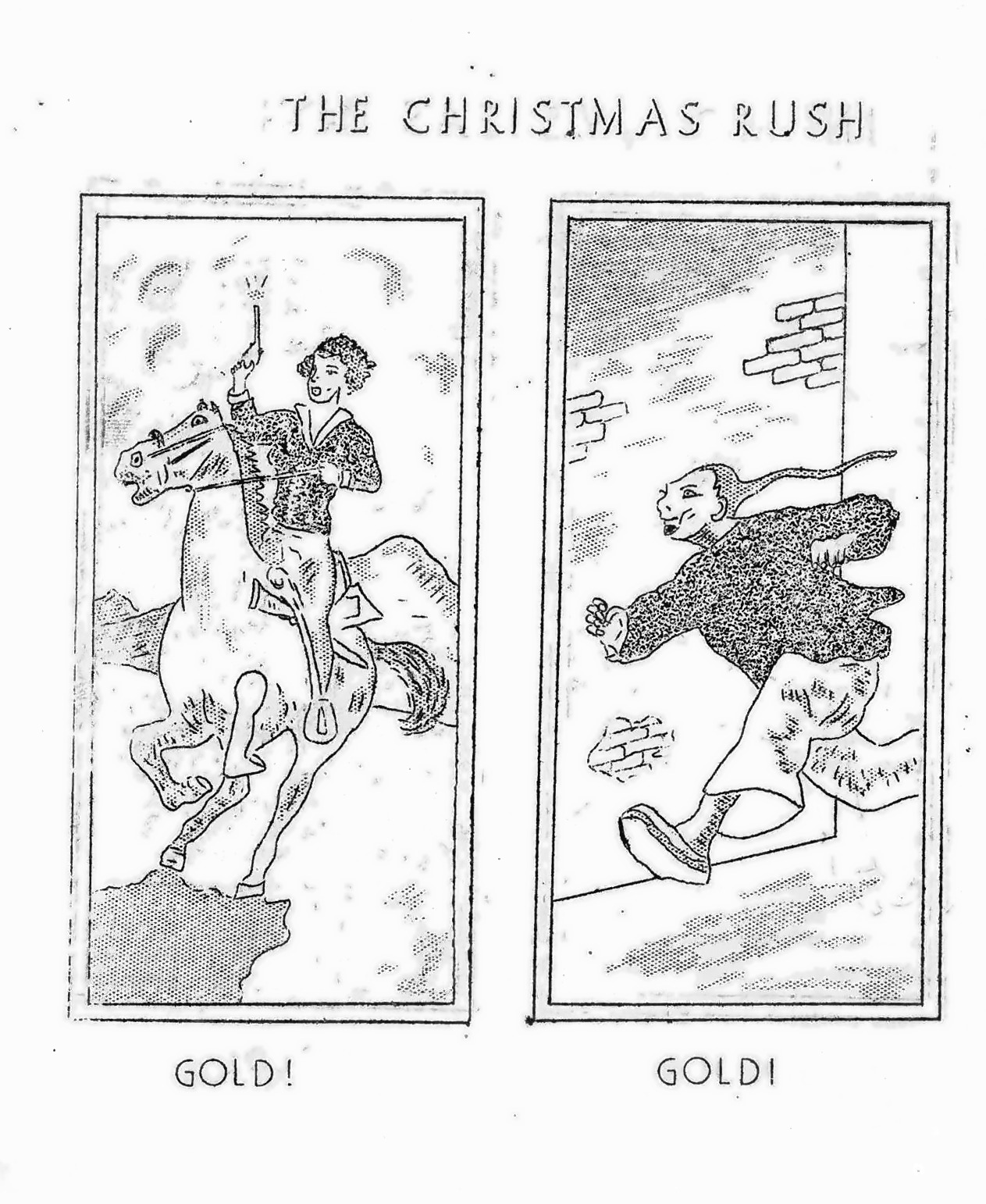
[The centre spread is a four-panel cartoon: “The Christmas Rush—In Mojave Fashion,” each panel captioned “Gold!”]
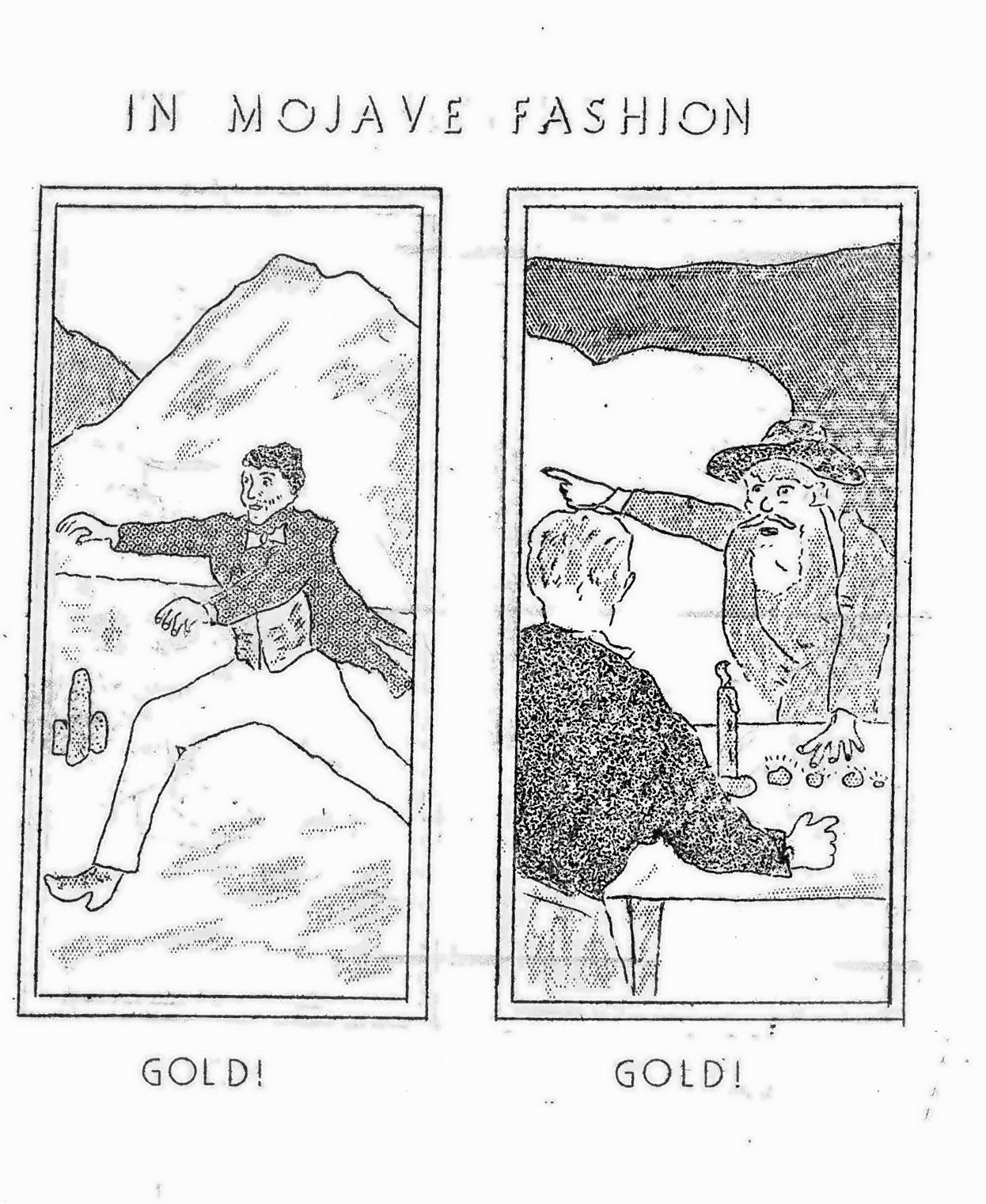
[Page 7: second half of the centre-spread cartoon, “In Mojave Fashion” (see scan)]
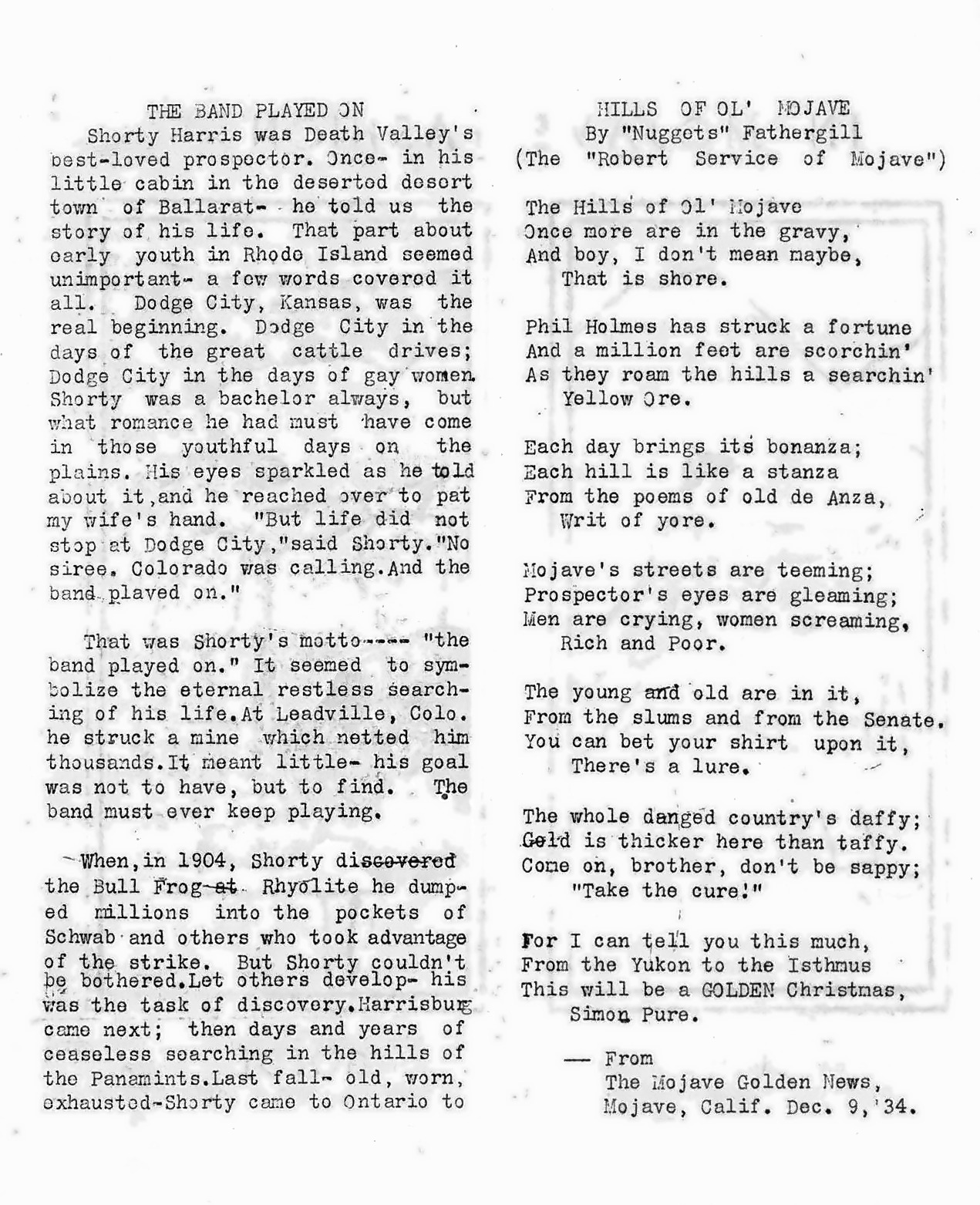
THE BAND PLAYED ON
Shorty Harris was Death Valley’s best-loved prospector. Once—in his little cabin in the deserted desert town of Ballarat—he told us the story of his life. That part about early youth in Rhode Island seemed unimportant—a few words covered it all. Dodge City, Kansas, was the real beginning. Dodge City in the days of the great cattle drives; Dodge City in the days of gay women. Shorty was a bachelor always, but what romance he had must have come in those youthful days on the plains. His eyes sparkled as he told about it, and he reached over to pat my wife’s hand. “But life did not stop at Dodge City,” said Shorty. “No siree. Colorado was calling. And the band played on.”
That was Shorty’s motto—”the band played on.” It seemed to symbolize the eternal restless searching of his life. At Leadville, Colo. he struck a mine which netted him thousands. It meant little—his goal was not to have, but to find. The band must ever keep playing.
When, in 1904, Shorty discovered the Bull Frog Rhyolite he dumped millions into the pockets of Schwab and others who took advantage of the strike. But Shorty couldn’t be bothered. Let others develop—his was the task of discovery. Harrisburg came next; then days and years of ceaseless searching in the hills of the Panamints. Last fall—old, worn, exhausted—Shorty came to Ontario to stay with friends. Folks said he was dying. Maybe he was—but what of it? There was gold yet to find; there was music yet to play. Last November, Shorty set out again toward the unexplored hills. And there—alone, still searching—was where death found him. It could not have been otherwise. He carried the baton to the last. The strange lonesome, glorious, melody of his own life was a perfect requiem.
HILLS OF OL’ MOJAVE
The Hills of Ol' Mojave
Once more are in the gravy,
And boy, I don't mean maybe,
That is shore.

Phil Holmes has struck a fortune
And a million feet are scorchin'
As they roam the hills a searchin'
Yellow Ore.

Each day brings its bonanza;
Each hill is like a stanza
From the poems of old de Anza,
Writ of yore.

Mojave's streets are teeming;
Prospector's eyes are gleaming;
Men are crying, women screaming,
Rich and Poor.

The young and old are in it,
From the slums and from the Senate,
You can bet your shirt upon it,
There's a lure.

The whole danged country's daffy;
Gold is thicker here than taffy.
Come on, brother, don't be sappy;
"Take the cure!"

For I can tell you this much,
From the Yukon to the Isthmus
This will be a GOLDEN Christmas,
Simon Pure.
—From The Mojave Golden News, Mojave, Calif. Dec. 9, ’34.
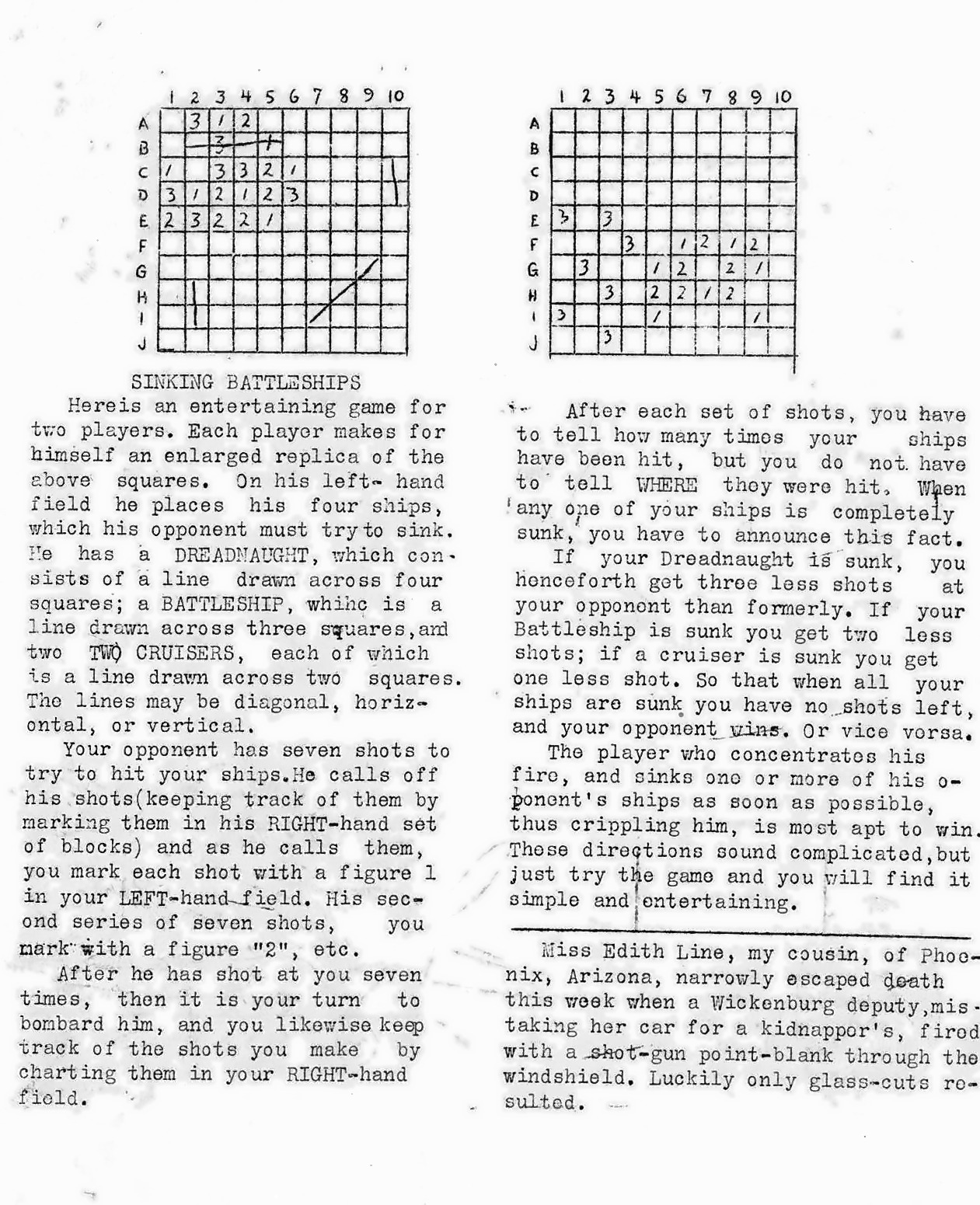
SINKING BATTLESHIPS
Here is an entertaining game for two players. Each player makes for himself an enlarged replica of the above squares. On his left-hand field he places his four ships, which his opponent must try to sink. He has a DREADNAUGHT, which consists of a line drawn across four squares; a BATTLESHIP, which is a line drawn across three squares, and two CRUISERS, each of which is a line drawn across two squares.
The lines may be diagonal, horizontal, or vertical.
Your opponent has seven shots to try to hit your ships. He calls off his shots (keeping track of them by marking them in his RIGHT-hand set of blocks) and as he calls them, you mark each shot with a figure 1 in your LEFT-hand field. His second series of seven shots, you mark with a figure “2”, etc.
After he has shot at you seven times, then it is your turn to bombard him, and you likewise keep track of the shots you make by charting them in your RIGHT-hand field.
After each set of shots, you have to tell how many times your ships have been hit, but you do not have to tell WHERE they were hit. When any one of your ships is completely sunk, you have to announce this fact.
If your Dreadnaught is sunk, you henceforth get three less shots at your opponent than formerly. If your Battleship is sunk you get two less shots; if a cruiser is sunk you get one less shot. So that when all your ships are sunk you have no shots left, and your opponent wins. Or vice versa.
The player who concentrates his fire, and sinks one or more of his opponent’s ships as soon as possible, thus crippling him, is most apt to win. These directions sound complicated, but just try the game and you will find it simple and entertaining.
[The game grids printed on the page are not reproduced; see the scan.]
Miss Edith Line, my cousin, of Phoenix, Arizona, narrowly escaped death this week when a Wickenburg deputy, mistaking her car for a kidnapper’s, fired with a shot-gun point-blank through the windshield. Luckily only glass-cuts resulted.
[Page 11 is a full-page colour greeting: “Best Wishes for Every Season.”]
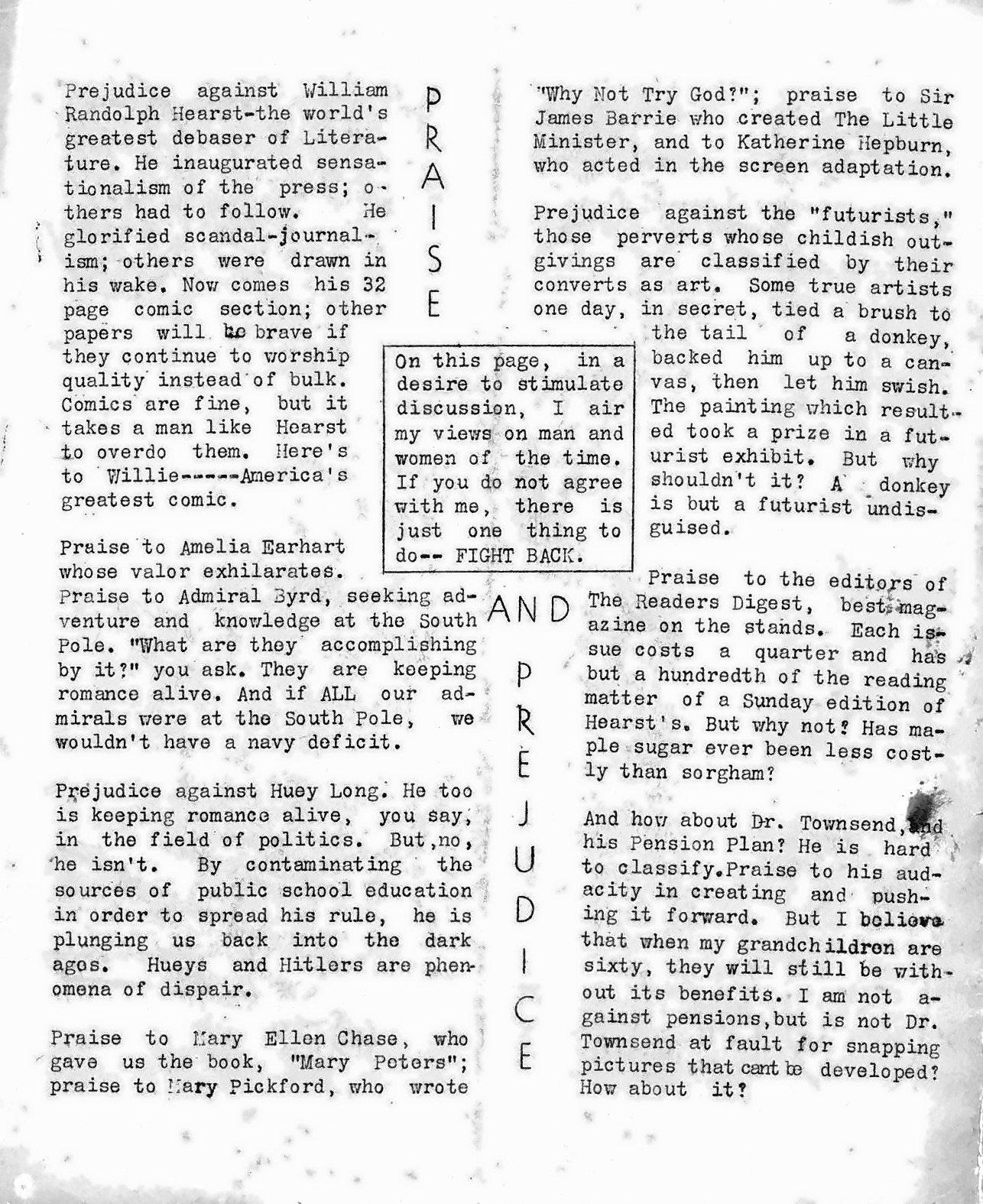
PRAISE AND PREJUDICE
On this page, in a desire to stimulate discussion, I air my views on men and women of the time. If you do not agree with me, there is just one thing to do—FIGHT BACK.
Prejudice against William Randolph Hearst—the world’s greatest debaser of Literature. He inaugurated sensationalism of the press; others had to follow. He glorified scandal-journalism; others were drawn in his wake. Now comes his 32 page comic section; other papers will be brave if they continue to worship quality instead of bulk. Comics are fine, but it takes a man like Hearst to overdo them. Here’s to Willie——America’s greatest comic.
Praise to Amelia Earhart whose valor exhilarates. Praise to Admiral Byrd, seeking adventure and knowledge at the South Pole. “What are they accomplishing by it?” you ask. They are keeping romance alive. And if ALL our admirals were at the South Pole, we wouldn’t have a navy deficit.
Prejudice against Huey Long. He too is keeping romance alive, you say, in the field of politics. But, no, he isn’t. By contaminating the sources of public school education in order to spread his rule, he is plunging us back into the dark ages. Hueys and Hitlers are phenomena of dispair.
Praise to Mary Ellen Chase, who gave us the book, “Mary Peters”; praise to Mary Pickford, who wrote “Why Not Try God?”; praise to Sir James Barrie who created The Little Minister, and to Katherine Hepburn, who acted in the screen adaptation.
Prejudice against the “futurists,” those perverts whose childish outgivings are classified by their converts as art. Some true artists one day, in secret, tied a brush to the tail of a donkey, backed him up to a canvas, then let him swish. The painting which resulted took a prize in a futurist exhibit. But why shouldn’t it? A donkey is but a futurist undisguised.
Praise to the editors of The Readers Digest, best magazine on the stands. Each issue costs a quarter and has but a hundredth of the reading matter of a Sunday edition of Hearst’s. But why not? Has maple sugar ever been less costly than sorghum?
And how about Dr. Townsend, and his Pension Plan? He is hard to classify. Praise to his audacity in creating and pushing it forward. But I believe that when my grandchildren are sixty, they will still be without its benefits. I am not against pensions, but is not Dr. Townsend at fault for snapping pictures that can’t be developed? How about it?
About this issue
The second letter (masthead: The Line-o-type, Vol. 1, Winter 1935, No. 2) answers the flood of replies to the first. It includes mailbag excerpts (“Mr. Farley’s Department Clicks”), political discussion of EPIC and the Townsend Plan, a page of Arthur Guiterman’s verse translations, “Santa Must Be Real,” “Mojave Gold,” “Hills of Ol’ Mojave,” “Sinking Battleships” and “Praise and Prejudice.”