
Line-O-Type 1935 Christmas Edition
Text from OCR, needs proofreading.
Filed under its printed name. The masthead reads The Line-o-type; the source database catalogues it as Line’s Hobby No. 3.
1935
December 21, 1935
Christmas 1935 folder (catalogued as Line’s Hobby No. 3)
The Line-o-type · Francis and Helen Line
The Lines’ Christmas card for 1935 is a whole folder, sent “to continue the bond between us and our friends.” Inside are Michigan sidelights, the mailbag, the little library at the end of Rosewood, and favourite reprints such as “Mary White” and “Riding High.”
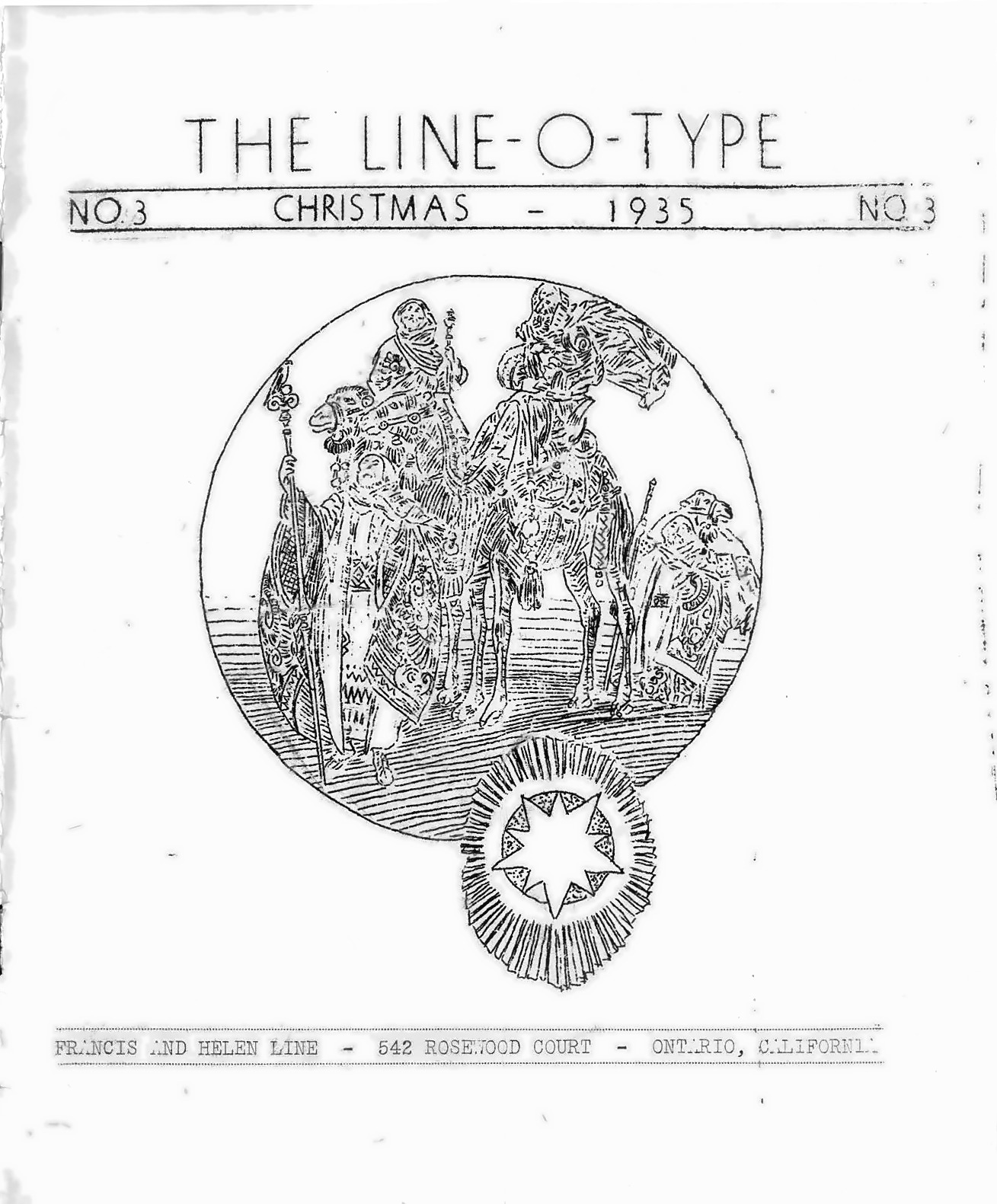
THE LINE-O-TYPE · NO. 3 · CHRISTMAS 1935
FRANCIS AND HELEN LINE · 542 ROSEWOOD COURT · ONTARIO, CALIFORNIA
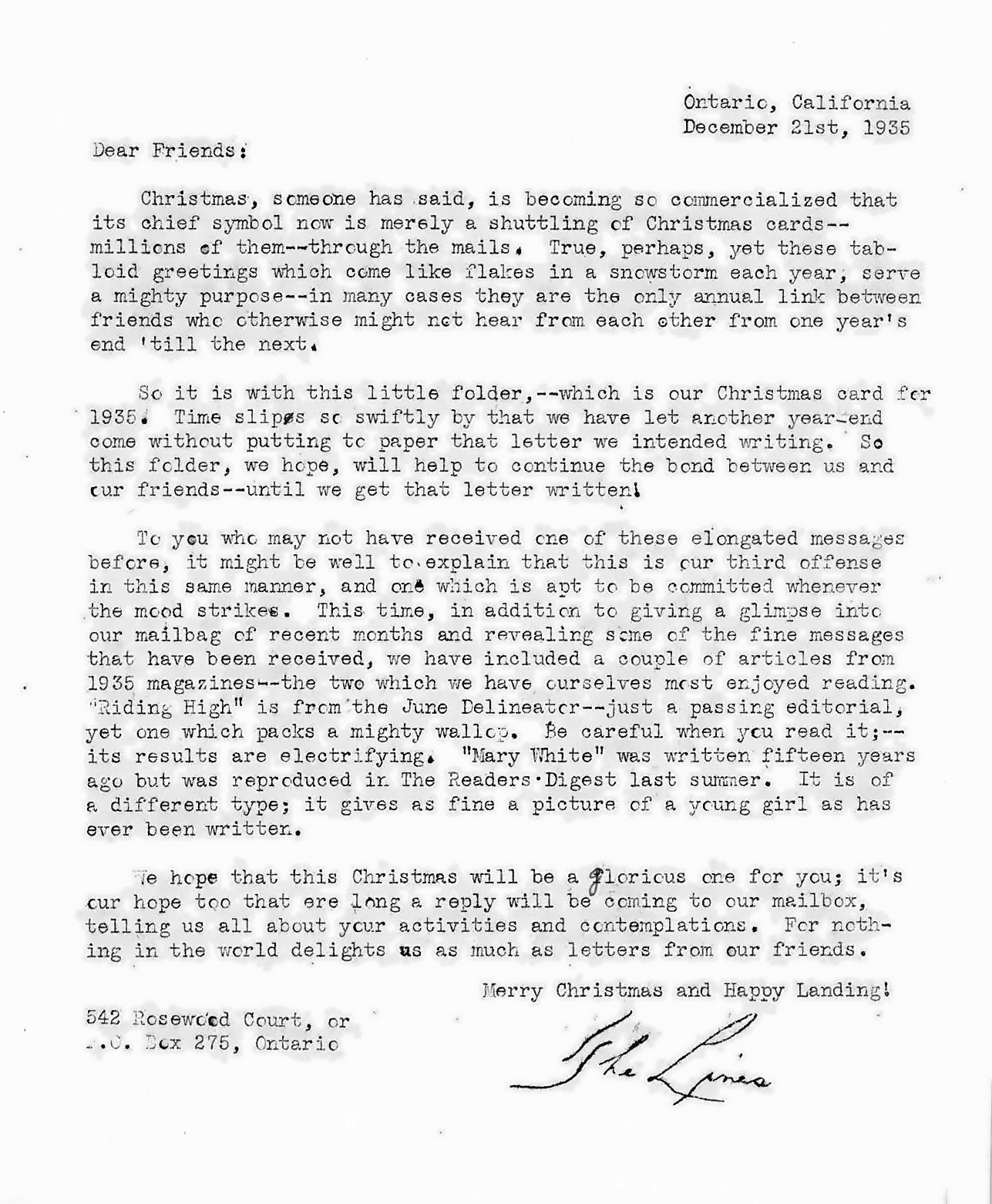
Ontario, California
December 21st, 1935
Dear Friends:
Christmas, someone has said, is becoming so commercialized that its chief symbol now is merely a shuttling of Christmas cards—millions of them—through the mails. True, perhaps, yet these tabloid greetings which come like flakes in a snowstorm each year, serve a mighty purpose—in many cases they are the only annual link between friends who otherwise might not hear from each other from one year’s end ’till the next.
So it is with this little folder,—which is our Christmas card for 1935. Time slips so swiftly by that we have let another year-end come without putting to paper that letter we intended writing. So this folder, we hope, will help to continue the bond between us and our friends—until we get that letter written!
To you who may not have received one of these elongated messages before, it might be well to explain that this is our third offense in this same manner, and one which is apt to be committed whenever the mood strikes. This time, in addition to giving a glimpse into our mailbag of recent months and revealing some of the fine messages that have been received, we have included a couple of articles from 1935 magazines—the two which we have ourselves most enjoyed reading. “Riding High” is from the June Delineator—just a passing editorial, yet one which packs a mighty wallop. Be careful when you read it;—its results are electrifying. “Mary White” was written fifteen years ago but was reproduced in The Readers Digest last summer. It is of a different type; it gives as fine a picture of a young girl as has ever been written.
We hope that this Christmas will be a glorious one for you; it’s our hope too that ere long a reply will be coming to our mailbox, telling us all about your activities and contemplations. For nothing in the world delights us as much as letters from our friends.
Merry Christmas and Happy Landing!
The Lines
542 Rosewood Court, or P.O. Box 275, Ontario
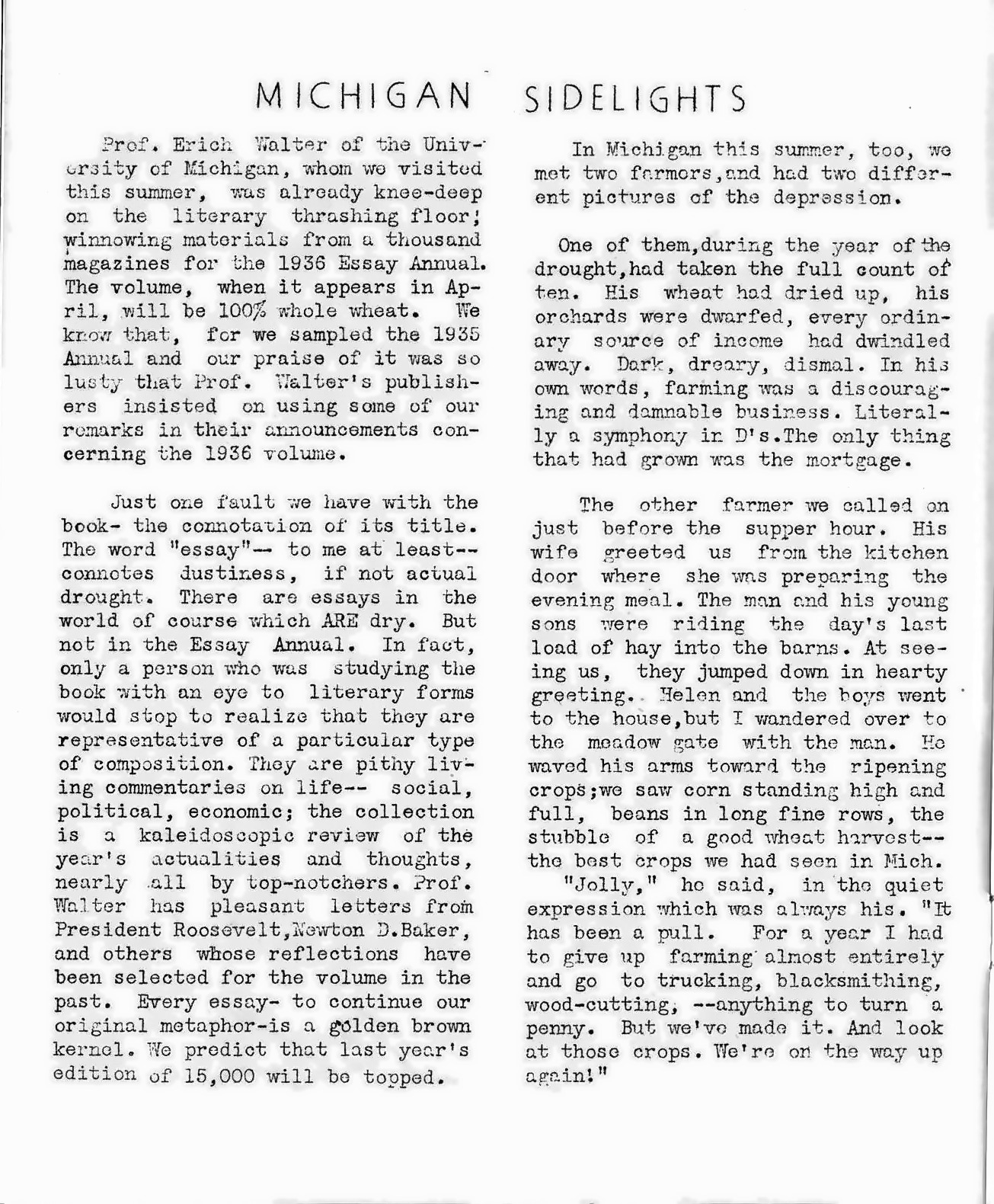
MICHIGAN SIDELIGHTS
Prof. Erich Walter of the University of Michigan, whom we visited this summer, was already knee-deep on the literary thrashing floor; winnowing materials from a thousand magazines for the 1936 Essay Annual. The volume, when it appears in April, will be 100% whole wheat. We know that, for we sampled the 1935 Annual and our praise of it was so lusty that Prof. Walter’s publishers insisted on using some of our remarks in their announcements concerning the 1936 volume.
Just one fault we have with the book—the connotation of its title. The word “essay”—to me at least—connotes dustiness, if not actual drought. There are essays in the world of course which ARE dry. But not in the Essay Annual. In fact, only a person who was studying the book with an eye to literary forms would stop to realize that they are representative of a particular type of composition. They are pithy living commentaries on life—social, political, economic; the collection is a kaleidoscopic review of the year’s actualities and thoughts, nearly all by top-notchers. Prof. Walter has pleasant letters from President Roosevelt, Newton D. Baker, and others whose reflections have been selected for the volume in the past. Every essay—to continue our original metaphor—is a golden brown kernel. We predict that last year’s edition of 15,000 will be topped.
In Michigan this summer, too, we met two farmers, and had two different pictures of the depression.
One of them, during the year of the drought, had taken the full count of ten. His wheat had dried up, his orchards were dwarfed, every ordinary source of income had dwindled away. Dark, dreary, dismal. In his own words, farming was a discouraging and damnable business. Literally a symphony in D’s. The only thing that had grown was the mortgage.
The other farmer we called on just before the supper hour. His wife greeted us from the kitchen door where she was preparing the evening meal. The man and his young sons were riding the day’s last load of hay into the barns. At seeing us, they jumped down in hearty greeting. Helen and the boys went to the house, but I wandered over to the meadow gate with the man. He waved his arms toward the ripening crops; we saw corn standing high and full, beans in long fine rows, the stubble of a good wheat harvest—the best crops we had seen in Mich.
“Jolly,” he said, in the quiet expression which was always his. “It has been a pull. For a year I had to give up farming almost entirely and go to trucking, blacksmithing, wood-cutting,—anything to turn a penny. But we’ve made it. And look at those crops. We’re on the way up again!”
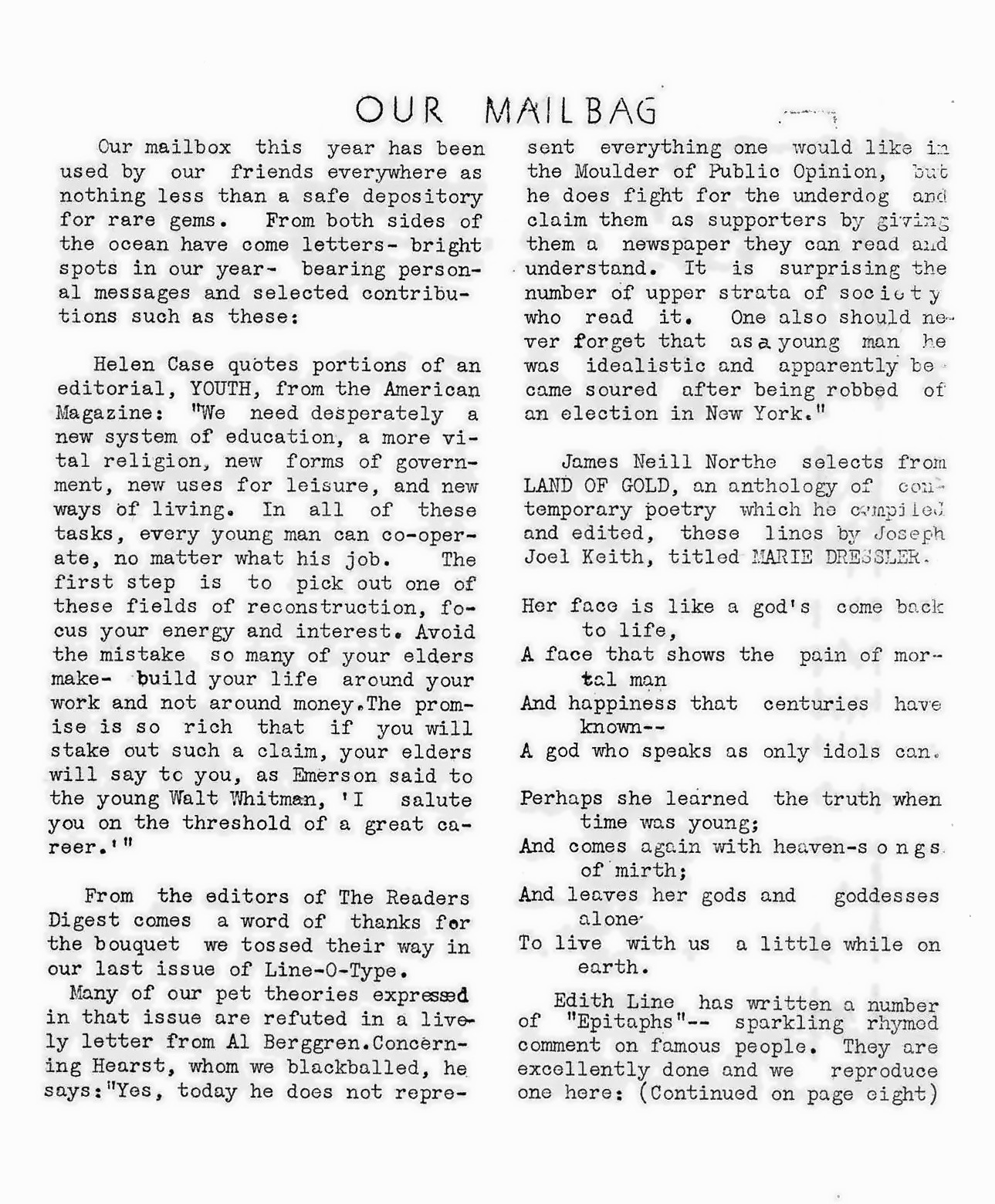
OUR MAILBAG
Our mailbox this year has been used by our friends everywhere as nothing less than a safe depository for rare gems. From both sides of the ocean have come letters—bright spots in our year—bearing personal messages and selected contributions such as these:
Helen Case quotes portions of an editorial, YOUTH, from the American Magazine: “We need desperately a new system of education, a more vital religion, new forms of government, new uses for leisure, and new ways of living. In all of these tasks, every young man can co-operate, no matter what his job. The first step is to pick out one of these fields of reconstruction, focus your energy and interest. Avoid the mistake so many of your elders make—build your life around your work and not around money. The promise is so rich that if you will stake out such a claim, your elders will say to you, as Emerson said to the young Walt Whitman, ‘I salute you on the threshold of a great career.'”
From the editors of The Readers Digest comes a word of thanks for the bouquet we tossed their way in our last issue of Line-O-Type.
Many of our pet theories expressed in that issue are refuted in a lively letter from Al Berggren. Concerning Hearst, whom we blackballed, he says: “Yes, today he does not represent everything one would like in the Moulder of Public Opinion, but he does fight for the underdog and claim them as supporters by giving them a newspaper they can read and understand. It is surprising the number of upper strata of society who read it. One also should never forget that as a young man he was idealistic and apparently became soured after being robbed of an election in New York.”
James Neill Northe selects from LAND OF GOLD, an anthology of contemporary poetry which he compiled and edited, these lines by Joseph Joel Keith, titled MARIE DRESSLER.
Her face is like a god's come back to life,
A face that shows the pain of mortal man
And happiness that centuries have known—
A god who speaks as only idols can.

Perhaps she learned the truth when time was young;
And comes again with heaven-songs of mirth;
And leaves her gods and goddesses alone
To live with us a little while on earth.
Edith Line has written a number of “Epitaphs”—sparkling rhymed comment on famous people. They are excellently done and we reproduce one here:
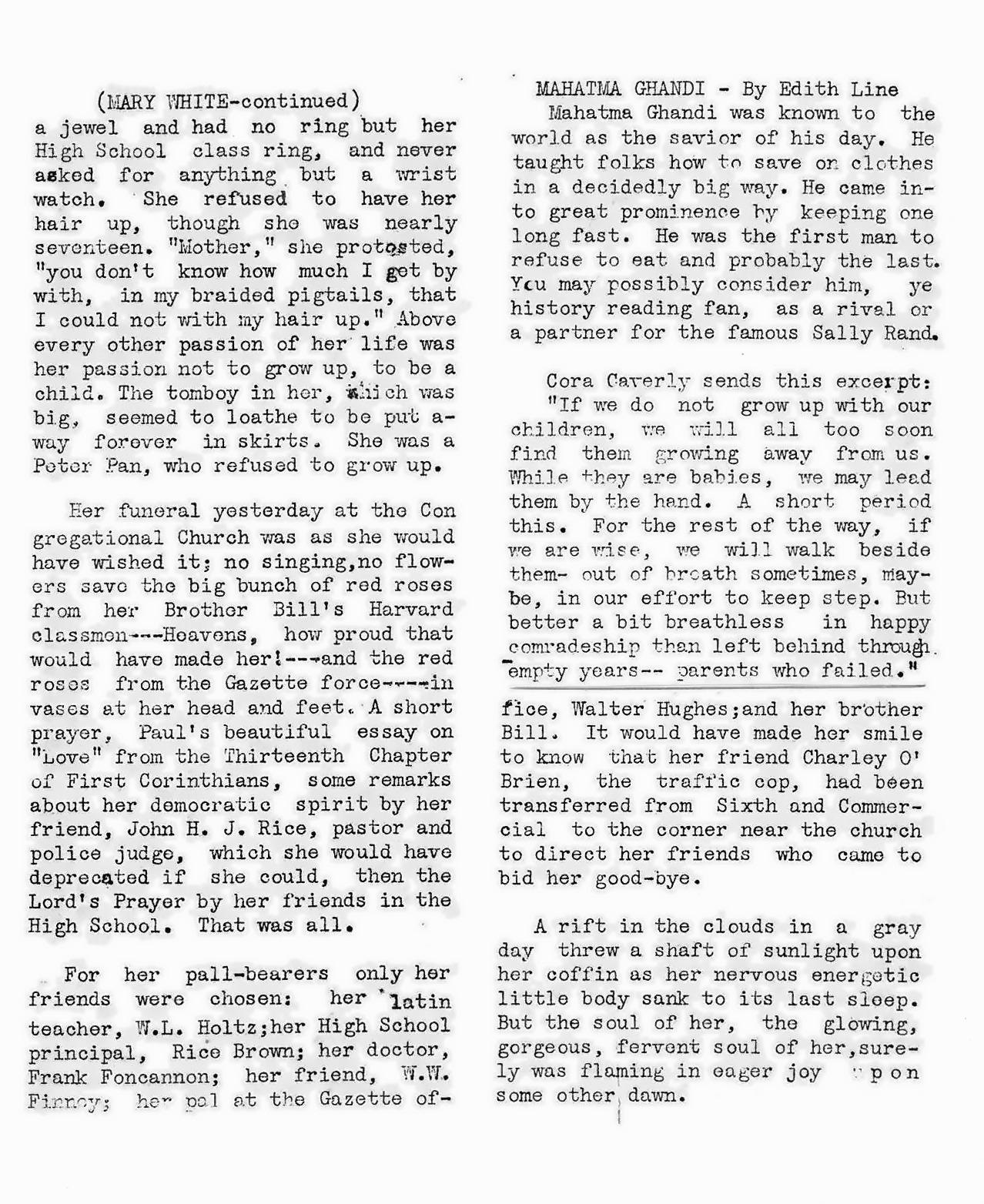
MAHATMA GHANDI – By Edith Line
Mahatma Ghandi was known to the world as the savior of his day. He taught folks how to save on clothes in a decidedly big way. He came into great prominence by keeping one long fast. He was the first man to refuse to eat and probably the last. You may possibly consider him, ye history reading fan, as a rival or a partner for the famous Sally Rand.
Time slips so swiftly by that we have let another year-end come without putting to paper that letter we intended writing.
Cora Caverly sends this excerpt:
“If we do not grow up with our children, we will all too soon find them growing away from us. While they are babies, we may lead them by the hand. A short period this. For the rest of the way, if we are wise, we will walk beside them—out of breath sometimes, maybe, in our effort to keep step. But better a bit breathless in happy comradeship than left behind through empty years—parents who failed.”
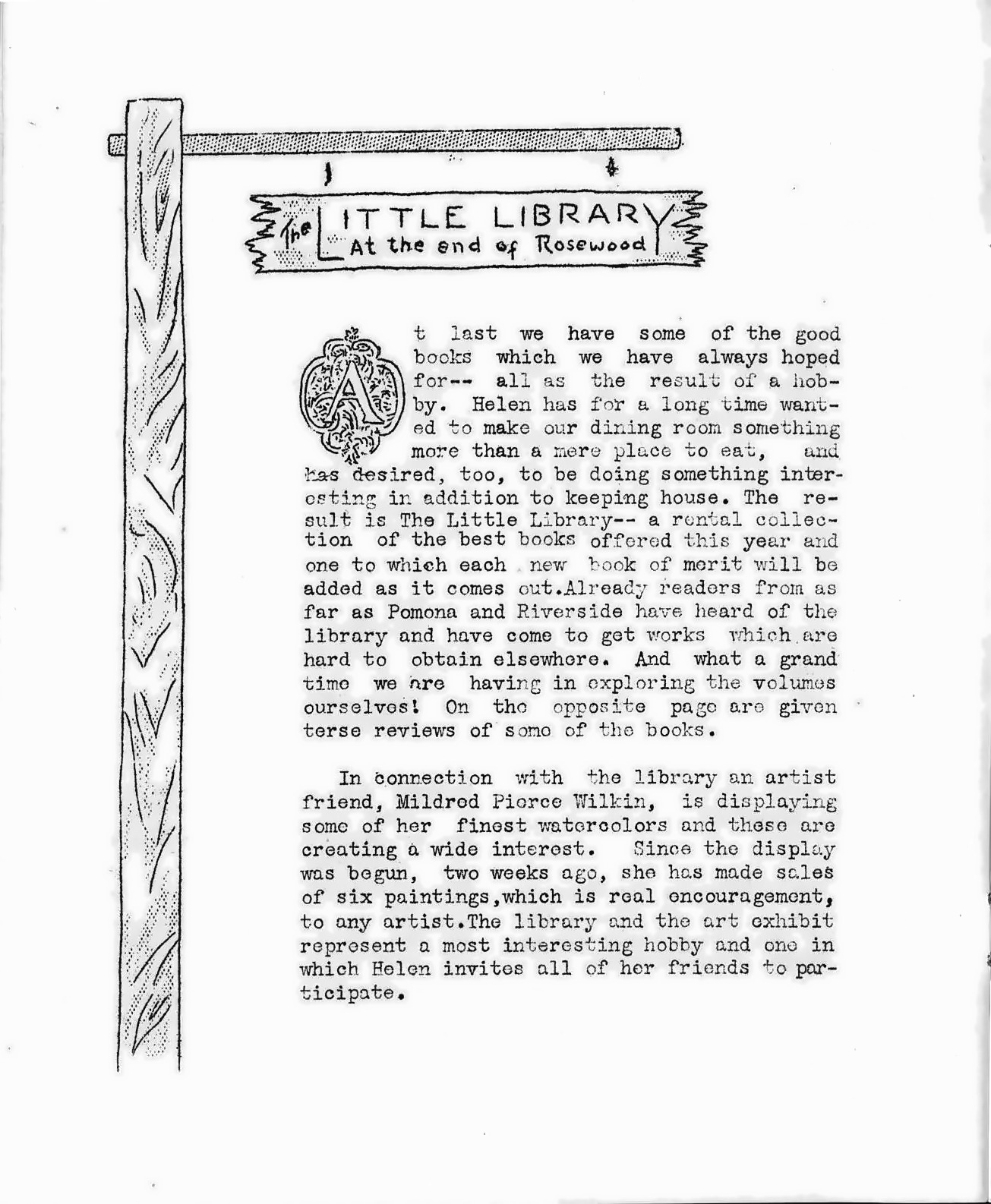
THE LITTLE LIBRARY AT THE END OF ROSEWOOD
At last we have some of the good books which we have always hoped for—all as the result of a hobby. Helen has for a long time wanted to make our dining room something more than a mere place to eat, and has desired, too, to be doing something interesting in addition to keeping house. The result is The Little Library—a rental collection of the best books offered this year and one to which each new book of merit will be added as it comes out. Already readers from as far as Pomona and Riverside have heard of the library and have come to get works which are hard to obtain elsewhere. And what a grand time we are having in exploring the volumes ourselves! On the opposite page are given terse reviews of some of the books.
In connection with the library an artist friend, Mildred Pierce Wilkin, is displaying some of her finest watercolors and these are creating a wide interest. Since the display was begun, two weeks ago, she has made sales of six paintings, which is real encouragement, to any artist. The library and the art exhibit represent a most interesting hobby and one in which Helen invites all of her friends to participate.
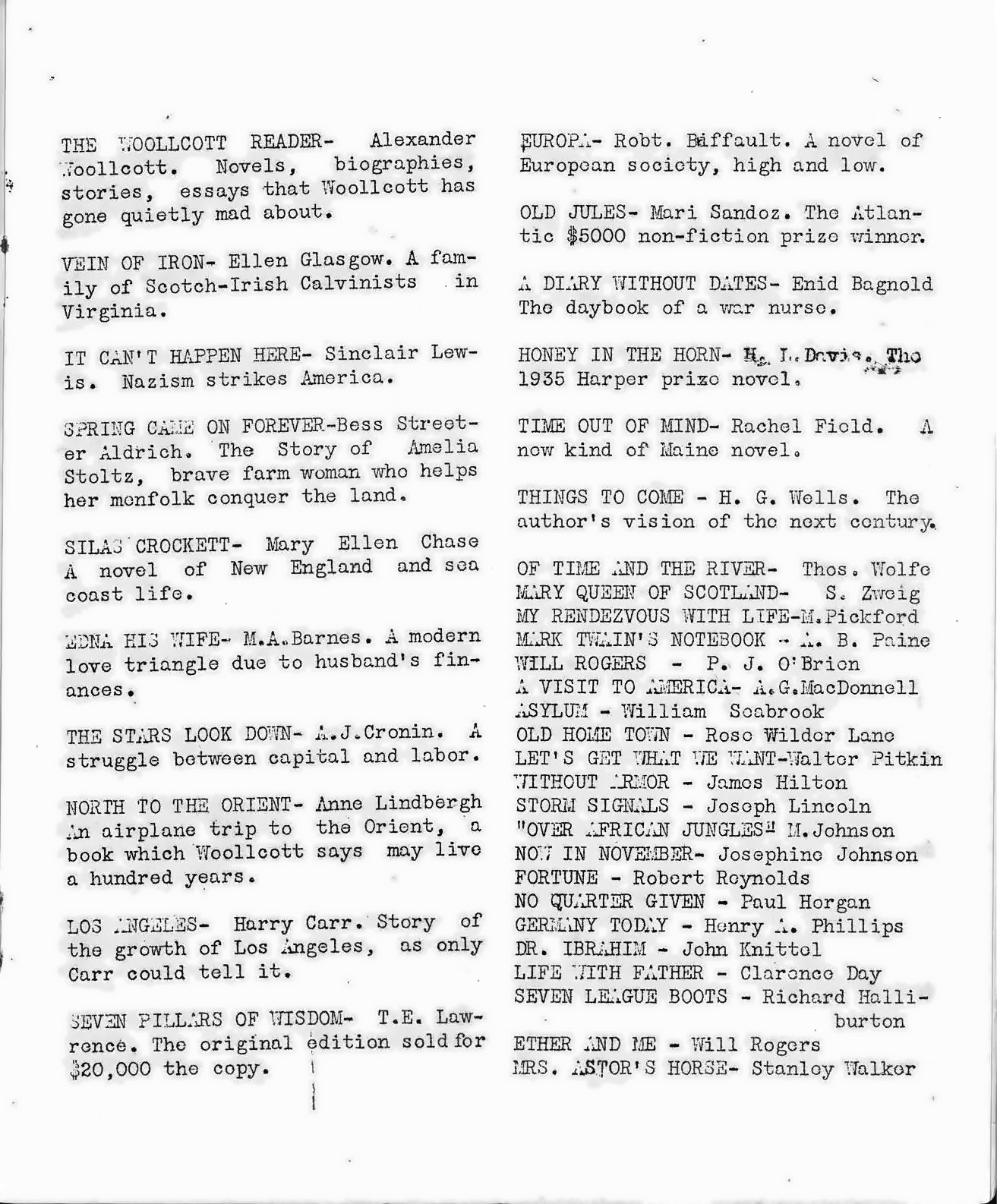
- THE WOOLLCOTT READER—Alexander Woollcott. Novels, biographies, stories, essays that Woollcott has gone quietly mad about.
- VEIN OF IRON—Ellen Glasgow. A family of Scotch-Irish Calvinists in Virginia.
- IT CAN’T HAPPEN HERE—Sinclair Lewis. Nazism strikes America.
- SPRING CAME ON FOREVER—Bess Streeter Aldrich. The Story of Amelia Stoltz, brave farm woman who helps her menfolk conquer the land.
- SILAS CROCKETT—Mary Ellen Chase. A novel of New England and sea coast life.
- EDNA HIS WIFE—M. A. Barnes. A modern love triangle due to husband’s finances.
- THE STARS LOOK DOWN—A. J. Cronin. A struggle between capital and labor.
- NORTH TO THE ORIENT—Anne Lindbergh. An airplane trip to the Orient, a book which Woollcott says may live a hundred years.
- LOS ANGELES—Harry Carr. Story of the growth of Los Angeles, as only Carr could tell it.
- SEVEN PILLARS OF WISDOM—T. E. Lawrence. The original edition sold for $20,000 the copy.
- EUROPA—Robt. Briffault. A novel of European society, high and low.
- OLD JULES—Mari Sandoz. The Atlantic $5000 non-fiction prize winner.
- A DIARY WITHOUT DATES—Enid Bagnold. The daybook of a war nurse.
- HONEY IN THE HORN—H. L. Davis. The 1935 Harper prize novel.
- TIME OUT OF MIND—Rachel Field. A new kind of Maine novel.
- THINGS TO COME—H. G. Wells. The author’s vision of the next century.
- OF TIME AND THE RIVER—Thos. Wolfe
- MARY QUEEN OF SCOTLAND—S. Zweig
- MY RENDEZVOUS WITH LIFE—M. Pickford
- MARK TWAIN’S NOTEBOOK—A. B. Paine
- WILL ROGERS—P. J. O’Brien
- A VISIT TO AMERICA—A. G. MacDonnell
- ASYLUM—William Seabrook
- OLD HOME TOWN—Rose Wilder Lane
- LET’S GET WHAT WE WANT—Walter Pitkin
- WITHOUT ARMOR—James Hilton
- STORM SIGNALS—Joseph Lincoln
- “OVER AFRICAN JUNGLES”—M. Johnson
- NOW IN NOVEMBER—Josephine Johnson
- FORTUNE—Robert Reynolds
- NO QUARTER GIVEN—Paul Horgan
- GERMANY TODAY—Henry A. Phillips
- DR. IBRAHIM—John Knittel
- LIFE WITH FATHER—Clarence Day
- SEVEN LEAGUE BOOTS—Richard Halliburton
- ETHER AND ME—Will Rogers
- MRS. ASTOR’S HORSE—Stanley Walker
“MARY WHITE”
The Associated Press reports carrying the news of Mary White’s death declared that it came as the result of a fall from a horse. How she would have hooted at that! She never fell from a horse in her life. Horses have fallen on her and with her—”I’m always trying to hold ’em in my lap,” she used to say. But she was proud of few things, and one was that she could ride anything that had four legs and hair. Her death resulted not from a fall, but from a blow on the head which fractured her skull, and the blow came from the limb of an overhanging tree on the parking.
The last hour of her life was typical of its happiness. She came home from a day’s work at school, topped off by a hard grind with the copy on the High School Annual, and felt that a ride would refresh her. She climbed into her khakis, chattering to her mother about the work she was doing, and hurried to get her horse and be out on the dirt roads for the country air and the radiant green fields of the spring. As she rode through the town on an easy gallop, she kept waving at passers-by. She knew everyone in town. For a decade the little figure with the long pig-tail and the red hair-ribbon has been familiar on the streets of Emporia, and she got in the way of speaking to those who nodded at her. She passed the Kerrs—-walking the horse—-in front of the Normal Library, and waved at them. She passed the Tripletts and waved her cowboy hat at them, still moving gayly north on Merchant Street. A Gazette carrier passed—-a High School boy friend—-and she waved at him, but with her bridle hand; the horse veered quickly, plunged into the parking where the low-hanging limb faced her, and, while she still looked back waving, the blow came. But she did not fall from the horse; she slipped off, dazed a bit, staggered, and fell in a faint. She never quite recovered consciousness.
But she did not fall from the horse, neither was she riding fast. A year or so ago, she went like the wind. But that habit was broken and she used the horse to get into the open to get fresh, hard exercise and to work off a certain surplus energy that welled up in her and needed a physical outlet. That need has been in her heart for years. It was back of the impulse that kept the dauntless little brownclad figure on the streets and country road of this community and built into a strong, muscular body what had been a frail and sickly frame during the first years of her life. But the riding gave her more than a body. It released a gay and hardy soul. She was the happiest thing in the world. And she was happy because she was enlarging her horizon. She came to know all sorts and conditions of men; Charley O’Brien, the traffic cop, was one of her best friends. W. L. Holtz, the Latin teacher, was another, Tom O’Connor, farmer-politician, and Rev. J. H. J. Rice, preacher and police judge, and Frank Beach, music master, were her special friends, and all the girls, black and white, above the track and below the track, in Pepville and Stringtown, were among her acquaintances. And she brought home riotous stories of her adventures. She loved to rollick. She was mischievous without malice, as full of faults as an old shoe. No angel was Mary White, but an easy girl to live with for she never nursed a grouch five minutes in her life.
Within the last two years she had begun to be moved by an ambition to draw——and this year she tasted the first fruits of success by having her pictures accepted by the High School Annual. No successful artist ever drank a deeper draft of satisfaction than she took from the little fame her work was getting among her schoolfellows. In her glory she almost forgot her horse—but never her car.
For she used the car as a jitney bus. It was her social life. She never had a “party” in all her nearly seventeen years—-wouldn’t have one; but she never drove a block in the car in her life that she didn’t begin to fill the car with pickups! Everybody rode with Mary White: white and black, old and young, rich and poor, men and women. She liked nothing better than to fill the car full of long-legged High School boys and an occasional girl, and parade the town. She never had a “date,” nor went to a dance, except once with her brother Bill, and the “boy proposition” didn’t interest her—yet. But young people—-great spring-breaking, varnish-cracking, fender-bending, door-sagging carloads of “kids”—gave her great pleasure. Her zests were keen. But the most fun she ever had in her life was acting as chairman of the committee that got up the big turkey dinner for the poor folks at the county. And the last endeavor of her life was to try to get a restroom for colored girls in the High School. She found one girl reading in the toilet, because there was no better place for a colored girl to loaf, and it inflamed her sense of injustice and she became a nagging harpie to those who, she thought, could remedy the evil. The poor she had always with her, and was glad of it. She hungered and thirsted for righteousness; and was the most impious creature in the world. She joined the Congregational Church without consulting her parents; not particularly for her soul’s good. She never had a thrill of piety in her life, and would have hooted at “testimony.” But even as a little child she felt the church was an agency for helping people to more of life’s abundance, and she wanted to help. She never wanted help for herself. Clothes meant little to her. It was a fight to get a new rig on her; but eventually a harder fight to get it off. She never wore a jewel and had no ring but her High School class ring, and never asked for anything but a wrist watch. She refused to have her hair up, though she was nearly seventeen. “Mother,” she protested, “you don’t know how much I get by with, in my braided pigtails, that I could not with my hair up.” Above every other passion of her life was her passion not to grow up, to be a child. The tomboy in her, which was big, seemed to loathe to be put away forever in skirts. She was a Peter Pan, who refused to grow up.
Her funeral yesterday at the Congregational Church was as she would have wished it; no singing, no flowers save the big bunch of red roses from her Brother Bill’s Harvard classmen—-Heavens, how proud that would have made her!—-and the red roses from the Gazette force——in vases at her head and feet. A short prayer, Paul’s beautiful essay on “Love” from the Thirteenth Chapter of First Corinthians, some remarks about her democratic spirit by her friend, John H. J. Rice, pastor and police judge, which she would have deprecated if she could, then the Lord’s Prayer by her friends in the High School. That was all.
For her pall-bearers only her friends were chosen: her Latin teacher, W. L. Holtz; her High School principal, Rice Brown; her doctor, Frank Foncannon; her friend, W. W. Finney; her pal at the Gazette office, Walter Hughes; and her brother Bill. It would have made her smile to know that her friend Charley O’Brien, the traffic cop, had been transferred from Sixth and Commercial to the corner near the church to direct her friends who came to bid her good-bye.
A rift in the clouds in a gray day threw a shaft of sunlight upon her coffin as her nervous energetic little body sank to its last sleep. But the soul of her, the glowing, gorgeous, fervent soul of her, surely was flaming in eager joy upon some other dawn.
PERSONALS
Barbara is three years old, and now we have concluded that there is no time in a child’s life quite so wonderful as is the age of three. We thought the same thing when she was two, and one, and six months, and three months. Well, you know how it goes!
On our hurried trip to Michigan this summer we renewed laughs with the Fourniers—hadn’t had a good laugh since leaving there six years before.
The old home state, by the way, looked really finer than we had ever seen it before. For the first time since becoming native sons of California we had to admit it might be a wee bit ahead of us.
Clare Gates (who by the way has a fine new position in the extension department of the University of Michigan) has a hobby of collecting pennies. We promised to send him some bearing the Frisco mint mark—and have still neglected to do so. Helen Gates’ hobby, incidentally, so she says, is still “just Clare.”
We ran into Dorothy Chamberlain and her fine family out here the other day. For six years they had lived near by and this is the first time we had known it.
The Nichols from Howell called two weeks ago. “A fine trip across, in their Covered Wagon,” they report. And now they are off on a jaunt to Oregon.
Fine old Mrs. Steele, one of our best friends in the whole world, passed away this summer at the age of 83. Her fondest wish remained unrealized—to ride with the China Clipper on its first air voyage to the Orient. But perhaps the journey she is on is even more thrilling. Certainly a world traveler such as she was could not have looked forward to it with anything but anticipation.
I still continue to spend most of my time radiating in and out from the State Building and Loan Commissioner’s office in Los Angeles, and driving at the rate of 2500 miles a month about this part of the state. The opportunities available here at this time are still too good to pass by, but I will really be glad when there is a lull. Then there are some hobby horses I want to trot out.
More than a dozen excellent suggestions were sent in for names to use in place of “Line-O-Type” for this pamphlet. Our big trouble was in choosing, so we are going to wait until the next issue before making a decision.
It is now Dec. 20th. Holiday greetings are flooding in. To which we reply, “Merry Christmas.”
RIDING HIGH
Whenever the moon is riding high with that lofty arrogance that a full moon has in the top of the sky, I think of June and a maple tree in full leaf and a lady-at-her-best. June, the triumphant belle of the calendar, a gracious maple tree spreading herself in a meadow, and a woman in her thirties, who has everything.
Riding high.
If there is one thing in this world young things ought to be told by their parents, it is “Make the most of every good thing while you have it.”
Think of the things you learn from one to ten—impressions thick and fast as whirling snow-flakes! Then from ten to twenty—the stepping over the borderline of childhood through the exciting, terrifying forest of adolescence, into the unknown country of grown-ups. All the things you surmise and wonder about! The ground rocks beneath your feet with your discoveries. Adventure pulls you, uncertainty binds and trips you, romance makes your heart hide and quiver—it’s a terrific time.
And then from twenty to thirty—the first real freedom, the sense of unrealized power. But life looks like serious business too! Ambition pushes you. Lack of experience binds you. Life is a song, life is a whip, life is adventure, life is a fight.
And then comes thirty to forty! Power in your hands, power in your heart and head, realized power even in the lift of your lashes, the tone of your voice. At last you understand a little of what it is all about. You love—not that lovely excitement of dreams and longing—more, much more than that!
You enter in and know why it is birds sing, why flowers push up through the ground into bloom, how it is that life can never die.
You and the moon proudly riding the sky, you and the maple tree in full leaf. Make the most of it! Live it to the full! Finish with it—when you really do—don’t be afraid to finish with it—there’s something just as wonderful beyond. Do it superbly. One of the most tragic wastes in the world is to keep on with a thing after you’ve finished with it in spirit. Never deceive yourself. Never pretend. Live your fulness splendidly and you will find in your hand, at fifty, the key to the door of the next room—just as beautiful a room as the one you are leaving, more spacious, and on the floor above, where you get a better view.
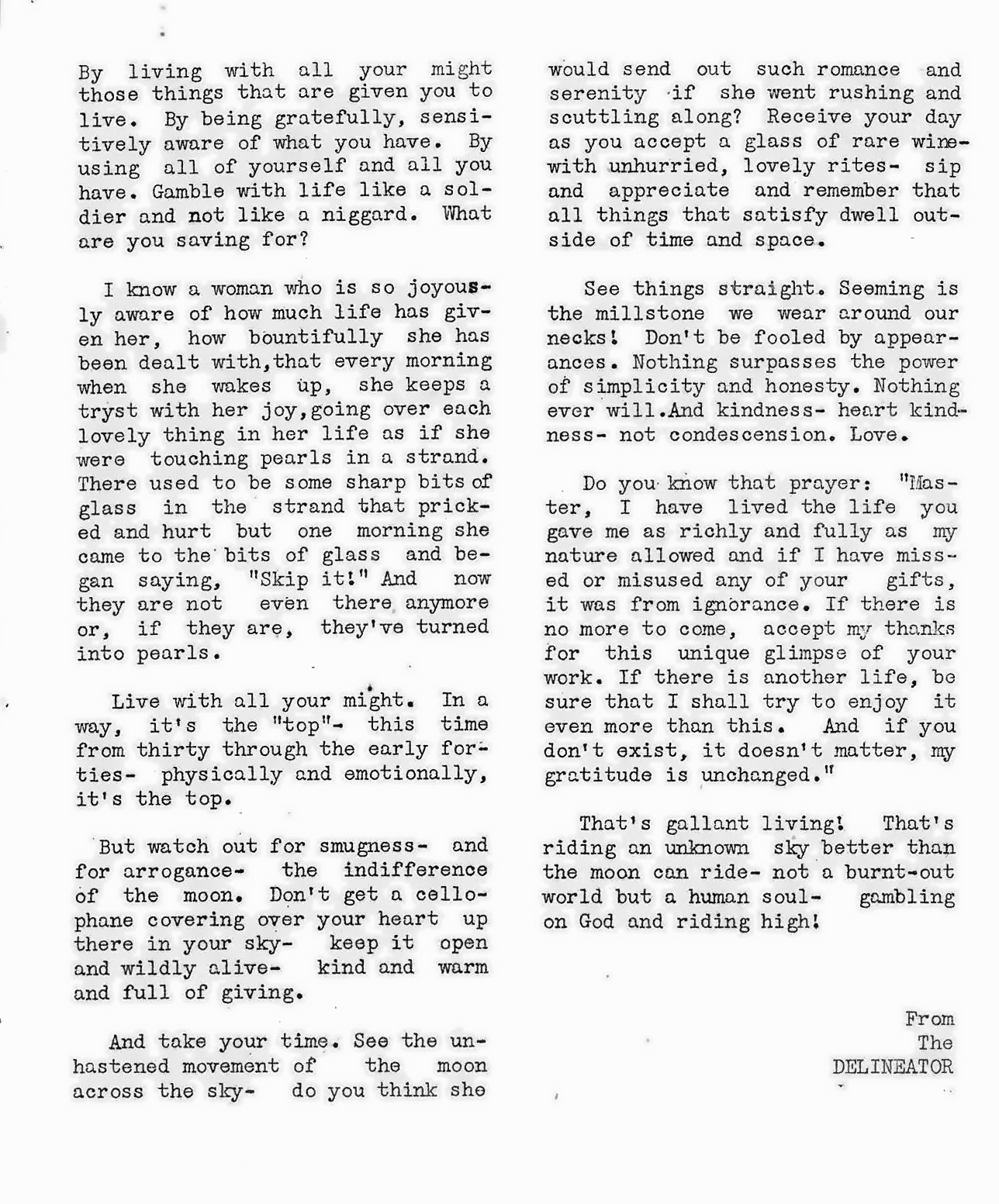
How can you make the most of it? By living with all your might those things that are given you to live. By being gratefully, sensitively aware of what you have. By using all of yourself and all you have. Gamble with life like a soldier and not like a niggard. What are you saving for?
I know a woman who is so joyously aware of how much life has given her, how bountifully she has been dealt with, that every morning when she wakes up, she keeps a tryst with her joy, going over each lovely thing in her life as if she were touching pearls in a strand. There used to be some sharp bits of glass in the strand that pricked and hurt but one morning she came to the bits of glass and began saying, “Skip it!” And now they are not even there anymore or, if they are, they’ve turned into pearls.
Live with all your might. In a way, it’s the “top”—this time from thirty through the early forties—physically and emotionally, it’s the top.
But watch out for smugness—and for arrogance—the indifference of the moon. Don’t get a cellophane covering over your heart up there in your sky—keep it open and wildly alive—kind and warm and full of giving.
And take your time. See the unhastened movement of the moon across the sky—do you think she would send out such romance and serenity if she went rushing and scuttling along? Receive your day as you accept a glass of rare wine—with unhurried, lovely rites—sip and appreciate and remember that all things that satisfy dwell outside of time and space.
See things straight. Seeming is the millstone we wear around our necks! Don’t be fooled by appearances. Nothing surpasses the power of simplicity and honesty. Nothing ever will. And kindness—heart kindness—not condescension. Love.
Do you know that prayer: “Master, I have lived the life you gave me as richly and fully as my nature allowed and if I have missed or misused any of your gifts, it was from ignorance. If there is no more to come, accept my thanks for this unique glimpse of your work. If there is another life, be sure that I shall try to enjoy it even more than this. And if you don’t exist, it doesn’t matter, my gratitude is unchanged.”
That’s gallant living! That’s riding an unknown sky better than the moon can ride—not a burnt-out world but a human soul—gambling on God and riding high!
From The DELINEATOR
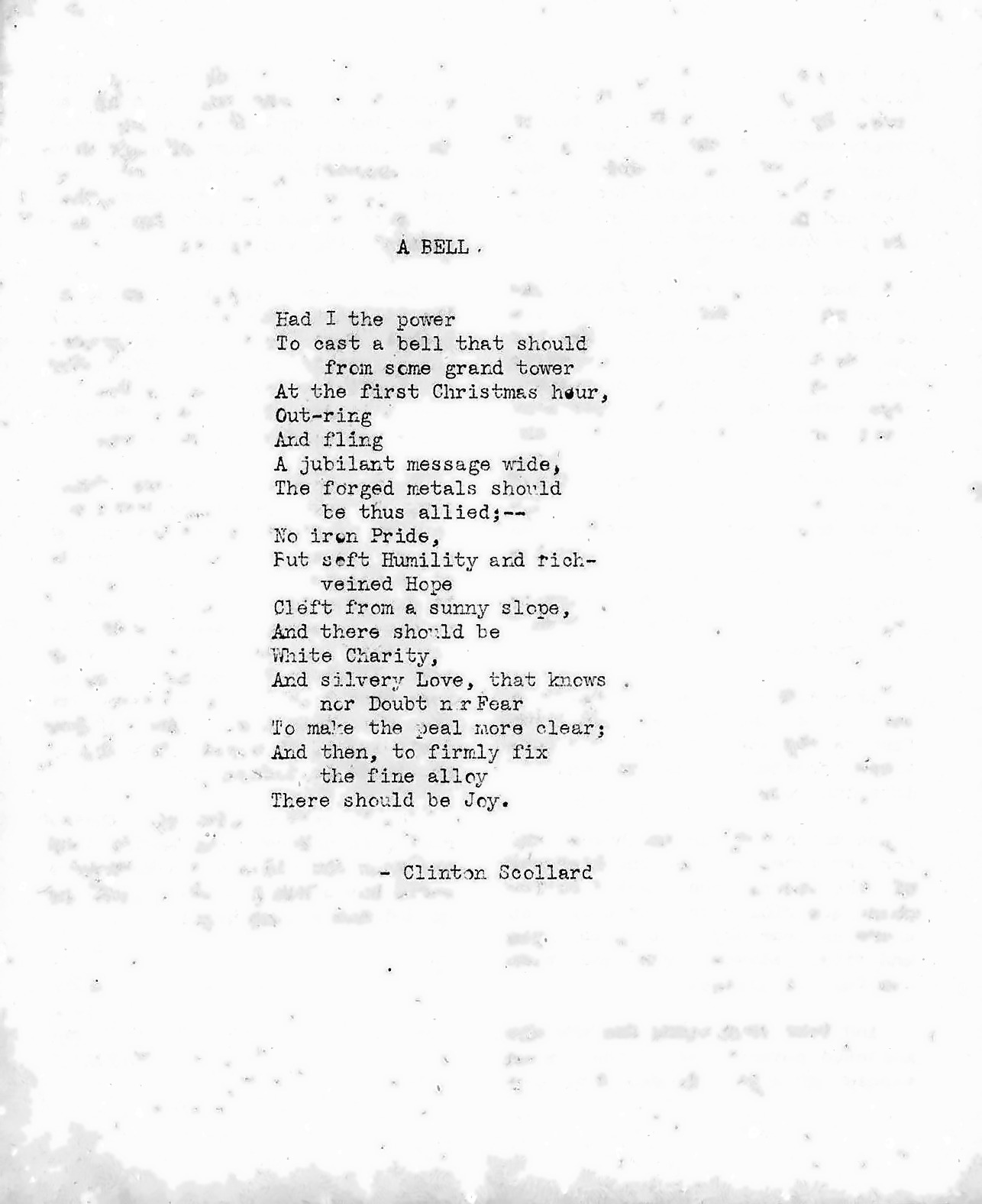
A BELL
Had I the power
To cast a bell that should from some grand tower
At the first Christmas hour,
Out-ring
And fling
A jubilant message wide,
The forged metals should be thus allied;—
No iron Pride,
But soft Humility and rich-veined Hope
Cleft from a sunny slope,
And there should be
White Charity,
And silvery Love, that knows nor Doubt nor Fear
To make the peal more clear;
And then, to firmly fix the fine alloy
There should be Joy.
—Clinton Scollard
About this issue
A Christmas folder from Ontario dated December 21, 1935. It has Michigan sidelights, the mailbag (including a piece on Gandhi by Edith Line), a reading list from “The Little Library at the End of Rosewood,” William Allen White’s “Mary White,” personals, the reprinted article “Riding High,” and a closing Christmas poem.