
Line’s Hobby 1938 Christmas Edition
One page appears to be missing from the scan (about the Lines’ forest-fire film). The text notes where it happens.
1938
Christmas 1938
Christmas 1938
Line’s Hobby · Francis and Helen Line
Francis and Helen’s mailing list has reached five hundred friends, “not just acquaintances, but tried and true friends.” The issue covers a Michigan summer, Colonial Williamsburg, forest fires near the family cabins, and a new film, “People of Pala.”
LINE’S HOBBY · NO. 6 · CHRISTMAS 1938
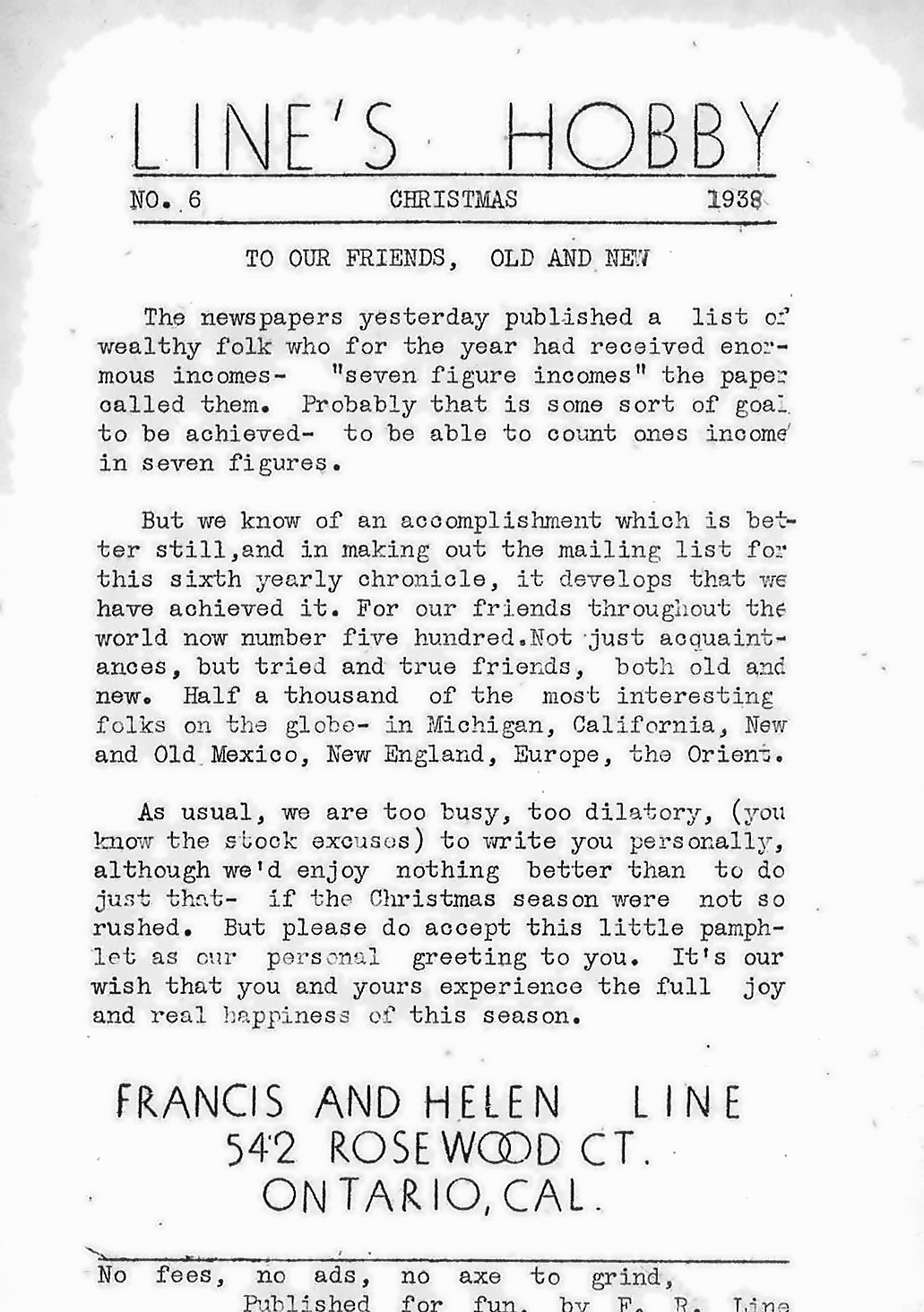
TO OUR FRIENDS, OLD AND NEW
The newspapers yesterday published a list of wealthy folk who for the year had received enormous incomes—”seven figure incomes” the paper called them. Probably that is some sort of goal to be achieved—to be able to count ones income in seven figures.
But we know of an accomplishment which is better still, and in making out the mailing list for this sixth yearly chronicle, it develops that we have achieved it. For our friends throughout the world now number five hundred. Not just acquaintances, but tried and true friends, both old and new. Half a thousand of the most interesting folks on the globe—in Michigan, California, New and Old Mexico, New England, Europe, the Orient.
As usual, we are too busy, too dilatory, (you know the stock excuses) to write you personally, although we’d enjoy nothing better than to do just that—if the Christmas season were not so rushed. But please do accept this little pamphlet as our personal greeting to you. It’s our wish that you and yours experience the full joy and real happiness of this season.
FRANCIS AND HELEN LINE
542 Rosewood Ct.
Ontario, Cal.
No fees, no ads, no axe to grind, Published for fun, by F. R. Line
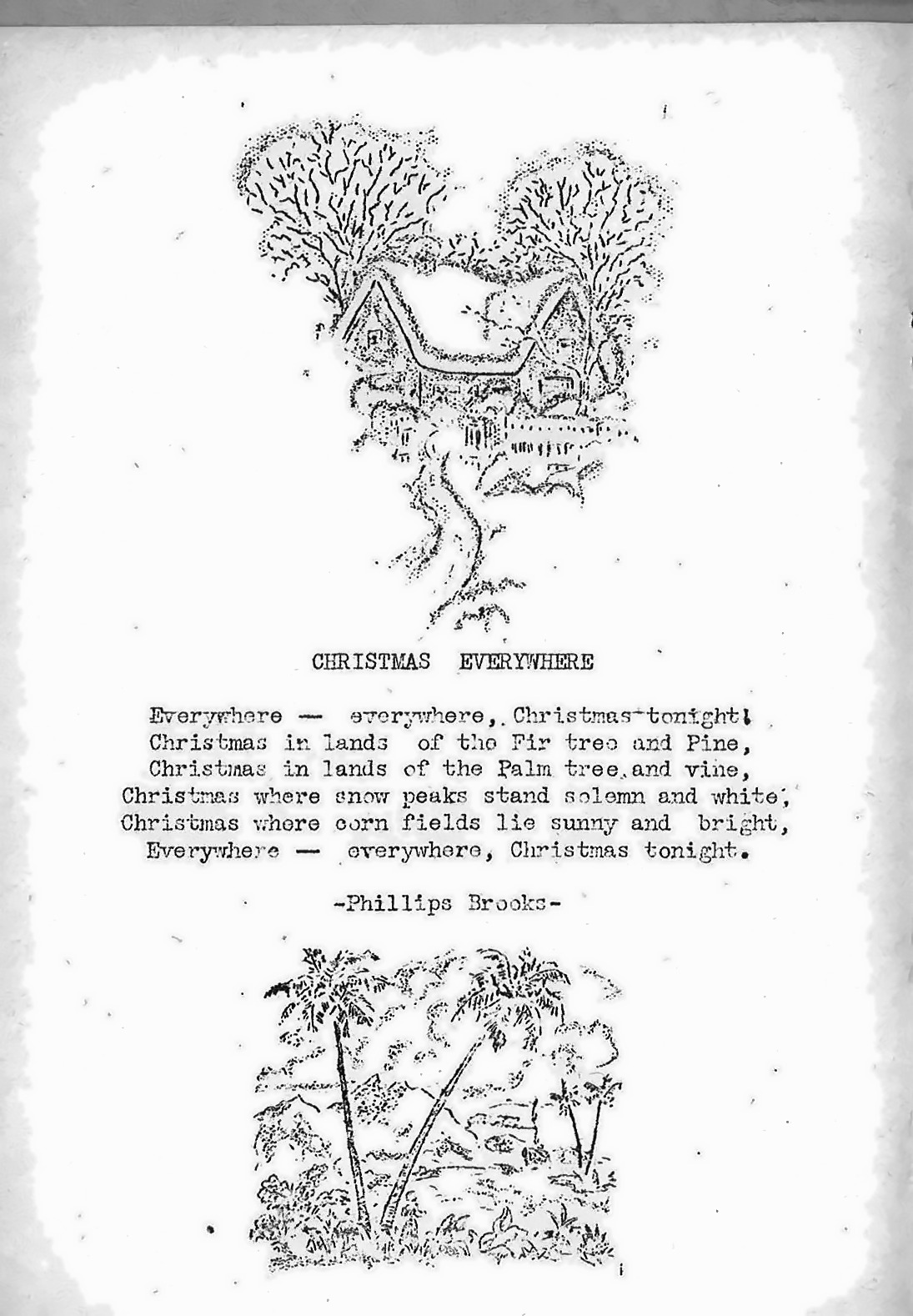
CHRISTMAS EVERYWHERE
Everywhere—everywhere, Christmas tonight!
Christmas in lands of the Fir tree and Pine,
Christmas in lands of the Palm tree and vine,
Christmas where snow peaks stand solemn and white,
Christmas where corn fields lie sunny and bright,
Everywhere—everywhere, Christmas tonight.
MICHIGAN
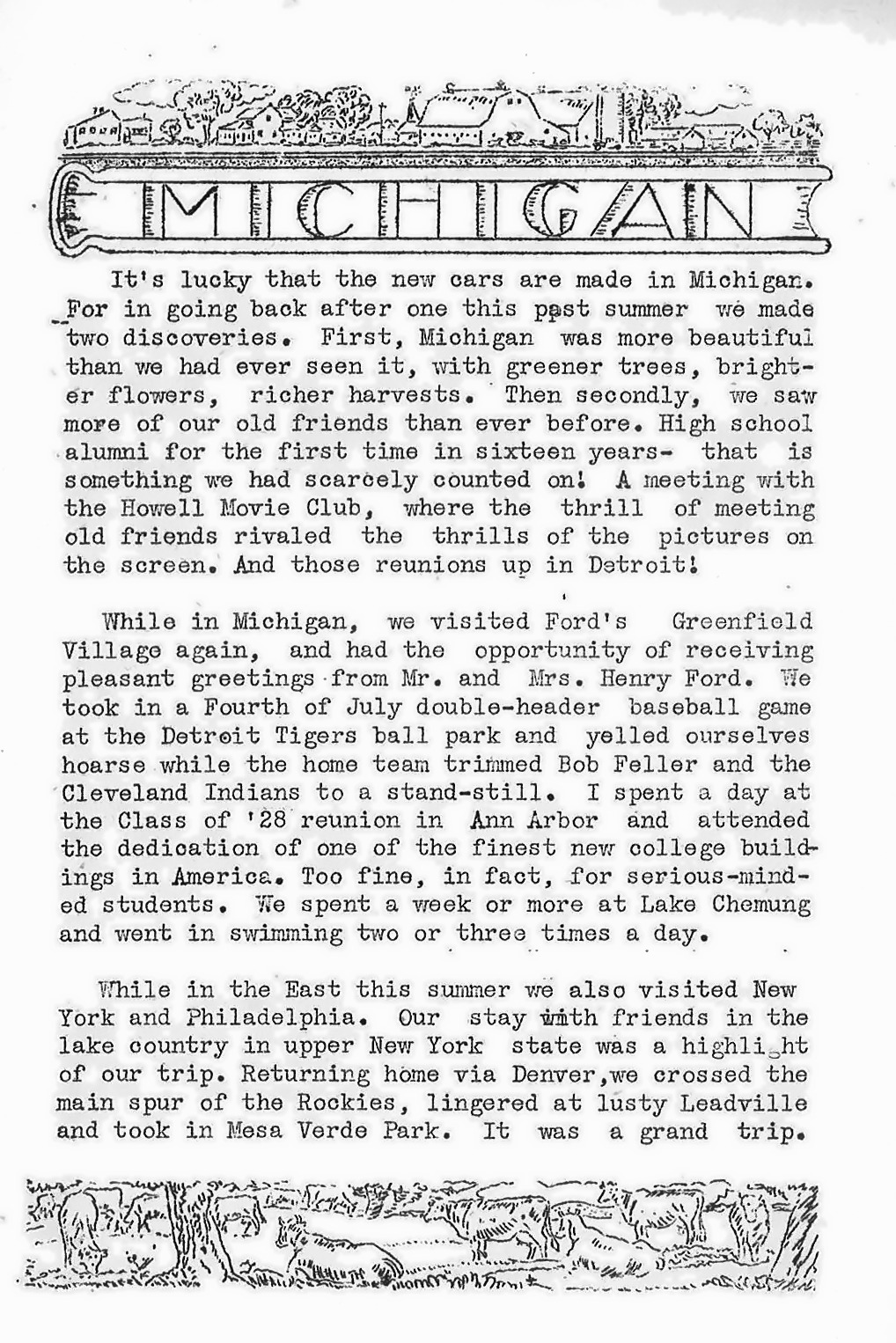
It’s lucky that the new cars are made in Michigan. For in going back after one this past summer we made two discoveries. First, Michigan was more beautiful than we had ever seen it, with greener trees, brighter flowers, richer harvests. Then secondly, we saw more of our old friends than ever before. High school alumni for the first time in sixteen years—that is something we had scarcely counted on! A meeting with the Howell Movie Club, where the thrill of meeting old friends rivaled the thrills of the pictures on the screen. And those reunions up in Detroit!
While in Michigan, we visited Ford’s Greenfield Village again, and had the opportunity of receiving pleasant greetings from Mr. and Mrs. Henry Ford. We took in a Fourth of July double-header baseball game at the Detroit Tigers ball park and yelled ourselves hoarse while the home team trimmed Bob Feller and the Cleveland Indians to a stand-still. I spent a day at the Class of ’28 reunion in Ann Arbor and attended the dedication of one of the finest new college buildings in America. Too fine, in fact, for serious-minded students. We spent a week or more at Lake Chemung and went in swimming two or three times a day.
While in the East this summer we also visited New York and Philadelphia. Our stay with friends in the lake country in upper New York state was a highlight of our trip. Returning home via Denver, we crossed the main spur of the Rockies, lingered at lusty Leadville and took in Mesa Verde Park. It was a grand trip.
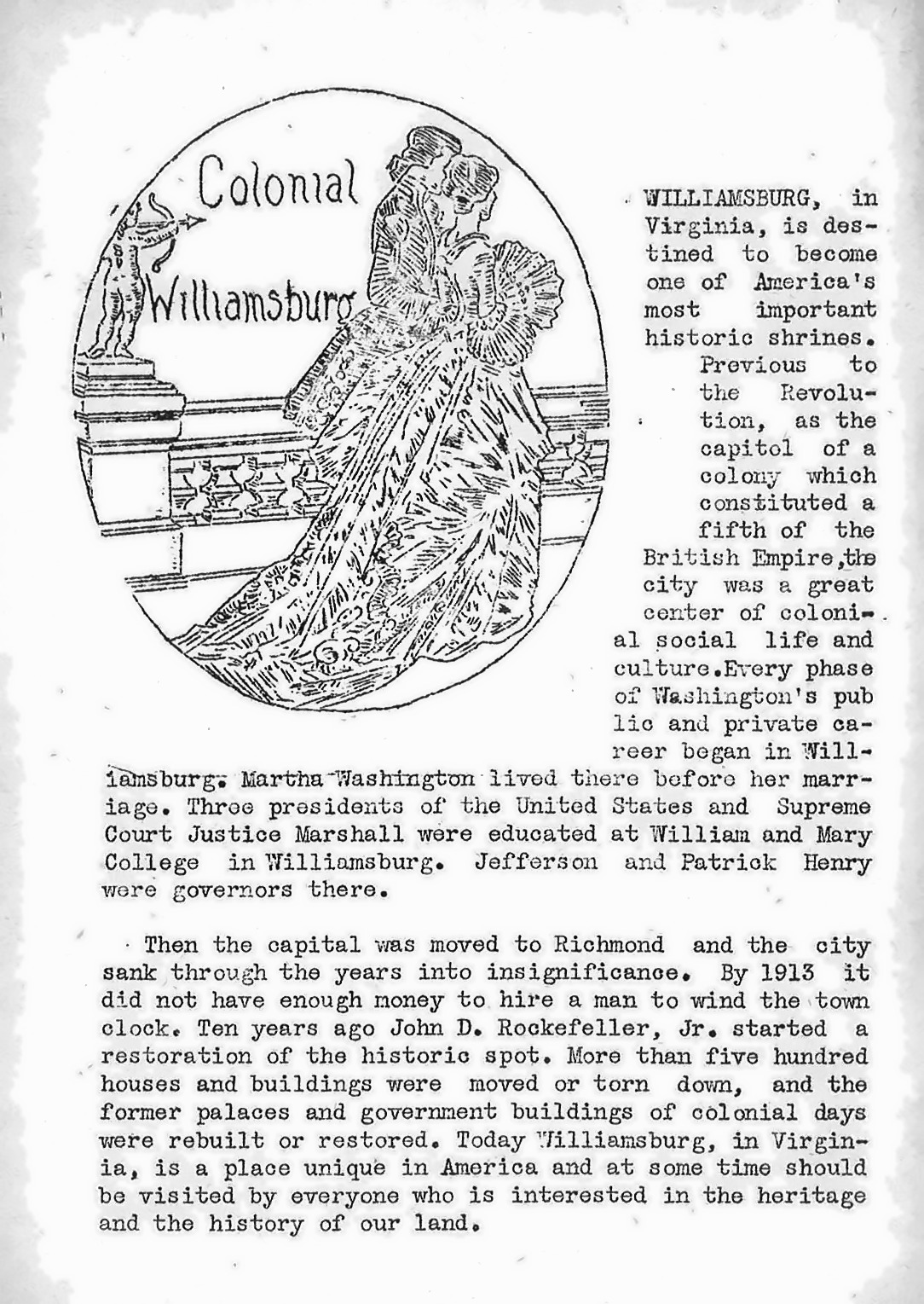
COLONIAL WILLIAMSBURG
WILLIAMSBURG, in Virginia, is destined to become one of America’s most important historic shrines. Previous to the Revolution, as the capitol of a colony which constituted a fifth of the British Empire, the city was a great center of colonial social life and culture. Every phase of Washington’s public and private career began in Williamsburg. Martha Washington lived there before her marriage. Three presidents of the United States and Supreme Court Justice Marshall were educated at William and Mary College in Williamsburg. Jefferson and Patrick Henry were governors there.
Then the capital was moved to Richmond and the city sank through the years into insignificance. By 1913 it did not have enough money to hire a man to wind the town clock. Ten years ago John D. Rockefeller, Jr. started a restoration of the historic spot. More than five hundred houses and buildings were moved or torn down, and the former palaces and government buildings of colonial days were rebuilt or restored. Today Williamsburg, in Virginia, is a place unique in America and at some time should be visited by everyone who is interested in the heritage and the history of our land.
JUST PEEKING AROUND
For our friends throughout the world now number five hundred.
My brother Win and his wife just returned from a three-months trip to Korea, Japan, and Hawaii. Haven’t seen them yet, or their pictures. We read their fine newspaper articles and are looking forward to hearing all about the trip first hand.
The recent forest fires near Baldy just missed our cabin up there, and the second fire, above San Bernardino, came closer still to our Crestline cabin. We moved some of the furniture out at Baldy, but couldn’t even get up to our Crestline place.
This year I am serving as secretary for the Southern California District of Lions Clubs. Lots of chances for visiting the clubs in other cities and meeting many fine Lions.
Miss Frieda Iselin, a former teacher of Helen’s who has been teaching for seven years in Hawaii, called on us this summer. It was a real treat.
Never having been affiliated with Phi Beta Kappa locally, I joined the Gamma chapter at Pomona College this fall. Helen and I attended their first meeting in November.
Took a train excursion (for a change) to Santa Barbara this fall and, with Gladys Worsham, had a golden day in the hills and valleys about Santa Ynez and Las Cruces—both historic places. Santa Barbara is hard to beat, both as to beauty and general interest.
[A page appears to be missing from the scan here: the next surviving page begins mid-sentence, partway through an account of the family’s forest-fire film.]
… is growing. In fact, if this yearly Christmas letter seems too hastily put together, it is simply because there has been no time between fire-film showings to work on it. But, to repeat, it was a thrilling experience, and we hope the showings of our pictures will induce mountain visitors to realize the horrible results of the carelessness which causes such conflagrations.
PEOPLE OF PALA
The fire interrupted our work on another movie which we are making—a two-reeler of the Pala Indian Country below Hemet, California. At Pala is the most interesting of the old missions—the only one still used for regular services by the Indians. The Indians of Pala grow chile peppers and spread them in great red masses over the hill sides to season. They have their small fields of varicolored corn and snowy cotton. They drive their sheep each day from the valleys to the highlands. The women folk grind their flour with heavy stones from acorns. We have worked Barbara and Adrienne into the story and they, as well as ourselves, have had a new world of interest opened to us. We hope to have the film finished by the New year. It is to be called “People of Pala.”
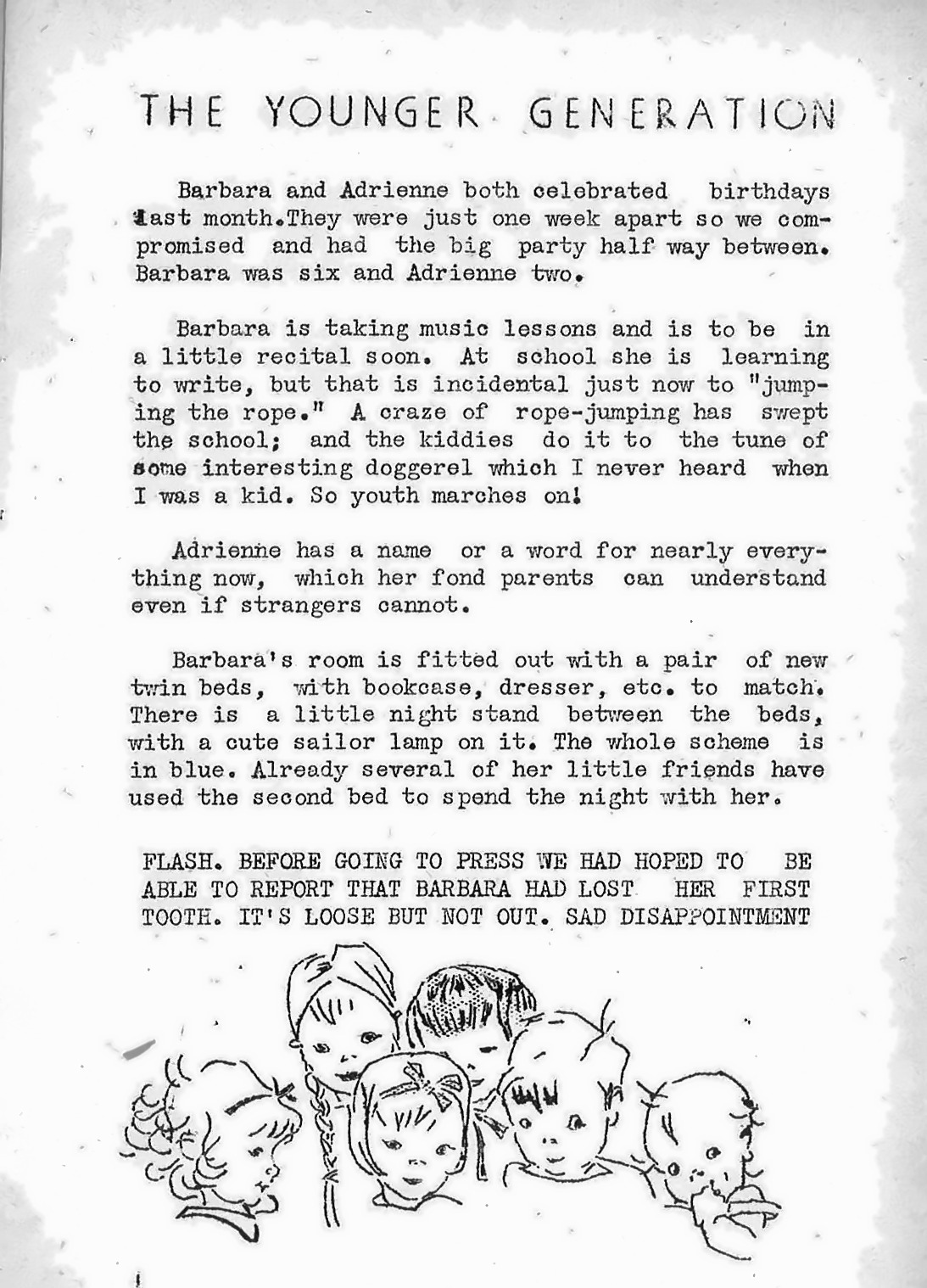
THE YOUNGER GENERATION
Barbara and Adrienne both celebrated birthdays last month. They were just one week apart so we compromised and had the big party half way between. Barbara was six and Adrienne two.
Barbara is taking music lessons and is to be in a little recital soon. At school she is learning to write, but that is incidental just now to “jumping the rope.” A craze of rope-jumping has swept the school; and the kiddies do it to the tune of some interesting doggerel which I never heard when I was a kid. So youth marches on!
Adrienne has a name or a word for nearly everything now, which her fond parents can understand even if strangers cannot.
Barbara’s room is fitted out with a pair of new twin beds, with bookcase, dresser, etc. to match. There is a little night stand between the beds, with a cute sailor lamp on it. The whole scheme is in blue. Already several of her little friends have used the second bed to spend the night with her.
FLASH. BEFORE GOING TO PRESS WE HAD HOPED TO BE ABLE TO REPORT THAT BARBARA HAD LOST HER FIRST TOOTH. IT’S LOOSE BUT NOT OUT. SAD DISAPPOINTMENT.
PLAYS—ART—BOOKS
As chairman of the Art Section for the Ontario Woman’s Club this year, Helen is directing a study of “Color in Art.” Color in Costume and Design, in Home Furnishing, in Fine Arts, and in the Motion Picture are phases of the study. Color is a subject which grows in interest as one delves into it. A trip to the mountains or desert becomes twice as vivid when one is on the lookout for beautiful color effects.
In the field of flower arrangements, Helen has also been doing and learning many new things, the climax being an exhibit which she made of original arrangements at the Gold Hill studio of Clare Cronenwett in Monrovia.
We have made several trips to Los Angeles to take in some plays and musical events. Ann Harding on the stage was a real treat, even though the play in which she starred, “Candida,” was not our type.
Yehudi Menuhin, whom we heard in November, was nothing short of a thrill. After hearing Kreisler two years ago, we thought he couldn’t be surpassed as a violinist. But Menuhin surpassed him. The audience kept him “encoring” far into the night.
The Don Cossack Russian Male Singers were almost as good in their own field. Still to come on the course are Argentinita, Heifetz, Marian Anderson, Crooks, Rubenstein, Iturbi, Hofmann, Ballet Russe, and many other numbers.
“Listen, the Wind,” Anne Lindberg’s new book, is well worth reading. It is really poetry in narrative form. Speaking of poetry, Helen heard Edna St. Vincent Millay, at Claremont, the other night. She said I missed much by not being able to go.
Some new friends of ours recently took us to dinner and a play at the Padua Hills Mexican Theater. This lovely place, just eight miles from Ontario, is now ranked among the seven best “Little Theaters” of America. The Mexican actors, who were also the waiters, sang and danced during the dinner hour and the atmosphere was as unique and good as the food.
Ontario’s Armistice Day parade is becoming an event of state-wide importance. I was unlucky enough to draw the job of being chairman of the Chamber of Commerce Float this year. We took second place, but there were a couple of tense moments when I thought the float (a particularly tall one) would not go under some of the telephone-wires above Euclid Ave. It missed one by 3 inches.
We have been reconstructing the patio of our home and Helen is becoming a veteran gardener. She has put in so many strange and interesting plants now that I have forgotten the names of even the simple ones.
To celebrate the Harvest Moon in October, we had an old-fashioned hay ride up to our mountain cabin at Camp Baldy. Old-fashioned, that is, except that we used a truck instead of horses. Twenty-two of us nestled in the hay to keep warm.
Two musical movies well worth seeing are Moonlight Sonata, with Paderewski, and The Great Waltz.
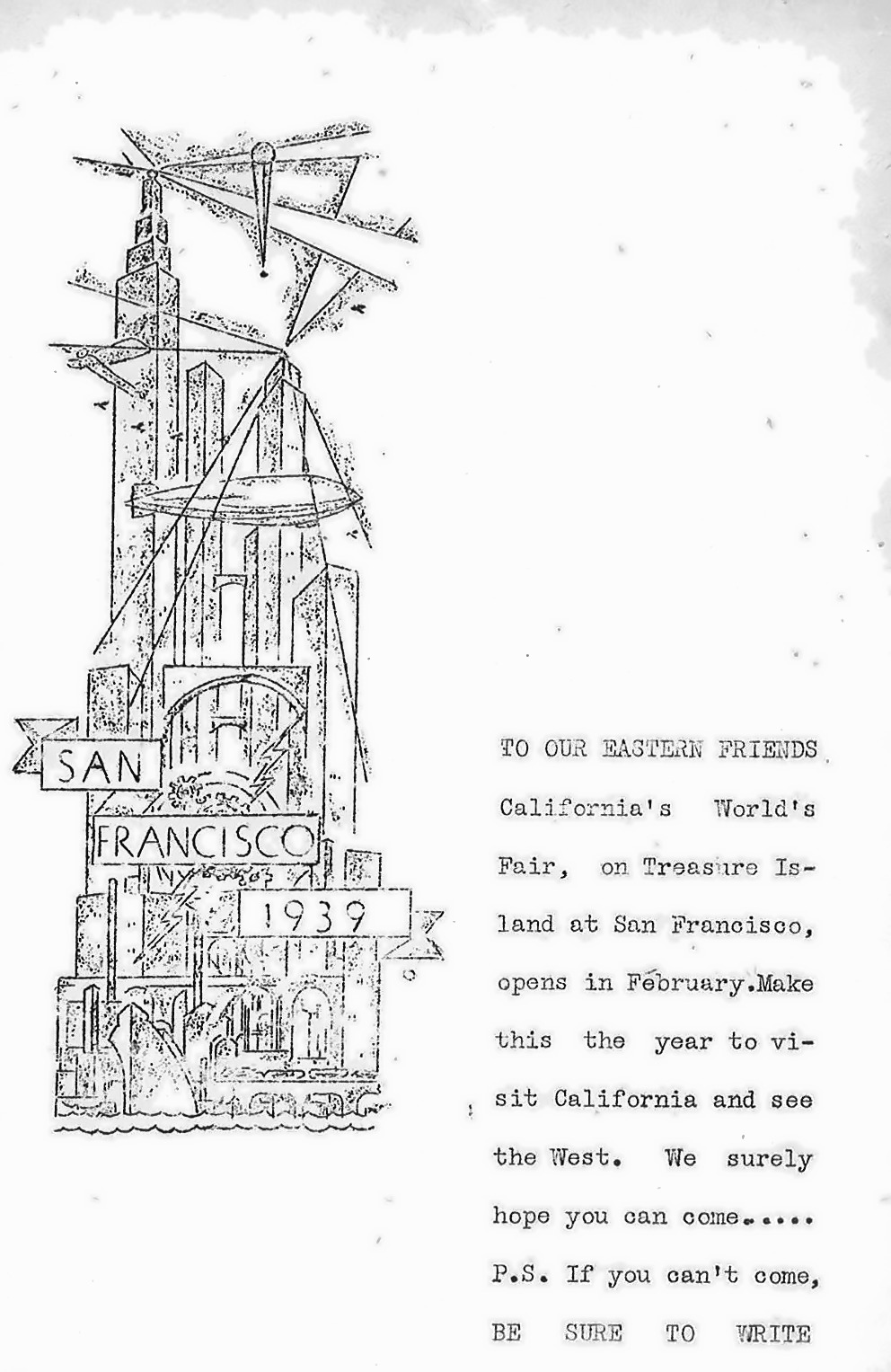
TO OUR EASTERN FRIENDS
[Drawing: “San Francisco 1939.”]
California’s World’s Fair, on Treasure Island at San Francisco, opens in February. Make this the year to visit California and see the West. We surely hope you can come…..
P.S. If you can’t come, BE SURE TO WRITE
From the original scan
PDF, 12 pages, 6.5 MB
About this issue
The sixth yearly chronicle, from 542 Rosewood Ct., Ontario. It covers a summer trip to Michigan, the East and the Rockies, Colonial Williamsburg, forest fires near the Baldy and Crestline cabins, the Lines’ fire film and the new two-reeler “People of Pala,” Barbara and Adrienne’s birthdays, Helen’s “Color in Art” study, concerts and plays, and an invitation to San Francisco’s 1939 World’s Fair. One page appears to be missing from the scan.