
A Line on ’57-’58
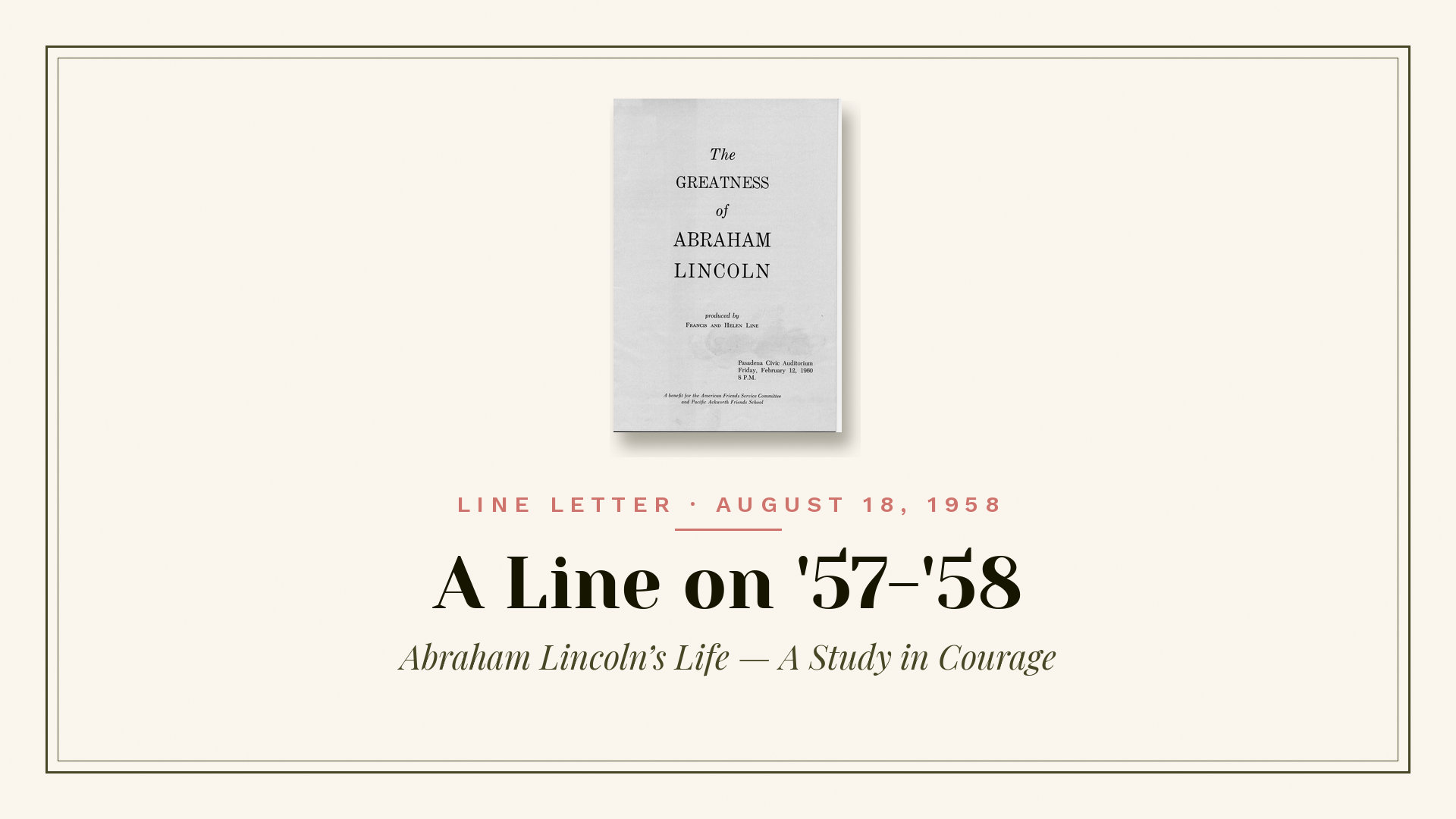
1957-58
August 18, 1958
Our 25th annual letter
Annual Letter · Francis and Helen Line
The twenty-fifth annual letter, mailed at midsummer: a year of film-making and of studying Abraham Lincoln, with “important family happenings” on the next page.
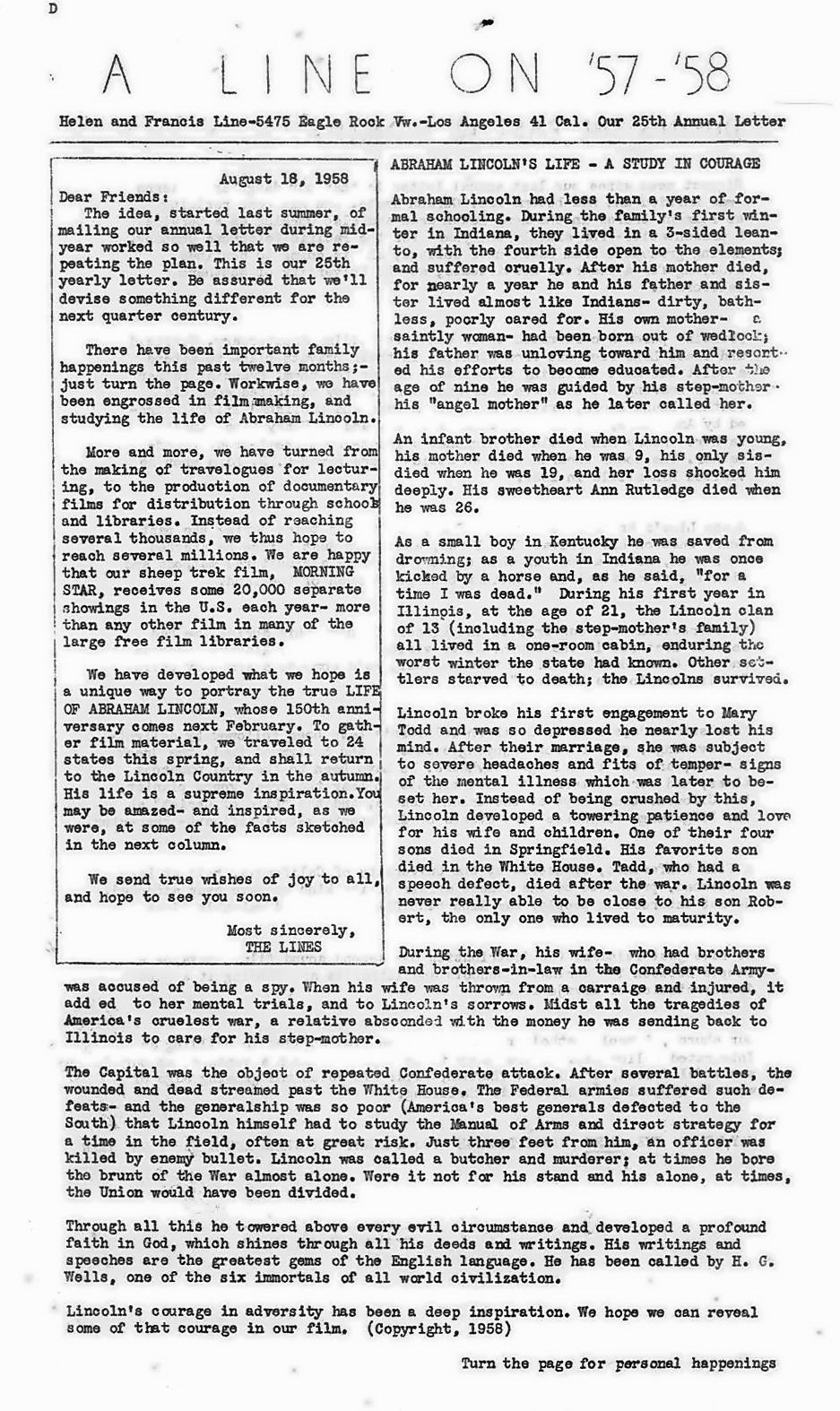
Helen and Francis Line · 5475 Eagle Rock Vw. · Los Angeles 41 Cal. · Our 25th Annual Letter
August 18, 1958
Dear Friends:
The idea, started last summer, of mailing our annual letter during midyear worked so well that we are repeating the plan. This is our 25th yearly letter. Be assured that we’ll devise something different for the next quarter century.
There have been important family happenings this past twelve months;—just turn the page. Workwise, we have been engrossed in film making, and studying the life of Abraham Lincoln.
More and more, we have turned from the making of travelogues for lecturing, to the production of documentary films for distribution through schools and libraries. Instead of reaching several thousands, we thus hope to reach several millions. We are happy that our sheep trek film, MORNING STAR, receives some 20,000 separate showings in the U.S. each year—more than any other film in many of the large free film libraries.
We have developed what we hope is a unique way to portray the true LIFE OF ABRAHAM LINCOLN, whose 150th anniversary comes next February. To gather film material, we traveled to 24 states this spring, and shall return to the Lincoln Country in the autumn. His life is a supreme inspiration. You may be amazed—and inspired, as we were, at some of the facts sketched in the next column.
We send true wishes of joy to all, and hope to see you soon.
Most sincerely,
THE LINES
ABRAHAM LINCOLN’S LIFE—A STUDY IN COURAGE
Be assured that we’ll devise something different for the next quarter century.
Abraham Lincoln had less than a year of formal schooling. During the family’s first winter in Indiana, they lived in a 3-sided lean-to, with the fourth side open to the elements; and suffered cruelly. After his mother died, for nearly a year he and his father and sister lived almost like Indians—dirty, bath-less, poorly cared for. His own mother—a saintly woman—had been born out of wedlock; his father was unloving toward him and resented his efforts to become educated. After the age of nine he was guided by his step-mother—his “angel mother” as he later called her.
An infant brother died when Lincoln was young, his mother died when he was 9, his only sister died when he was 19, and her loss shocked him deeply. His sweetheart Ann Rutledge died when he was 26.
As a small boy in Kentucky he was saved from drowning; as a youth in Indiana he was once kicked by a horse and, as he said, “for a time I was dead.” During his first year in Illinois, at the age of 21, the Lincoln clan of 13 (including the step-mother’s family) all lived in a one-room cabin, enduring the worst winter the state had known. Other settlers starved to death; the Lincolns survived.
Lincoln broke his first engagement to Mary Todd and was so depressed he nearly lost his mind. After their marriage, she was subject to severe headaches and fits of temper—signs of the mental illness which was later to beset her. Instead of being crushed by this, Lincoln developed a towering patience and love for his wife and children. One of their four sons died in Springfield. His favorite son died in the White House. Tadd, who had a speech defect, died after the war. Lincoln was never really able to be close to his son Robert, the only one who lived to maturity.
During the War, his wife—who had brothers and brothers-in-law in the Confederate Army—was accused of being a spy. When his wife was thrown from a carriage and injured, it added to her mental trials, and to Lincoln’s sorrows. Midst all the tragedies of America’s cruelest war, a relative absconded with the money he was sending back to Illinois to care for his step-mother.
The Capital was the object of repeated Confederate attack. After several battles, the wounded and dead streamed past the White House. The Federal armies suffered such defeats—and the generalship was so poor (America’s best generals defected to the South) that Lincoln himself had to study the Manual of Arms and direct strategy for a time in the field, often at great risk. Just three feet from him, an officer was killed by enemy bullet. Lincoln was called a butcher and murderer; at times he bore the brunt of the War almost alone. Were it not for his stand and his alone, at times, the Union would have been divided.
Through all this he towered above every evil circumstance and developed a profound faith in God, which shines through all his deeds and writings. His writings and speeches are the greatest gems of the English language. He has been called by H. G. Wells, one of the six immortals of all world civilization.
Lincoln’s courage in adversity has been a deep inspiration. We hope we can reveal some of that courage in our film. (Copyright, 1958)
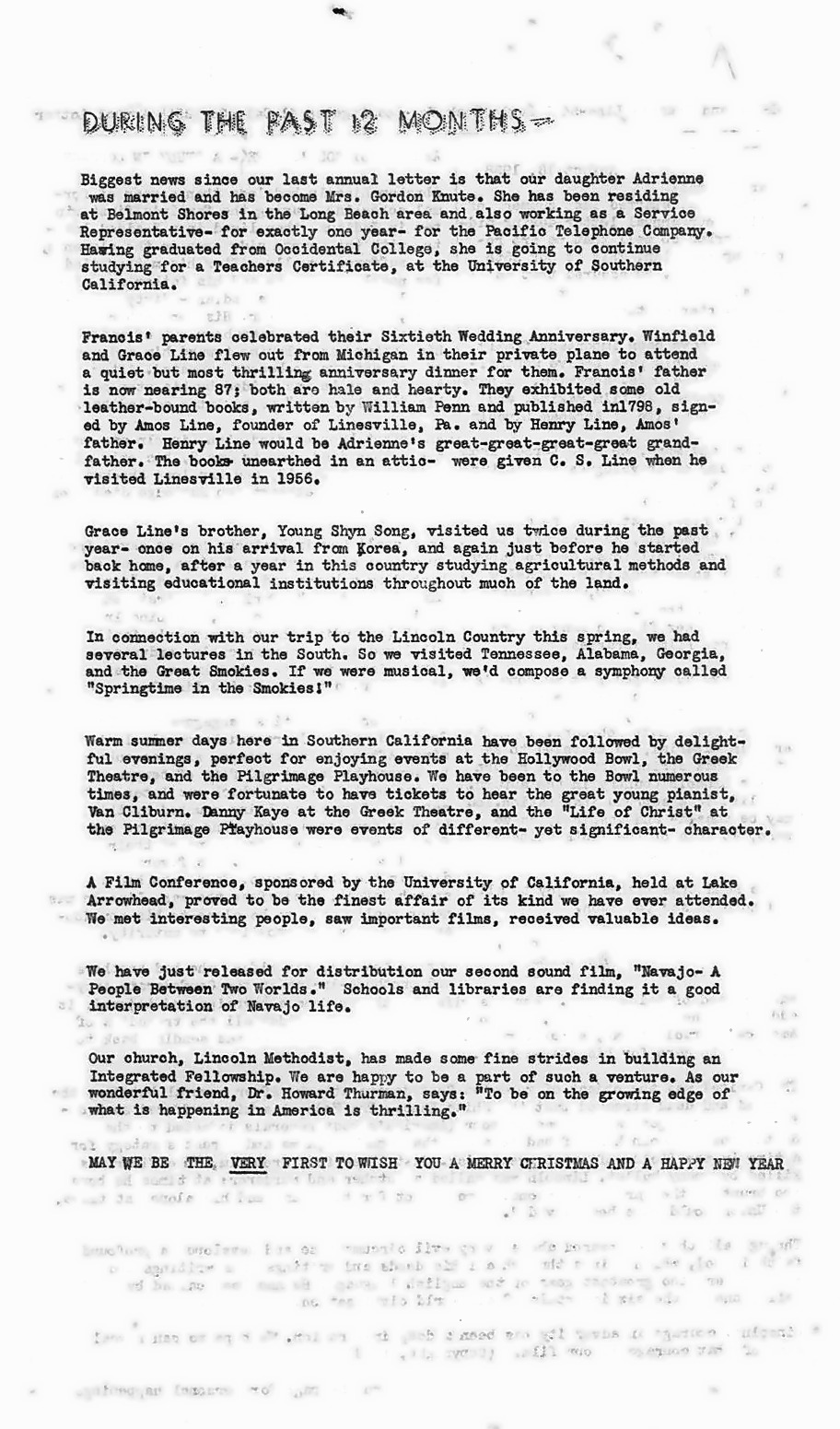
DURING THE PAST 12 MONTHS
Biggest news since our last annual letter is that our daughter Adrienne was married and has become Mrs. Gordon Knute. She has been residing at Belmont Shores in the Long Beach area and also working as a Service Representative—for exactly one year—for the Pacific Telephone Company. Having graduated from Occidental College, she is going to continue studying for a Teachers Certificate, at the University of Southern California.
Francis’ parents celebrated their Sixtieth Wedding Anniversary. Winfield and Grace Line flew out from Michigan in their private plane to attend a quiet but most thrilling anniversary dinner for them. Francis’ father is now nearing 87; both are hale and hearty. They exhibited some old leather-bound books, written by William Penn and published in 1798, signed by Amos Line, founder of Linesville, Pa. and by Henry Line, Amos’ father. Henry Line would be Adrienne’s great-great-great-great grandfather. The books—unearthed in an attic—were given C. S. Line when he visited Linesville in 1956.
Grace Line’s brother, Young Shyn Song, visited us twice during the past year—once on his arrival from Korea, and again just before he started back home, after a year in this country studying agricultural methods and visiting educational institutions throughout much of the land.
In connection with our trip to the Lincoln Country this spring, we had several lectures in the South. So we visited Tennessee, Alabama, Georgia, and the Great Smokies. If we were musical, we’d compose a symphony called “Springtime in the Smokies!”
Warm summer days here in Southern California have been followed by delightful evenings, perfect for enjoying events at the Hollywood Bowl, the Greek Theatre, and the Pilgrimage Playhouse. We have been to the Bowl numerous times, and were fortunate to have tickets to hear the great young pianist, Van Cliburn. Danny Kaye at the Greek Theatre, and the “Life of Christ” at the Pilgrimage Playhouse were events of different—yet significant—character.
A Film Conference, sponsored by the University of California, held at Lake Arrowhead, proved to be the finest affair of its kind we have ever attended. We met interesting people, saw important films, received valuable ideas.
We have just released for distribution our second sound film, “Navajo—A People Between Two Worlds.” Schools and libraries are finding it a good interpretation of Navajo life.
Our church, Lincoln Methodist, has made some fine strides in building an Integrated Fellowship. We are happy to be a part of such a venture. As our wonderful friend, Dr. Howard Thurman, says: “To be on the growing edge of what is happening in America is thrilling.”
MAY WE BE THE VERY FIRST TO WISH YOU A MERRY CHRISTMAS AND A HAPPY NEW YEAR
From the original scan
PDF, 2 pages, 4.6 MB
About this issue
The twenty-fifth letter, sent in midsummer 1958. It is devoted to the Lines’ study of Abraham Lincoln’s life for a documentary (“A Study in Courage”) and to the past twelve months: Adrienne’s marriage to Gordon Knute, Francis’s parents’ 60th anniversary, the Navajo film, and church and community news. It also carries a related PROGRAM magazine article and closes with an early Christmas wish.