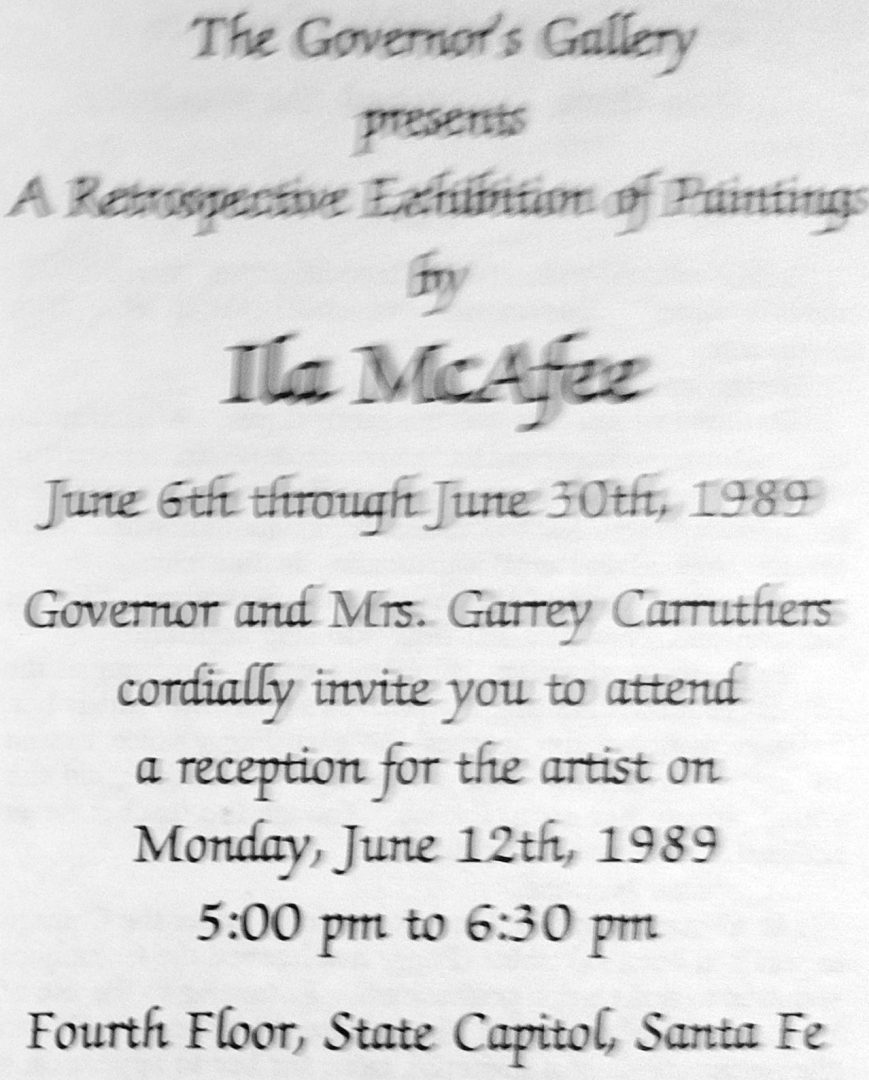
Chapter 1: Ila McAfee Turner, 91 and Just Begun
At 91 years of age, Ila McAfee Turner paints vigorously, exhibits widely, and—in her spare time—travels to such places as Yucatan to seek scenes for her sketchbook. She is probably America’s most outstanding painter of horses. She has a field day—along with the horses—in her work as an artist. Whether she is doing watercolors or oils, animals of some kind usually dominate the scenes, and they are most often horses. Helen and I have been close friends of hers for 60 years. Her life has been intent and intense from the very start.
Ila’s dad loved horses, and on the nearly half dozen Colorado mountain ranches that he owned or rented while she was growing up, he became an expert trainer of horses for himself and for his neighbors. That’s where her love of them began.
“Playing horse” was a favorite game with which she had passed countless golden days. But Ila had carried it beyond play; she had studied the gaits of the animals on the ranch and then practiced those gaits by trotting or galloping as she went about her chores. She even tried pacing, but that was difficult with only two legs, so sometimes she used two long sticks for front legs—one in each hand—and did a good job of pacing.
She and her sister rode horseback the five miles to the rural Logan school, first down Cochetopa Valley, then across the wider Tomechi Valley to the rustic building.
She rode a horse to help in the cattle drives. She drove horses while raking hay. Once she secretly sneaked feed to a stray mare that had come to the ranch, in hopes of making it welcome; she spent hours absorbing the rich wealth of atmosphere about the tiny blacksmith shop on the Jimmy Moran Ranch. Ila grew to understand how horses thought and felt as well as acted.
Horses! Horses and colors and paints had been a large part of her entire existence.
Ila could not even remember how old—or how young—she was when she started drawing horses. Her mother had sketched them for her at first, on scraps of wrapping paper and envelopes, for Ila to copy. Her mother had made just points for feet.
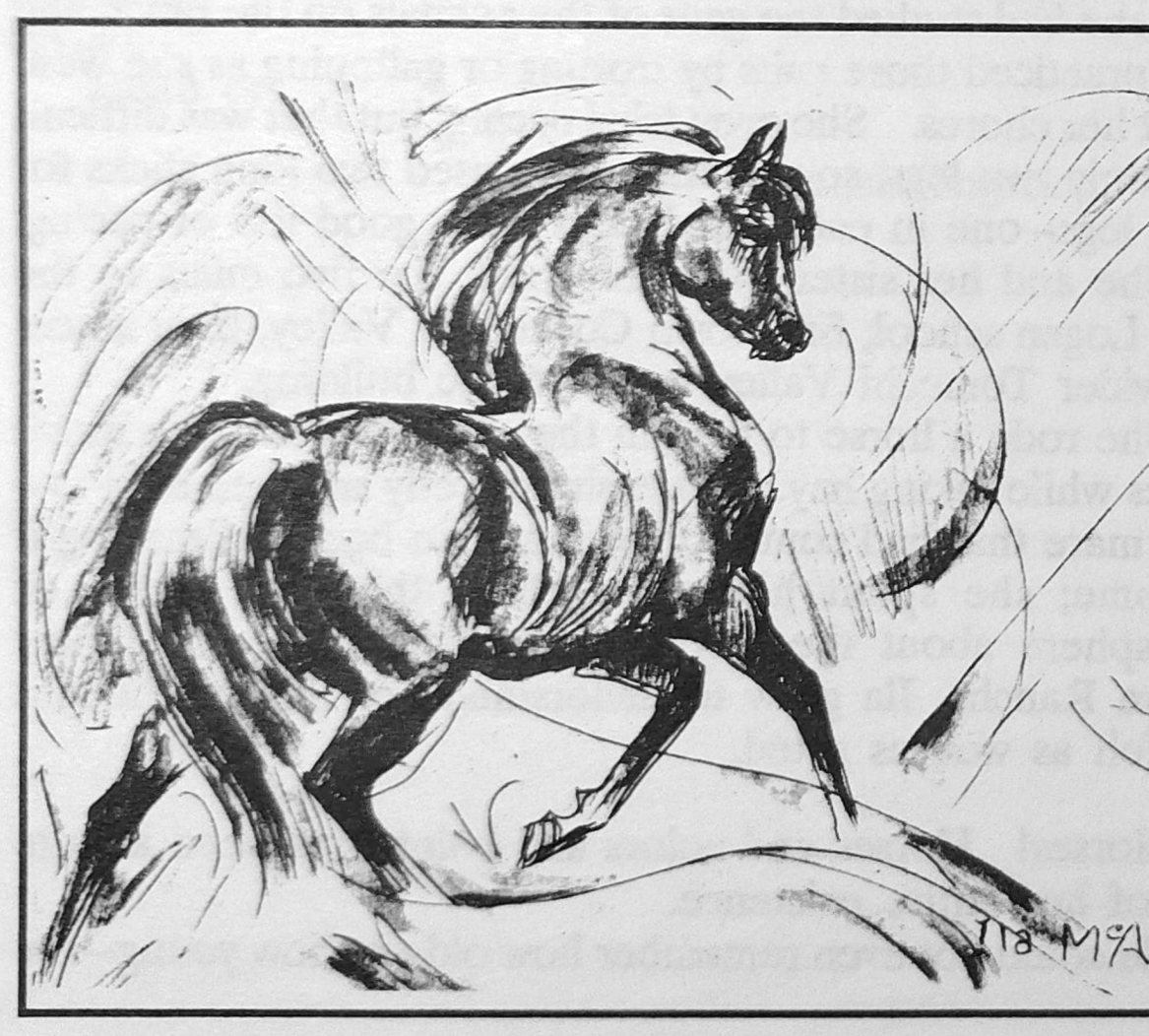
But horses don’t have points, they have feet, Ila reasoned to herself. Taking the pencil she drew a horse with real hooves.
There had been no regular drawing materials at home but she employed scraps of wrapping paper, envelopes, and flyleaves of books. It was exciting to start school, with real blackboards. Throughout recess she would draw on the boards every animal she was familiar with from her free ranch life—rabbits, beaver, mountain lions, goats, cattle, but most of all, stallions and mares and colts.
In fourth grade, in a school in Greeley, a freckle-faced wavy-haired boy across the aisle whispered during class: “I’ll give you a penny for a horse picture.” He handed over a clean white sheet of unlined stationery, and with pounding heart Ila executed her first commission and earned her first fee.
Then came the day, still glistening in her memory, when a man who had heard about her drawings came on a visit to the ranch and gave her a dollar to draw him some horses.
When Ila was about 14 it was decided she should have art lessons. There was an evening class at the Normal School in Gunnison, 15 miles away. She rode in on horseback once a week, took her lesson, and stayed overnight with a woman who rented her a room, with a place in the barn for her horse.
Her teachers were Henry L. Richter and his wife Catherine. One day Ila realized that Mrs. Richter was standing behind her, watching her do a drawing.
“Ila,” she exclaimed, “you’re creating a real life horse scene—mares and stallions and colts—without even looking at a model, or even a photograph.”
“Yes,” Ila answered meekly, “I never look at horses when I draw them, or paint them, like artists do when they make portraits.”
“This is remarkable,” Mrs. Richter continued. “You have the complete anatomy of every horse exactly right—all the muscles and bone structures.”
“I always paint from memory, not models,” Ila explained. “I was born and raised with horses. I know them almost better than I know myself. I can close my eyes and see every detail.”
Catherine Richter declared that here was a girl who should pursue her training in art. It was her influence that caused Ila, when she was 19, to head for Chicago to meet the great artist Lorado Taft.
Taft recommended that she study and work in the studio of the muralist James McBurney. That is where she met Elmer Turner, who had just recently returned from France where he had served in World War I. Both Ila and Elmer were aspiring artists. They worked together, they studied together, they painted together. One day they arrived at a mutual decision: they should spend the rest of their lives together, as husband and wife. The muralist, James McBurney, promised them a mural assignment in California as soon as they were married.
In a setting of autumn leaves at Ila’s home in the Colorado Rockies, Ila and Elmer stood before the Rev. Geiser and joined hands and lives “until death do us part.”
Rev. Geiser was an artist as well as a minister, who had lived in the art colony of Taos in the New Mexican Rockies. Ila and Elmer had heard of the place but had never been there. “You will love Taos,” the minister promised, “and Taos will love you. Since you are going to California for a mural assignment, you should stop in Taos for a visit.”
Elmer Turner, ex-soldier, teacher, muralist and landscape painter, and Ila McAfee Turner, the artist with the musical name and the girl who loved horses, headed west.
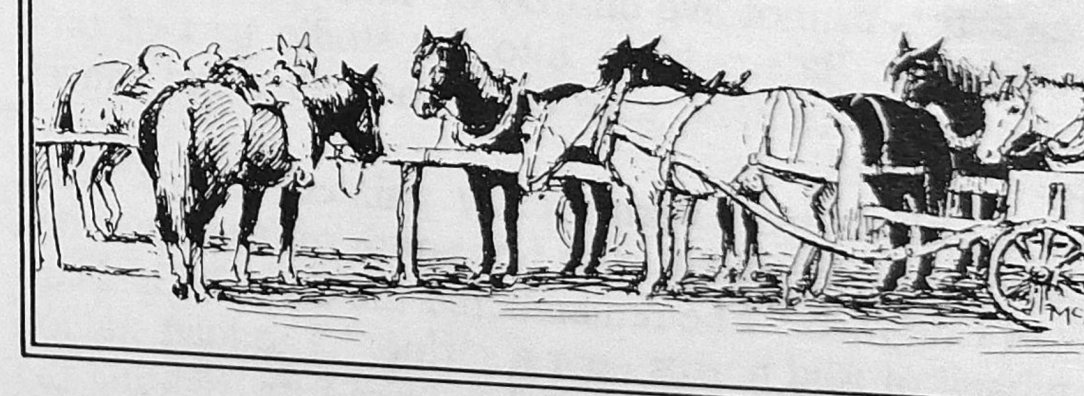
Rev. Geiser had been correct. Ila and Elmer loved Taos. The wine of its late autumn colors intoxicated them as they stopped at the New Mexican art colony on the way to their California mural assignment. They lingered long enough to let the intoxication mellow into longing as they caught the flavor of the place—blanketed Indians from the pueblo adding color to the plaza, Spanish-Americans, bright of dress, sparkling the air with their liquid musical language. And horses. All four sides of the plaza were lined with hitching posts where saddle horses or teams with wagons were tied.
And Taos loved the Turners. It loved the bold, joyous manner in which Elmer knocked on the doors of the leading artists, introduced himself and his bride, and said that he just wanted to get acquainted. He and Ila might be coming back some day to live.
Come back they did, to friends ready-made, who took nearly as much interest in plans for their new home as did the Turners themselves. The weekly paper gossiped intimately about the progress of the house they started to build. It was a cozy adobe studio-home, earth-hugging, typical of New Mexican houses. When the sign “White Horse Studio” went up by the little gate, the paper formally welcomed its two artist-occupants.
Taos loved the Turners, and every artist in the colony felt concern when Elmer began to experience difficulty with his right hand, aftereffects of influenza he had suffered in France. Month by month his condition grew worse. As the second autumn came, and the third, and the fourth, it grew harder for him to reach to the far side of the paint box to mix the ambers and golds and reds. His right hand shook as he held the brush, but he tightened his fingers around it, set his teeth, and made the strokes to finish his paintings.
Then the right hand failed.
Every artist in Taos felt a glow of pride in their townsman when Elmer quietly picked up the brushes in his left hand—and learned to paint all over again.
One of his radiant mountain scenes of Longs’s Peak in Colorado made the May 27, 1927 front cover of one of the country’s greatest national magazines, The Literary Digest. His Along the Rio Grande took first prize at the Phoenix art show. Galleries far and near exhibited his works. Art lovers from a dozen states bought his paintings.
Elmer’s left hand became weaker. His brush strokes again wavered. Paralysis, an aftermath of the influenza, crept over his body. Ila mixed his paints to save him that effort.
One season he lay down his brushes. The next season he could not pick them up. At this point Elmer began giving much attention to the garden. A winsome smile stole across his features as he said to Ila, “I’ll grow a picture instead of painting one.”
At that wedding ceremony in the sparkling autumn of the Colorado Rockies they had made a vow, “for richer or poorer, for better or worse, in sickness and in health.” Now one of them was sick, but their love was strong. Now Ila’s hands must be hands for both, but Elmer’s spirit must soar even to new heights in order that he might buoy her up in her terrific task. They were still partners, still walking life’s path as one.
Their little studio-house had become not only a home but a sanctuary of beauty, creativity, and love, with both of them creating ideas and concepts. In spare moments Ila set about enhancing its loveliness. She could scarcely have done otherwise, for creativity flowed from her fingers. Beds and furniture were carved with Indian motifs. Ceramic dishes were designed and fired, usually with a horse showing somewhere. Interesting mobiles were created. Navajo blankets, collected by Elmer over the years, added gaiety and color.
The kitchen, where Ila and Elmer ate, was another glowing spot of color. As each meal started, Ila and Elmer grasped hands and bowed heads in thanks. A man who could not paint, or talk, or feed himself, and a woman who must now be hands and feet and tongue and almost life itself for her husband, gave thanks that they had their spirit and their love.
Even artists cannot live entirely on love. When Elmer’s needs were met, Ila would go into the studio part of their home, switch on the light, take easel and pallet and canvas, and begin to paint.
Horses, of course. Permanently painted in her mind, unerasable, were the pictures of her youth on the mountain ranches of Colorado. She remembered the time she had surprised a band of wild horses near a spring. The lead stallion had stood upright, not from fright but from fury, fighting the air with his front legs as his mane and flowing tail swept in glorious accompaniment. Then, turning suddenly, the whole herd had circled the spring in thunderous beauty and swirled madly and majestically away. Before the day was over Ila had the memory on canvas—a sweeping, swirling rhythm of horses and beauty and color. In almost mystic metamorphosis, the timeless golden days and experiences of a Colorado ranch became the challenging creations on canvas in a studio in Taos.
Elmer named the paintings, as he had named almost every one she had ever done. It was he who saw rhythms of the swirling heavens in her wild horse picture and called it Spiral Nebulae. Helen and I now have that painting of Ila’s as our own. It was one of her finest.
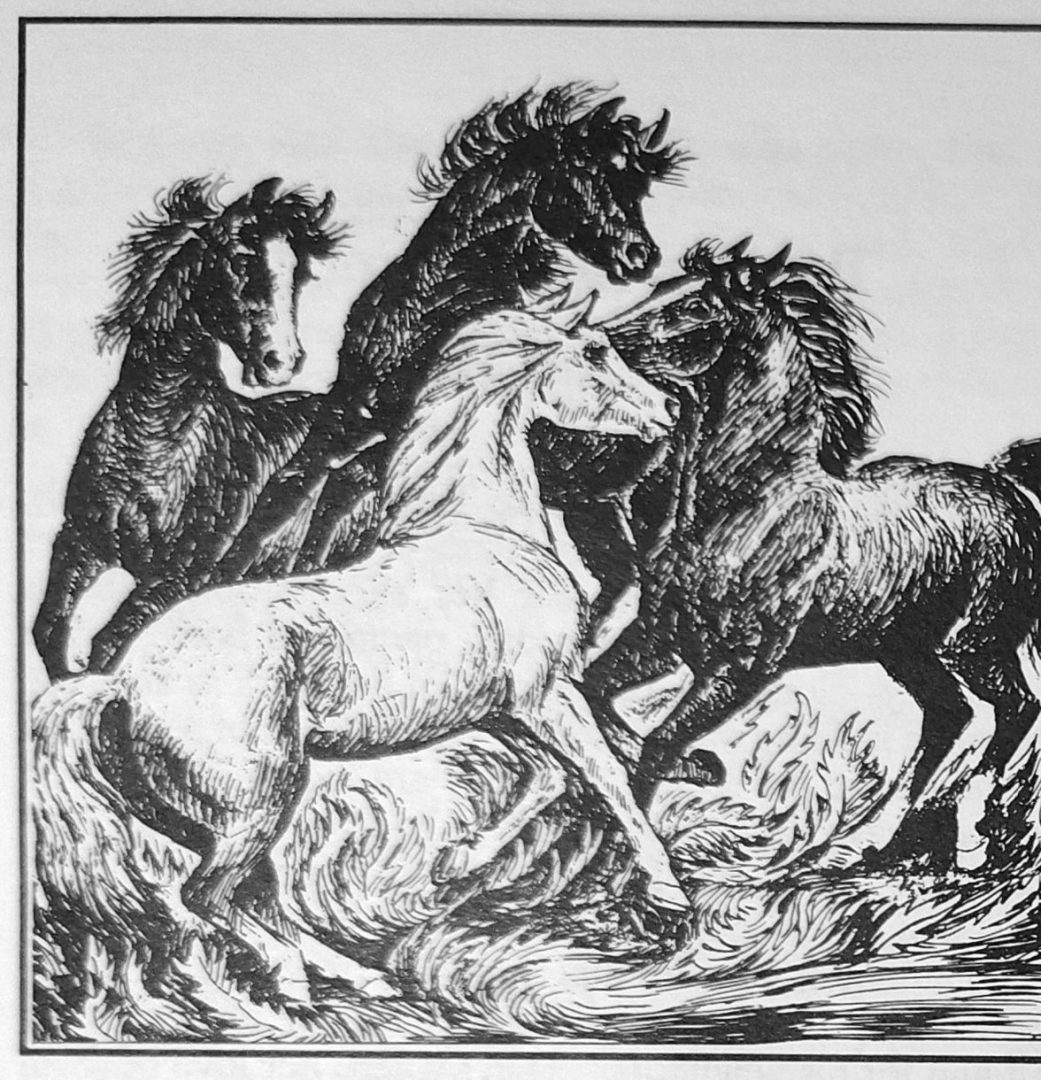
The name of an Ila McAfee Turner painting came to have a significance almost equal to the brushwork itself, and probably never have works of art been named with more thought or love or care. With a flare for symbolism and allegory as well as realism, Ila created studies of moods and effects that cried out for the name that was apt. From Elmer those names came. Black Mesa, Stampede of the Waves, Entrance to Spring, Exuberance, Sportsman’s Dream, Desert Dwellers, Turbulence. His name of Winds Variable for a surging powerful study of four horses plunging off in opposite directions helped to sell it to the Agricultural College of Utah. More than one of her paintings found its market because of its name.
One day Ila made a record 50-yard dash from their mailbox out to the garden where Elmer was “growing a painting,” using shovel and hoe as best he could instead of palette and brush. “The garden is all weeded and fresh,” she began explaining breathlessly. “How would you like to relax for a while? Our letter about the Texas mural assignment has been answered. We’ve received the commission. I’ll paint it. You name it.”
The era of post office murals, in which the history of each locale was depicted on the walls of government buildings, found one of its finest artisans in Ila. Who better qualified than she to paint the record of the almost extinct longhorns for the post office at Clifton, Texas? To absorb the spirit of her subject firsthand she put Elmer into the car, packed brushes and luggage, and set off for the plains of Texas to fulfill her first mural commission. The walls of post offices in three states soon carried her conception of the history of early western life.
The golden leaves of the aspens in the mountain meadows surrounding Taos were beginning to drift to the ground when Elmer took Ila’s hand, kissed it and went to sleep. He never awakened. It was in the autumn of 1966.
In those last months together he had talked over with Ila the possibilities of dozens of painting subjects which she might execute. They had made lists of such possible paintings.
With that list as an inspiration, and needing release from her sorrow, Ila loaded her van with easel, palette and paint, and all the paraphernalia of an artist and started out to transfer her world to canvas. She loaded the same van with finished paintings when invitations for exhibits came and she went to help set them up. Through the years she has held such exhibits in many western states. She has seen more than 1600 of her paintings sold to private collectors. Her mural executions—nearly always with horses or other animals as themes—enliven the walls of libraries, post offices, and public buildings throughout the West. To see a woman as mature in years as Ila wielding a brush from a vantage point of ladders and scaffolding while executing such murals is a sight nearly as inspiring as her finished painting.
Ila has traveled with sketchbook and drawing pencils to Alaska, Hawaii, and New Zealand, to Africa twice and to Europe four times. Many of these painting safaris came in her 60s and 70s and 80s. Then she headed off to Florida, to the Rio Grande Valley, and to Yucatan in her 90s. To seek fields of a different character she and a woman companion used a dugout canoe to journey through parts of Ecuador.
Not only did Ila paint animals, she trained another kind of animal to a point of perfection such as Helen and I—who saw the results—could not have believed possible. This was a Royal Siamese cat.
“I’ve named it ‘Sanka,’ ” she explained. “It doesn’t keep me awake at night.”
Helen and I made a short documentary color motion picture of the antics of that cat.
“What tricks can it do?” I had asked her. She proceeded to give us a three-ring circus demonstration. On command, Sanka played a small piano, striking enough keys to produce some Siamese music. The cat played checkers, moving the pieces as her turn came, even if such moves seldom produced victory. When Ila arranged a row of capped milk bottles in her studio, Sanka jumped up onto the first bottle and walked sedately, from bottle-top to bottle-top, across the room. She pulled a small wagon. She could roll over and salute. She could climb up and down ladders. She jumped through hoops and rang a bell on command. In her repertoire were 75 well-executed tricks.
People came to the studio to see Sanka perform. To raise money for her church, Ila decorated a can with a half-moon slot at the top and invited visitors to see what happened if they put a coin on the can. Sanka promptly pushed it into the slot.
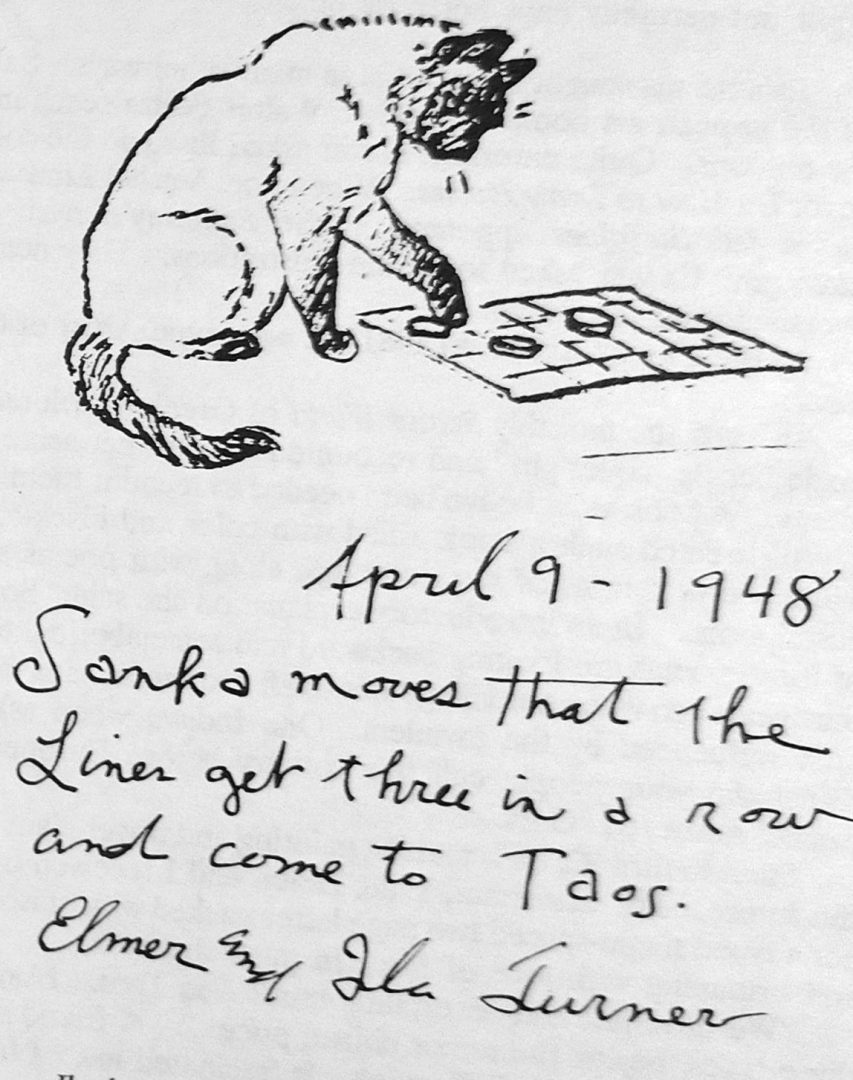
“Too bad she can’t use bills,” one man remarked. “Try her and see,” came Ila’s reply. As soon as the bill was rested on the can Sanka wadded it up with her dexterous paws and stuffed it into the can. The church treasury was enriched by more than five hundred dollars because of Sanka.
Invitations came from schools and clubs. Ila became as busy putting on feline exhibitions as she was arranging exhibitions of art. Sanka may not have kept her awake at night but certainly kept her busy by day.
Ila’s talents sought their outlet in many other ways. Sales of the popular art books by the late Walter Foster reach into the millions. Quite naturally, Foster asked Ila to do the color cover for How to Draw Horses. When poet Vachel Lindsay’s Flower-fed Buffaloes appeared in the Saturday Review of Literature, Ila was asked to do the illustrations. They nearly overshadowed the poem.
In the City of Artists, in 1981, Ila was voted Artist of the Year.
In 1985 the monthly Senior World of Greeley, Colorado, made her its “cover girl” and recounted some of her achievements. A book would have been needed to recount them all.
Ila created such a book, filled with color and black-and-white reproductions of her paintings, along with poems and descriptions. In an introductory explanation she said, “Some of these poems are looking backward and remembering, to a time years ago when our village was small and the Indians were little influenced by the invaders. One Indian, when asked ‘What did your people call this country before Europeans came?’ answered ‘Ours.’ ”
Soon to turn 92, Ila is making painting and travel plans for the future. For Christmas, 1988, Helen and I received from her a typed single-spaced two page letter packed with episodes and brimming with love of life. In part, she said:
“We have just had an exciting musical in Taos. I saw it three times, paying the senior citizen price. … A friend sent me a book on Hot Air Ballooning. It fascinated me. I have been up four times. …
“There was one trip to California, for the one hundredth birthday of Catherine Richter, my art teacher in school at Gunnison. I have known her for 72 years. She is still painting, has a strong voice and a steady hand. She is a remarkable person, and was the one who started me off in my life in the art world by sending me to Chicago to meet Lorado Taft, who then told me about James E. McBurney. It was in his studio that I met Elmer Turner.
“Two other special events in 1988 were The Retrospective Show that the Art Association of Taos gave me last January, and a big birthday party given for me on October 21st. My 91st! I seem to be getting a lot more attention now than when I was younger. … It may be true that time is a great healer, but it’s no beauty specialist. A small girl, about six, asked me recently, ‘What is the matter with your face?’
“My winter plans are to go to Yucatan with Catherine Fels. We have gone to Tucson twice together, painting, so get along very well. We have painted the Rio Grande three times this year—Spring, Summer, and Fall. I don’t know what I’ll paint in Yucatan, but I can paint horses any old place. I am looking forward to it.”
“I am looking forward to it.” Those words are a capsulated summary of Ila McAfee Turner’s 91 years of life so far.
“She has really captured the secret of living,” Helen said to me as we finished reading her letter.
“She creates fine pictures of horses, without models,” I replied, “because she has studied them all her life. She knows how to live because she has been putting into practice the real art of living every day of her life, rain or shine.”
We are looking forward to her next letter, describing her ongoing adventures.