
Chapter 10: Hulda Crooks Still Climbs at 93, in More Ways Than One
Hulda Crooks climbed Japan’s 12,388-foot Mt. Fuji when she was 91 years old, reaching the summit on July 24, 1987, the oldest woman ever to do so. The temperature had dropped to freezing; near the top the wind blew black volcanic dust into her face. Just six weeks after the Fuji climb she made it to the top of Mt. Whitney, 14,495 feet in elevation, the highest peak in the contiguous United States. Someone challenged her to climb the avalanche of steps leading to the top of the Capitol Dome in Washington, D.C. Steps are sometimes more difficult than a mountain trail, but Hulda Crooks accepted the challenge—and won. She became a “cover girl” on magazines, appeared on talk shows, received the personal congratulations of the president in the Oval Office, and inspired millions as her accomplishments were told on the evening TV news. On the ABC nightly news Peter Jennings named her “Person of the Week.” The Hulda Crooks Scholarship and Loan Fund has been created at Loma Linda University. A Hulda Crooks Award of Achievement is now presented each year to individuals who demonstrate the importance of healthful living and are committed to achieving life’s fullest potential.
Hulda’s life story reveals, in an almost unbelievable way, how one can meet the challenge of drastically altering one’s lifestyle when threatening circumstances require it. Born in western Canada, she had become overweight as a child. “I grew up on a farm,” she explains, “on a diet of meat, potatoes, and bread with an abundance of milk, cheese, butter, and eggs.
In addition, in my father’s country store I had free access to a barrel of candy and a gunnysack of peanuts. . . . These extras I munched between meals in addition to three big meals a day.
When I was 16, at five-feet-two inches in height, I weighed 160 pounds.”
In the area where she grew up, learning how to work was more important than learning from books. At age 18 she had completed only five grades of country school.
Then the pendulum began to swing too far in the other direction. As she explained, “In the long climb from sixth grade to a Bachelor of Science degree I nearly ruined my health. Long hours of study made me neglect almost all physical activity. I had to work to support myself and it was just too much.”
Pneumonia struck her; she spent a year recovering from it, but her condition grew worse. “I remember once trying to do some gardening but I became so tired I thought I was going to die,” she said. “For years I wasn’t worth much. I was nervous, anemic, and perpetually tired.”
At age 31 Hulda married Dr. Samuel A. Crooks and with him she began to reevaluate her lifestyle. The results have had worldwide effect.
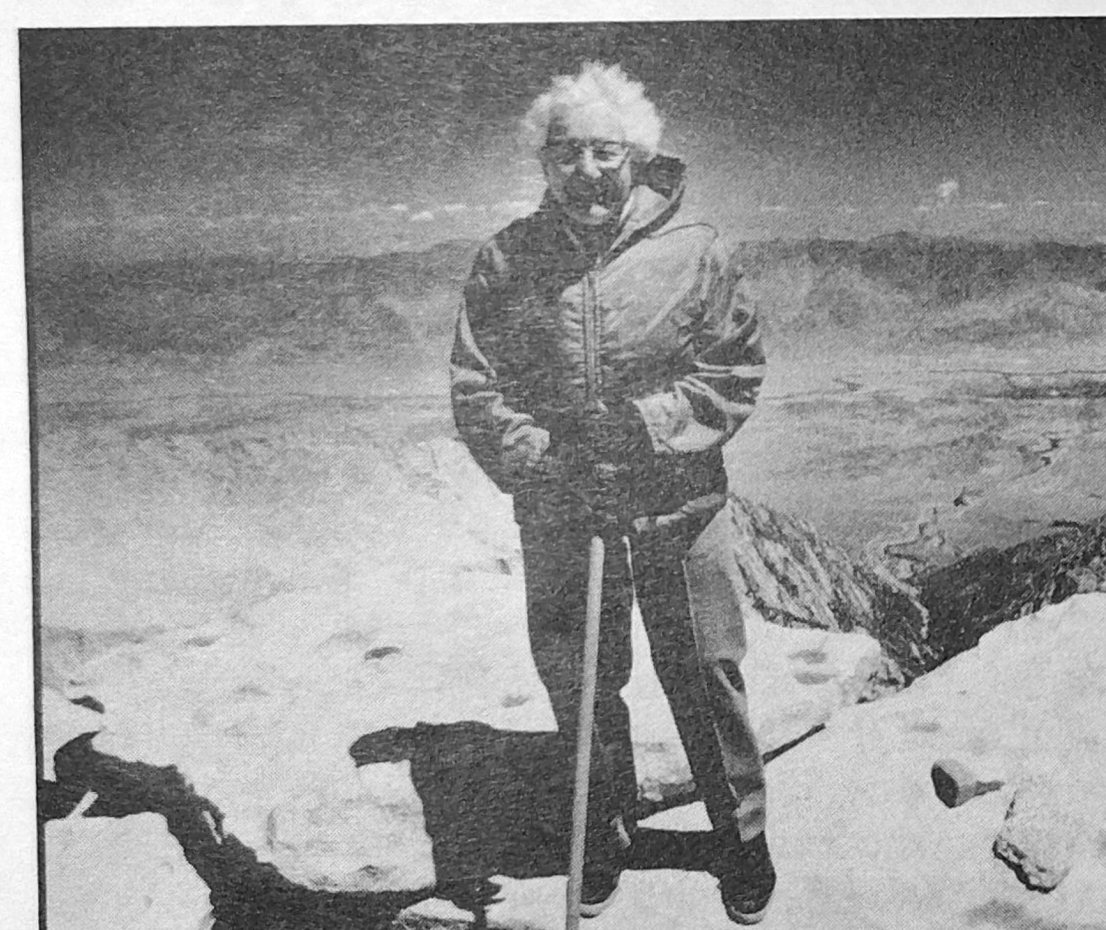
“He took me literally for better or for worse,” Hulda explained. “He had just finished his medical training and he confidently waded into the task of taking a tired, nervous 31-year-old woman to keep or to cure.”
He encouraged her to minimize her housework and spend more time outdoors, at anything she enjoyed.
“Although fond of tasty foods,” said Hulda, “he gave me little praise for spending hours in the kitchen cooking, baking, and washing piles of dishes. He gave me outdoor books, everything from flowers to rocks and insects. I’ll never forget the first book he gave me. We were out walking one spring afternoon when we came across a field of yellow daisylike flowers with white tips. I wondered what they were. Out of his pocket Sam pulled a book and handed it to me. It was written for laymen and had the flowers arranged by colors. I turned to the yellow section and there it was—tidy tips! The surge of pleasure that swept through me when I found the name of that sunny-faced flower elated every cell in my being.
It was better medicine than anything ever ordered on a prescription blank.”
More gifts of nature books followed, enabling Hulda to learn the names of all kinds of flowers, trees, shrubs, and butterflies. These interests led to mountain climbing near their home, although, because of a heart condition, Sam could not go to the higher elevations that she was able to tackle.
One summer as they were driving in the vicinity of Lone Pine her husband pointed out the car window. “See that peak? That’s Mt. Whitney, highest mountain in the United States.” She looked at it with interest as a scenic wonder, never even thinking of it as a goal. But she did continue her outdoor pursuits and her climbing close to home.
Then—Sam died. That was followed by the loss of their only son. Mountain climbing became not just a way toward physical health but a means of easing her grief.
“I climbed whenever I had the chance. My health continued to improve until I was able to hold a full-time job. I found that I felt best when I walked a lot, so I disposed of my car to decrease my expenses and increase my daily exercise.”
At Loma Linda University, Hulda became a dietician-researcher and made herself an example of what exercise and a completely proper diet can do. She was in touch with many students and sometimes heard them talk about climbing Mt. Whitney. “I wondered, could I possibly do it? But the years slipped by and with them the likelihood of my ever trying.”
“Then two friends—a young couple—asked me to try climbing Whitney with them. I was 66 years old. That was 30 years after my husband had pointed out the car window and said, ‘See that peak?’ ”
They tackled the peak. It is estimated that more than half of those who attempt it, regardless of age, give up before reaching the top. Hulda Crooks did not give up. They made it. The next year she climbed it again. Preceding those two Whitney ascents she had conditioned herself by first climbing a lesser peak, San Gorgonio, close to her home. For her attempt at Whitney the third time she neglected the conditioning, and could hardly make it to the first camping spot. Two days of mountain workouts, however, changed everything; she made the summit and realized it was not so much a matter of age as it was of conditioning.
Nine years in a row she ascended Mt. Whitney, beginning the climb each time at Whitney Portal, where most hikers start. To celebrate being 75 she sought something even more challenging, coming in from the north. That was 70 miles of mountain exercise. The next year she decided to try the Whitney ascent by an even more difficult route. Starting from Sequoia National Park on the west side of the Sierra she took the High Sierra Trail across the Great Western Divide, dipped down into Kern Canyon, then up and down and finally up again to the peak of Whitney, after six-and-one-half days of hiking with one day of rest.
In 1984 my daughter, my granddaughter, and I decided to celebrate the fact that I had turned 80 by climbing Mt. Whitney. Just as we had left our car, at Whitney Portal, and were searching for the start of the Whitney trail, we met Hulda and her party. She was 88 then, and had been climbing Whitney almost every year since she was 66. To my surprise she told me she’d seen my color motion picture Sheep, Stars, and Solitude when I had shown it at what is now Loma Linda University near her California home 40 years before.
Our visit at Whitney Portal was long and enthusiastic. We met again on the trail. From that time on we have been the closest of friends. Helen and I have watched this nonagenarian mountain climber, step by step, climb into international fame.
Besides climbing mountains, Hulda also lectures and is an authority on healthful living. Helen booked her as a speaker at a Community Forum in San Clemente. Before the lecture, as Hulda was having dinner at our home, we said: “You must not forget to take your broomstick.”
That broomstick was part of her evening program; she used it dramatically to stress one of her points. Seizing it firmly at both ends, she raised it back over her head, brought it down, then up over her head again, continuing to repeat the exercise while the audience gasped.
Hulda’s lecture appearances used to be confined to California; now they are apt to cover the continent. In November of 1988 a Thanksgiving greeting card came from her, postmarked Tampa, Florida. She was in the Sunshine State for a series of lectures. Her 1988 Christmas card contained a hastily written note: “Have been flown a number of places recently to give talks. My wings are getting tired! Scheduled for Georgia to take part in a February, 1989 youth rally of about 350. It is a privilege and responsibility to meet with high school age.
Love, Hulda.”
After each of these appearances she hands out to her listeners a tiny booklet. As an expert on buoyant living, through actual practice and also as a dietician, she has incorporated into its 14 pages some invaluable hints of her concepts regarding good health.
“When a man-made machine wears out it can be replaced with a new one,” she writes. “Not so with the human body.
Rich or poor, wise or foolish, the limit is one body per customer. No exchanges, trade-ins, or replacements. What’s more, only one lease of life is granted. Its performance during that lease will, to a large extent, be dependent on the intelligent care given it by the lessee.
“Too many of us are concerned only with present desires.
We do not ask: ‘How will my current lifestyle affect my health in years to come?’ ”
She tells how the striking benefits of a reasonable observance of the laws of health were analyzed in an exhaustive survey made by the California State Department of Public Health.
The study investigated the relationship between physical well-being and everyday life practices. The habits surveyed that might affect health included regularity of meals, snacking, hours of sleep, weight for height, exercise, and the indulgence in or avoidance of tobacco and alcohol.
“As you would expect,” she says, “the people who practice good health habits in all seven categories had the best health, but this was not all. Not only did these subjects enjoy superior health, but their state of health was equal to that of people 30 years younger who did not follow sound practices.
“Thirty extra years of good health is like an extension of youth, WHO WOULDN’T GO FOR THAT!
“Muscles, not used, atrophy; bones, not put under stress, lose minerals and become weak; and joints, not moved sufficiently as in walking, working, or other forms of exercise, become stiff from disuse. The blunt facts are that your body needs intelligent care. Learn to enjoy good food simply prepared. No type of flesh food is required for good nutrition; if used, the lean is preferable.
“Plan and put into use a regular exercise program. Set your stake as high as you wish, but work toward it gradually.
Don’t suddenly demand more of your system than it can give.
Work toward your goal patiently and persistently and your body will respond to the utmost of its physiological ability.
“And don’t underestimate the effect of your mental attitudes. Disturbed emotions, when fostered, can undo the benefits of the best-regulated program. Anger in all its forms—hostility, frustration, jealousy, hatred, wounded pride—as well as fear in its variation of anxiety, worry, depression and the like, sap your life forces.”
Hulda Crooks sums up her axioms for a healthy life on a positive note. “Begin to count the happy moments of each day. Try to be grateful for whatever good comes to you, be it seemingly ever so little. Talk of the things that meet your needs and give you joy. Linger over each ‘find’ with thankful heart. This will grow into a most rewarding habit.”
Hulda’s life proves her points. At 93, between lecture engagements and hiking, she is engrossed in gathering together materials for the writing of her life story, at least up to this point. There may well have to be a sequel in years to come. Hulda Crooks is still climbing.
P.S. This chapter requires a postscript. Two examples reveal the influence that Hulda Crook’s life has had on others.
The first concerns 61-year-old Helen Hayes (not the stage actress) who first met Hulda on Mt. Whitney when Helen attempted to climb it in 1975. Helen Hayes reached the top but was too exhausted even to see the beauty all about her.
“Dear God,” she prayed, “if you’ll get me down from this mountain I’ll never climb another one.”
But Helen had met Hulda and they actually lived close to each other, near Loma Linda University. Instead of keeping her promise about not climbing another mountain, she realized what Hulda had done with her life and started remodeling her own. She has done so in a remarkable way.
Many times she has climbed Whitney again, with Hulda, and does it with comparative ease. Loma Linda University has an enormous series of stairs and Helen climbs 1200 steps, six days a week. She ran the Hawaiian Marathon and in May of 1989 did the Long Beach Marathon. All of this in addition to two jobs, working on drug prevention and teaching at Image Network, a self-improvement modeling school in Corona, California. She walks and runs an average of 160 miles, and climbs 34,000 steps, each month. In a recent letter to me she described her philosophy. “I maintain that it is not a matter of getting old, but just getting older, [although 61, she looks as though she were in her 40s] and with these years accumulating more wisdom and knowledge. We are programmed to see the aging process as ‘downhill all the way’ and I don’t like that; we’ve got to do something to turn this around.
“Here I am a grandmother and I don’t feel old or any older.
I attribute it to my lifestyle—good dietary habits, Nutrition, Exercise, Water, Sunshine, Temperance, Air, Rest, and Trust in God. That spells NEWSTART.”
N-E-W-S-T-A-R-T! That just about says it all.
The second example concerns 70-year-old Evelyn Bauman.
At age 66 she decided to try climbing Mt. Whitney because that was Hulda Crooks’s age upon first reaching its summit.
Evvy, as we all call her, was fortunate in meeting Hulda on that first Mt. Whitney climb and they have been the closest of friends since. She has conquered the mountain twice since then, her latest climb being in the summer of 1989.
Hulda also met a 16-year-old boy, Peter Robinson, on one of her early Whitney climbs. Now Hulda at 93, Evvy at 70, and Peter at 33 often give a three-generation talk and program to groups in Southern California.
Evelyn’s father, a fine example of Swiss longevity, lived to be 96, with never a sick day in his life. Evvy may be heading in that same direction.