
Chapter 12: Frank Laubach’s Life Is an Inspiration to All
If there are those who have reached middle age—50 years old or so—and feel they have not attained the goals they hoped for, such persons should steep themselves in the story of Frank Laubach. His vision, and the literacy movement he started, have resulted in tens of millions of individuals learning to read. During one four-year period he traveled to 105 different countries around the world and helped create reading lessons in 315 different languages. In 1984, on the 100th anniversary of his birth, a 30-cent United States postage stamp bearing his likeness was issued in his honor.
Norman Cousins, himself a Super Senior whose outreach has greatly influenced the world, has called Laubach “one of the noblest human beings of our times.”
But here is the fact which should inspire middle-agers: Laubach was nearly 50 before his lifetime goal was at all clear and, working in only one language, he had helped only a handful of obscure inhabitants of one country learn to read.
Frank Laubach, who died at age 85, and his wife Effa, who died at age 90, had it as their goal to work as missionaries among the Maranaos Muslims on the southern Philippine island of Mindanao. Conditions were so unsettled there that they had to work elsewhere in the Philippines for 15 years. When at last they were allowed to take up work in Mindanao, tragedy followed tragedy. The climate was hot; sanitary facilities were almost non-existent. One of their small sons died. Then another. And finally a third. Only their young son Robert was left. There were occasional furloughs back to the United States or to Manila for mother and remaining son, and sometimes for Frank Laubach as well. But eventually they returned to the area of their original goal, Mindanao and the Maranao Muslims.

Laubach wanted to start a school, train teachers, get a medical clinic and a church established. The Maranaos were suspicious and uncooperative. He was frustrated, discouraged; he even sensed defeat until, as though it were a miracle, he seemed to hear God giving him new directions. His son describes it in his book, The Vision Lives On.
“My child,” God seemed to be speaking through Frank Laubach’s own lips, “you have failed because you do not really love these Maranaos. You feel superior to them because you are white. If you can forget you are an American and think only how to love them, they will respond.”
Laubach took God’s advice. Wholeheartedly. Instead of just studying the Bible, he and the Maranaos studied the Koran and the Bible together. They studied the prophets who were common to both religions, such as Abraham and also the Prophet Jesus. Laubach was able to teach the Maranaos but he also began to discover that they had many things to teach him. “I find myself richer for the Islamic experience of God,” Laubach once wrote. A verse from an Edwin Markham poem became a favorite with him:
“He drew a circle that shut me out—
Heretic, rebel, a thing to flout.
But Love and I had the wit to win:
We drew a circle that took him in!”
These new friends of his—and that is what they really became after God had intervened—were among the few in Mindanao who could read Arabic. There was no Maranao written language. Together, Laubach and they started creating one. A cheap printing press was imported and set up. A Maranao dictionary was written, word for word, almost out of thin air. Some simple rules of grammar were established.
Before too long a thousand pages of handset type were available as reading material. Young Robert and his mother were there now, and they pitched in. Every day Robert would speed home from school on his bike and help with the press. People lined up in front of the print shop, eager for each new page that was printed. Robert describes it in his book: “The paid teaching staff grew to 75 and hundreds of people were learning to read every week. You could walk through villages all around and see ‘100% Literate’ on more and more doors.”
A young secretary, Minnie Schultz, had written Frank Laubach from Pennsylvania, asking permission to come and join them. She became the first official “Laubach Literacy volunteer.”
Almost at the same time that Minnie Schultz arrived, the Great Depression arrived as well. It hit the United States and soon affected the Laubachs and all those eager-to-learn Maranaos in that far southern island of the Philippines. The literacy budget was cut in half. Printing had to be curtailed. Worst of all, teachers had to be laid off. First, distress. Then impending disaster.
It is hard to realize that a crisis of such proportions as this could lead to the greatest forward step the Laubach Literacy movement could ever have. God works in mysterious ways, even bringing good out of Great Depressions. One of the Maranao leaders issued a virtual proclamation. “I have seen how much literacy means to my people,” he said. “The women are learning how to take better care of their children. The men are learning better ways of farming. Literacy in my village will not stop. Every man or woman who has learned how to read must teach someone else—or I’ll kill him!”
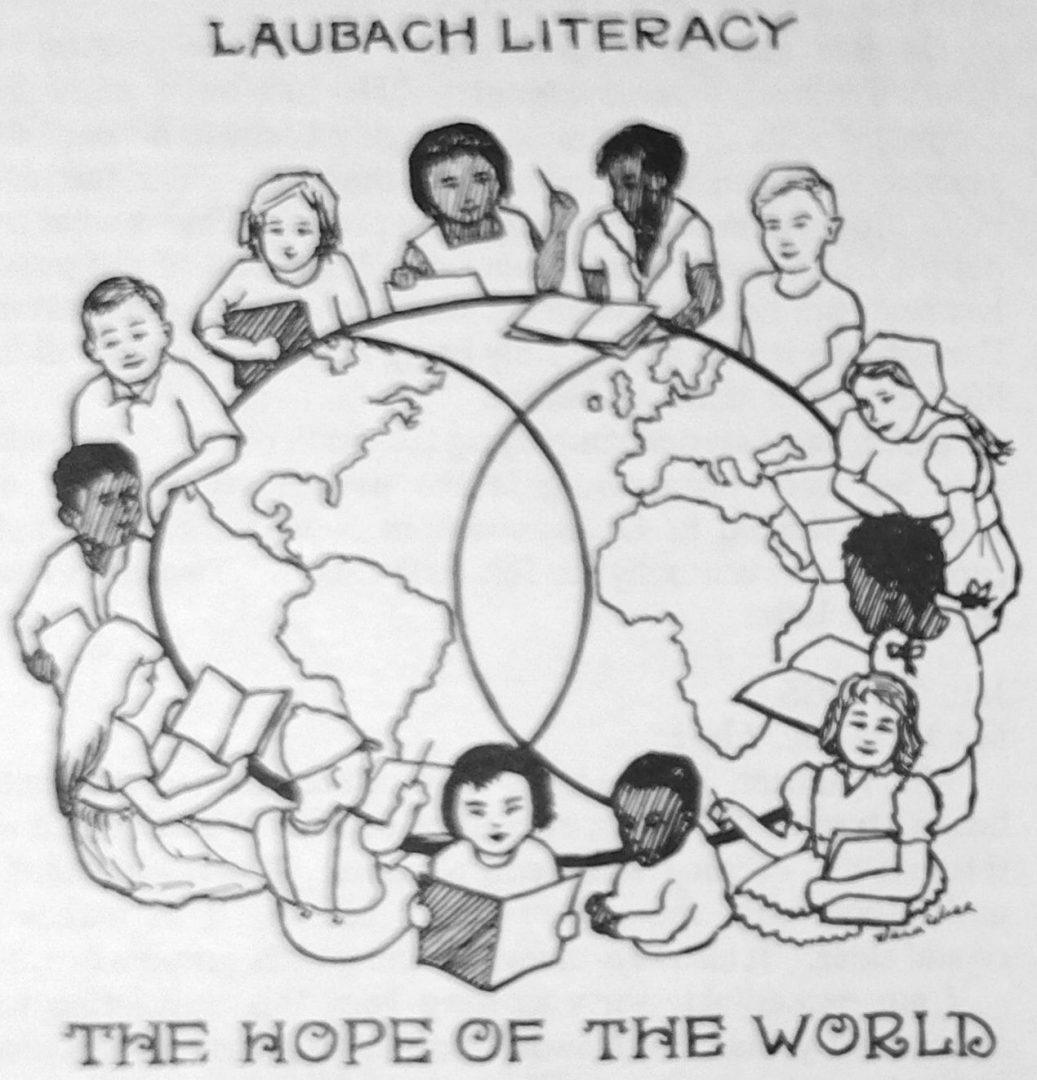
That was the beginning of Each One Teach One, the voluntary literacy movement that has reached to nearly every part of the globe. The Maranao leader did not have to kill a single person but, instead, millions of people around the world would eventually receive new life.
Frank Laubach lacked a year or so of being 50 years old when this crisis developed and was met in a way that only God could devise. He began his travels to all parts of the world, visiting more than a hundred countries, setting up the “each one teach one” plan, and devising new and simpler methods in over 300 different languages of teaching people to read. The Laubach method swept the world. The impact can only be measured by realizing the difference between a person not able to read, as contrasted with one who can, then multiplying this by the millions.
I am greatly indebted to Robert Laubach’s book, The Vision Lives On, for some of the details I have related.
Frank Laubach influenced Helen and me through his writings before we knew him personally, then through two work projects which were a part of his life.
The first book of Dr. Laubach’s that we ever read was small: Prayer, The Greatest Force in the World. Small in size but great in content. One has to read, and study, and practice its precepts to realize its power. We attempted to do that.
His Messages of a Modern Mystic was mind-stretching, soul-stretching, and powerful in a different way. Three short excerpts give just a suggestion of the flavor:
“A good Muslim ought to utter the sacred word of God every time he begins to do anything, to sleep, to walk, or even turn around. A good Muslim would fill his life with God. I fear there are few good Muslims.” (Laubach adds that Christians should do the same and that he fears there are few good Christians.)
“I am disgusted with the pettiness and futility of my unled self. . . . The sense of being led by an unseen hand which takes mine while another hand reaches ahead and prepares the way, grows on me daily.”
“We have got to saturate ourselves with the rainbows and the sunset marvels in order to radiate them. It is as much our duty to live in the beauty of the presence of God on some mount of transfiguration . . . as it is for us to go down where (people) grope, and grovel, and groan, and lift them to new life.”
Helen’s copy of Laubach’s Channels of Spiritual Power has nearly a third of the lines in many of the chapters underlined. She lived and lives by its precepts.
The first chapters of his Thirty Years with the Silent Billion is an amplified version of this brief sketch that I have given here. In the introduction, Lowell Thomas wrote of Laubach:
“By camel and canoe, jet, river boat, elephant, oxcart and shanks’ mare, he has been a unique missionary with a world-wide parish. . . . He has been called the foremost teacher of our times . . . here is the thrilling story of a man who has had the courage to attempt the impossible and make it seem possible.”
Helen and I were involved in two work projects in which we became associated with this man of miracles and hard work.
We first heard and met Dr. Frank Laubach some 35 years ago when he delivered an address at the First United Methodist Church in Pasadena, California. I still feel it is the most inspiring speech I have ever heard, not only for what he said but because of the absolute conviction with which he said it.
“We need volunteers,” he explained in essence, “not only for teaching, but for many other tasks as well. We need people to help make simplified translations of the Bible. I have simplified some of the chapters. Volunteers have worked on others. But much of the Bible still needs translation into simplified English, so our new readers, using the Laubach method, can read and understand it.”
Next day I had a long conference with Dr. Laubach in his hotel room. There are luxury hotels in Pasadena, but he was staying at an inexpensive one, in a small and simple room.
“The Book of Job is a vital chapter in the Bible,” he explained, as we searched for ways I could help. “In a simplified form it would be inspirational reading for millions.” I took on the task of translating Job into simplified English. Actually this did not end the way that either he or I intended, but I learned much along the way, not only about Job and his problems, but about Laubach literacy.
My first stop in working on this new project was at the World Literacy headquarters in New York City, while I was on a lecture trip in the East. Dr. Frederick Rex and Miss Madeline Beckman gave much advice and material that would be helpful in the Book of Job simplification.
“But it will be helpful, too,” Dr. Rex explained, “to understand the psychology that must be used in working with, and teaching, the illiterate adults throughout the world.” In his discussion of these principles I learned much about the literacy process.
“The people being worked with are adults and are given credit for being adult,” he went on. “While they are illiterate, they are nonetheless intelligent. Their struggle for livelihood and existence under adverse conditions has strengthened their physical powers and sharpened their intellectual powers.”
He explained to me that a common practice of teachers dealing with children in America is to teach by pointing out errors, having the children correct their errors and thus progress. “With sensitive adults in foreign lands,” he cautioned, “this can be a fatal method. As adults they are deeply sensitive to the fact that they cannot read. The least bit of criticism will often touch their sensitivity to such an extent that they will freeze up against the idea of trying to learn. A dozen extraneous excuses will be given, but the real reason is that they are ashamed or hurt.”
Dr. Rex then went on to reveal one of the reasons for Frank Laubach’s achievements. “He has been so highly successful with all these peoples largely because he uses the positive approach, absolutely and all the time. With the least bit of progress he will give inordinate praise. That is what the people need, and it spurs them on. When one of the pupils has read the first simple story, it is treated as a great event. For actually it is; a person truly being able to read who all his life had never done so before.”
Helen and I started simplifying the Book of Job. To make sure we were progressing in the proper style I sent an extensive sample to Dr. Laubach in New York. No reply came, and we eventually put Job on the shelf. Two years later came this letter:
Jan. 21, 1956
My Dear Mr. Line:
Mrs. Laubach found a letter today which you had written to her in March 1954, with a translation of Job. I have read it all through this evening with keen pleasure. I never felt that I understood what the poetry meant before. This makes it crystal clear. It also says the whole thing with genuine beauty.
I am exceedingly sorry to have kept this translation for almost two years. I am away from home nearly all the time and get a look at only a small fraction of the things that come through the mail. Please forgive me.
God bless you and give you
courage and perseverance
(signed Frank C. Laubach)
Helen and I had gained so much in our intense study of Job that we felt rewarded just by that. Five or six years later Dr. Laubach came down to our home in Capistrano Beach to spend a couple of days planning literacy work in this area.
Helen became a literacy teacher. She and Mrs. Barnes, wife of the newly-appointed Presbyterian minister in San Clemente, went out into the agricultural fields nearby. Mrs. Barnes was fluent in Spanish.
“Would you like to learn to speak English?” she would ask the Mexican field laborers. “Come up to Helen Line’s house tonight and we will start a class.”
They came, eventually by the dozens. From the fields came the Mexican men. From homes where they were working as servants came Mexican women—most of them beautiful young girls. A sprinkling of other nationalities joined in as well—Japanese, Polish, Ecuadorian. There were classes once a week and parties—social gatherings—usually once a month. One Fourth of July evening, when they all gathered to watch the San Clemente fireworks display visible from our living room, some of the men brought their guitars, and the ladies brought their lovely soprano and alto voices. We all went outside, overlooking the ocean, to see the fireworks better. Songs and music filled the air, and neighbors flocked in to share in the delightful music.
More teachers were needed. Helen took a course in instructing new volunteers to fill this need. She taught a dozen or so in our home, then was asked to go into South Central Los Angeles to train teachers there. Some of the Mexican and other foreign students who gathered at our home, and some of the 200 teachers in Los Angeles who Helen enlisted and taught, are today—and have been for years—our most cherished friends.
We are indebted to Frank Laubach for the inspiration of his life, the enlightenment that has come from the reading of his books, the enduring memories of having known him, and the scores of friendships that have enriched our lives in connection with Helen’s work in teaching literacy and training literacy teachers. The rewards will never end.
Nearly all of Laubach’s great work in literacy took place after his 50th birthday. That fact alone is an inspiration.
Since this book is about Super Seniors, some of them in their 90s, and since Frank Laubach loved humor and relished telling a good story, I cannot refrain from closing this chapter by relating one of his favorite jokes.
Two men were walking past the gate of a cemetery. “How old are ye, Jake?” one man asked. “91,” came the answer. “And ye?” “93,” Sam replied. A slight pause, then Sam added, “It ain’t hardly worth going home, is it?”