
Chapter 21: A 65th High School Reunion
A Time for Reminiscing
A Talk Given by Francis R. Line
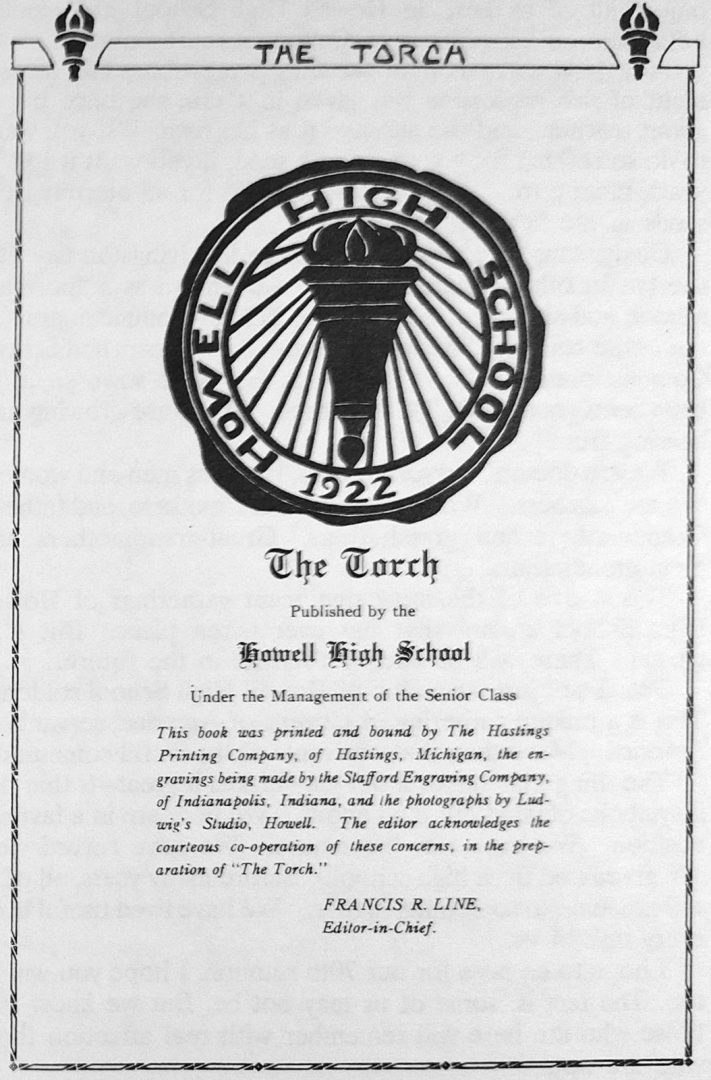
In September of 1987 my brother Winfield and I, both octogenarians, attended our 65th high school reunion of the Class of 1922 in the small town of Howell, Michigan. Of our original class of 56, 16 attended that gathering. We had invited members of the classes of 1923, ’24, and ’25 to join us. They had all been featured in the 1922 issue of our high school “Torch.” Of the original 241 members of the four classes, 75 were present. Dove Cook introduced me. To the group I gave this opening talk:
Thank you, Dove, for that flattering introduction. I want to start by asking a question. How many here today are octogenarians? Eighty years old! It does creep up. As Marshall McLuhan said: “The past went that-a-way.” Someone said, “Age is a matter of mind.” I think that means: “If you don’t mind, it doesn’t matter.”
People begin to show their age at about the same time they begin to show pictures of their grandchildren. Incidentally, I have a picture here of my great-grandson.
Seriously, when I turned 80, not quite four years ago, I wrote an article for an adventure magazine entitled, “Life Begins at 80.” There is much truth in that.
Grandma Moses started painting at 80 and kept going till 101.
Oliver Wendell Holmes was going strong as a justice of the Supreme Court at 90.
His father, Oliver Wendell Holmes, Sr., the poet, lived to 85. He wrote the “Wonderful One-Hoss Shay,” that lasted 100 years.
Michaelangelo, the great artist and sculptor, took up architecture at age 89.
At 93, George Bernard Shaw wrote an important play. At 89, Rubinstein gave one of his greatest recitals in New York’s Carnegie Hall. At 88, Pablo Casals was giving cello concerts.
Pablo Picasso was producing drawings and engravings when he was 90. Albert Schweitzer headed a hospital in Africa at 89 years of age.
Hulda Crooks just made world news two months ago by becoming the oldest woman ever to climb Mt. Fuji in Japan. She’s 91.
I think we should not ask “How old are you?” but rather, “How young are you?”
I admire Supreme Court Justice Hugo Black. His doctor told him he shouldn’t play tennis when he reached 40. He could hardly wait till he reached 50, so he could start playing again.
Consider this: You and I have spanned the years from “There’s a man in the moon” fantasy, to “Man on the moon” reality. From Around the World in 80 Days Jules Verne fiction, to “around the world in 80 seconds” communication.
We’ve spanned the years from carbon paper to copying machines, from scrub boards to electric washers, from roller skates to skateboards, from mud roads to freeways, from nickelodeons to television, from stereoptican slides to VCRs, from cap pistols to Star Wars.
We’ve experienced four great American mileposts: the hitching post, Emily Post, the Saturday Evening Post, and parcel post.
When we were young, for a nickel we could buy a newspaper and get three cents change. A phone call was five cents. For a dime we could buy a hamburger with all the trimmings. Fifty cents paid for a luscious meal including the tip. A five-and-ten-cent store was just that, with five thousand items to choose from. First-class postage was two cents.
We were before singing commercials and air mail, before social security and the income tax.
Those of us in this room have grown up with changes. According to Bible records, Methuselah lived to be 969 years old. You and I have seen ten times as many changes in our 80 years as Methuselah did in his entire 969.
I was born just 17 days after the Wright Brothers made the world’s first heavier-than-air flight. Neither my birth, nor the Wright Brothers’ flight, was any big deal. The flight lasted a few seconds; the distance covered was less than the length of a present-day airplane.
But that flight changed history; revolutionized the world.
All of those changes have occurred in the lifetimes of most of us in this room.
Now for a thought that is a bit more profound.
Most of us in this room today are part of the 241-member student body that made up our four classes. We share the common bond of having attended and graduated from Howell High School.
We are that—but much more. For over half a century we have been part of the real fabric of our community and country.
Along with the rest of our 241 classmates, we have deeply touched the lives of millions of people. We have directly or indirectly influenced the lives of three generations of men and women all over America.
That’s not an exaggeration. You know the old jingle: Doctor, Lawyer, Merchant, Chief. Our four classes have had them all.
Medical Doctor Charles Platt. He was one of my closest friends in school.
Harold Strobel and Gerald Pelkey, Doctors of Dental Surgery.
Lawyer and Superior Court Judge Marvin Salmon. The scope of his influence has been enormous.
Merchant Winfield Line. He founded a chain of stores and was so successful that he’s now become a philanthropist.
Bankers, engineers, farmers, homemakers, administrators—all of those professions are represented by those of us in this room.
And then there are teachers. In my opinion, teaching is the most vital profession of all. Teachers influence young people often even more than parents do. That influence goes on and on.
Many of you here today have been teachers. I salute you all. Dove Cook had a rewarding career of 45 years in teaching. Vera Ikens taught 25 years. They influenced hundreds. During Margarette Bird’s 23 years of high school teaching she had Gerald Hulce and Howard Gaylor as pupils while in Roscommon, Michigan. Gerald became a high executive in the Johns Mansville Company and Howard in the National Association of Independent Insurance Agents. They frequently write or phone to thank Margarette for the influence she had on him.
All of you who are teachers have had more life-shaping influences than you will ever know, just as the teachers who taught all of us here in Howell High School had similar influences on us. Gladys McCallum is representative of all you who have carried on the teaching profession. Her assessment of this profession was given in a talk she once heard about teachers, and she adopted it as her own. “If you want to do something for a year, plant a seed; if you want it for 10 years, plant a tree. If you want to plant for an eternity, sow seeds in the heart of a child.”
Gladys taught in rural schools here in Livingston County, she taught other teachers in what was known as a “normal” school, and she eventually became School Commissioner for the entire county. She was a teacher for 40 years and School Commissioner for 17. “The seeds that were sown seem to have been good seeds,” Gladys says. “They are growing and bearing fruit.”
We are doctors, lawyers, nurses, business men and women. We are teachers. We are homemakers, mothers, and fathers. Grandmothers and grandfathers. Great-grandmothers and great-grandfathers.
This is one of the most significant gatherings of Howell High School alumni that has ever taken place. But it is typical. There will be such gatherings in the future.
This is not just a reunion of Howell High School students. This is a unique gathering of citizens of America, servants of America. More than that—servants of the world community.
The thing that makes it unique—makes it great—is that this is symbolic of what life is all about. We here are in a favored position. We have run the course. We have served well. We graduated from high school. Before many years, all of us will graduate to something higher. We have lived useful lives, every one of us.
I hope to be here for our 70th reunion. I hope you will be too. The fact is, some of us may not be. But we know that those who are here will remember with real affection those who are not.
I can truthfully say this: Every individual here has made a positive contribution to our society. Consider your own contribution—how much it has meant to your community, your church, your family, your fellow citizens, the world. Then multiply that by 241—the combined size of our four classes. The sum is enormous. We are quite a group.