
Lines on ’55
1955
November 1955
22nd annual letter · Indian Summer
Annual Letter · Francis and Helen Line
“For us, the year 1955 has been an Indian spring, and summer, and fall.” The Lines spent the year in Navajo and Hopi country by Jeep, including a remote four-day Navajo Sing.
22nd ANNUAL LETTER · HELEN AND FRANCIS LINE · 77 PATRICIAN WAY, PASADENA · NOV. 1955
INDIAN SUMMER
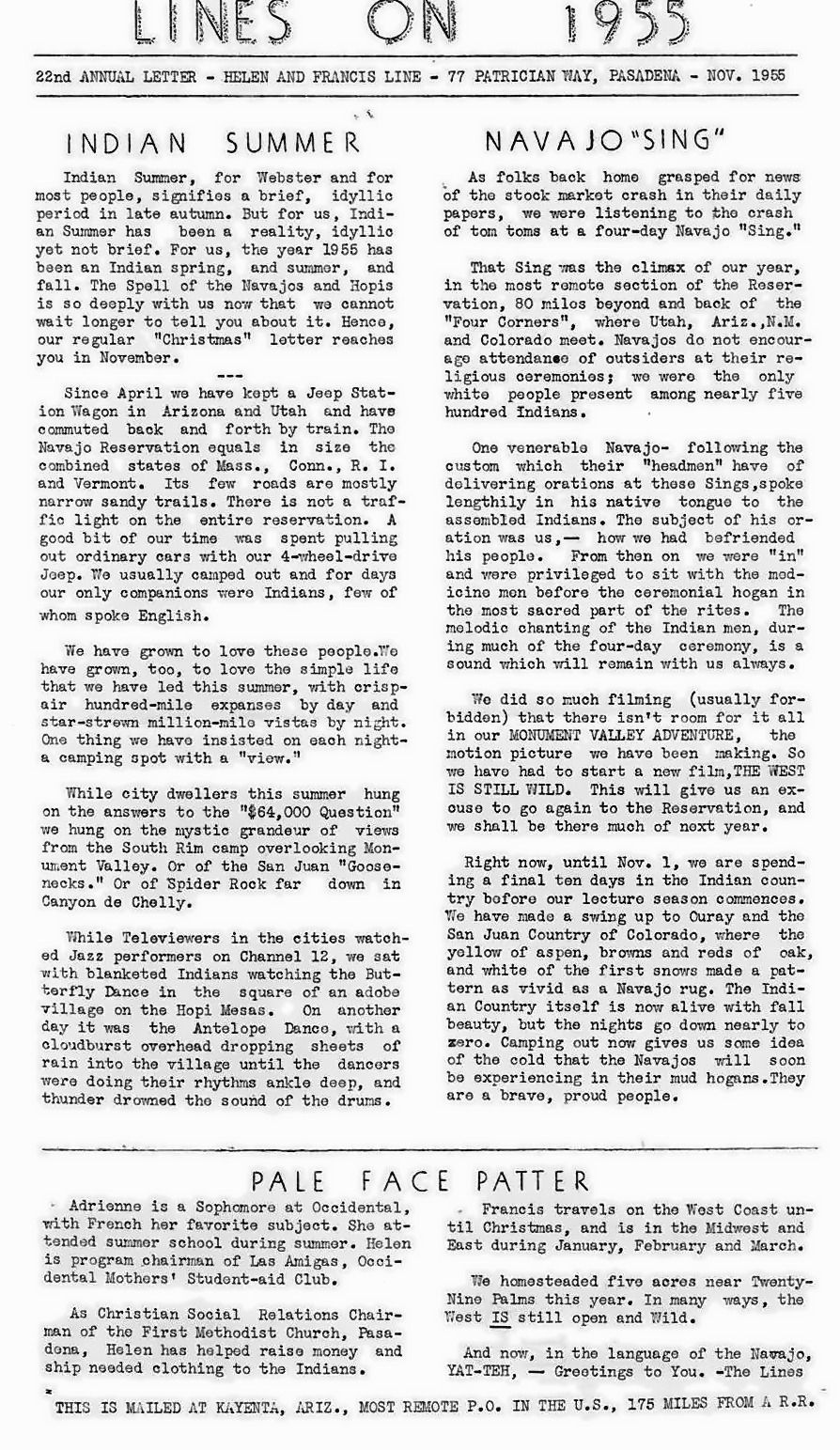
Indian Summer, for Webster and for most people, signifies a brief, idyllic period in late autumn. But for us, Indian Summer has been a reality, idyllic yet not brief. For us, the year 1955 has been an Indian spring, and summer, and fall. The Spell of the Navajos and Hopis is so deeply with us now that we cannot wait longer to tell you about it. Hence, our regular “Christmas” letter reaches you in November.
Since April we have kept a Jeep Station Wagon in Arizona and Utah and have commuted back and forth by train. The Navajo Reservation equals in size the combined states of Mass., Conn., R. I. and Vermont. Its few roads are mostly narrow sandy trails. There is not a traffic light on the entire reservation. A good bit of our time was spent pulling out ordinary cars with our 4-wheel-drive Jeep. We usually camped out and for days our only companions were Indians, few of whom spoke English.
We have grown to love these people. We have grown, too, to love the simple life that we have led this summer, with crisp-air hundred-mile expanses by day and star-strewn million-mile vistas by night. One thing we have insisted on each night—a camping spot with a “view.”
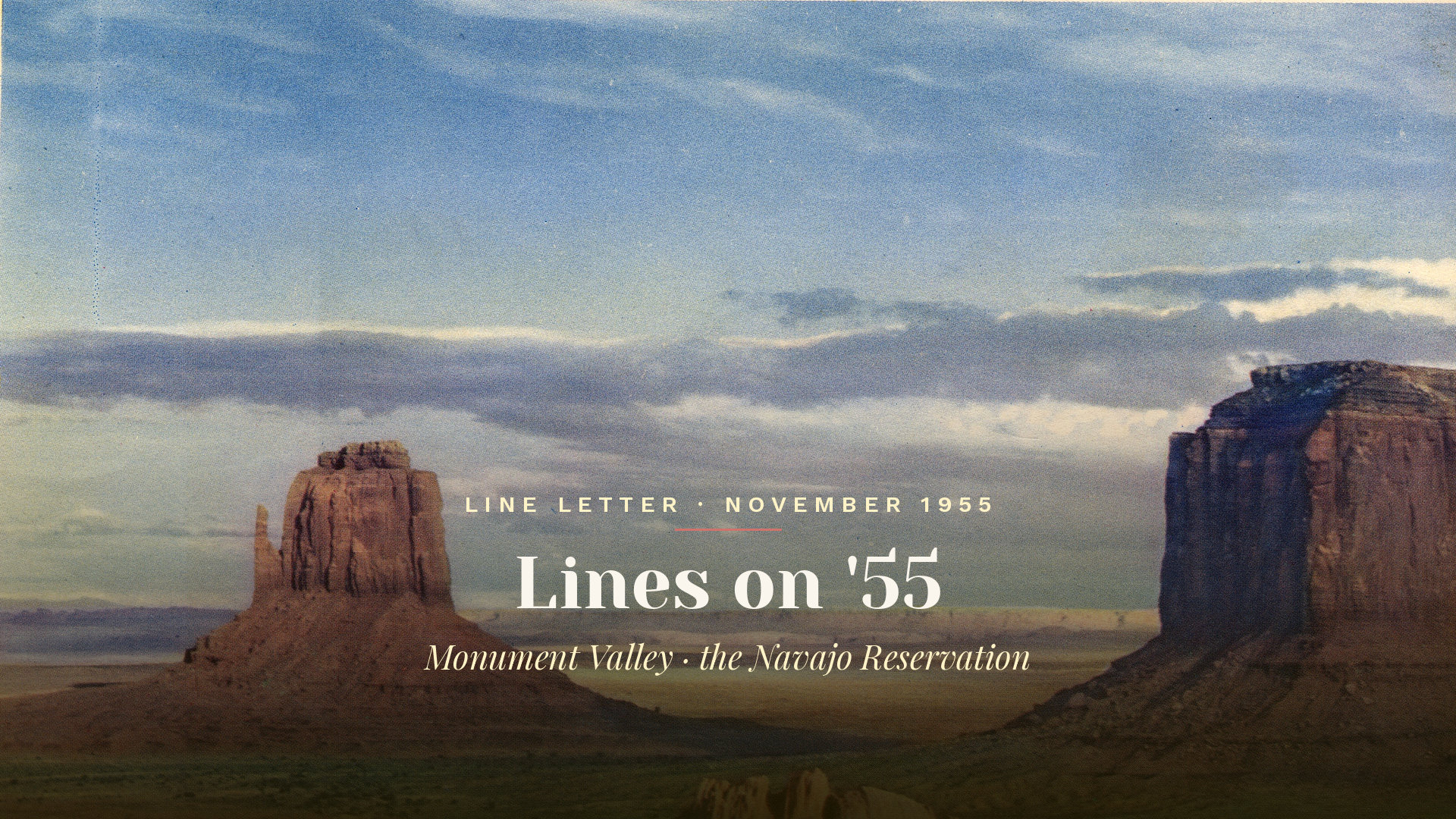
While city dwellers this summer hung on the answers to the “$64,000 Question” we hung on the mystic grandeur of views from the South Rim camp overlooking Monument Valley. Or of the San Juan “Goosenecks.” Or of Spider Rock far down in Canyon de Chelly.
For us, the year 1955 has been an Indian spring, and summer, and fall.
While Televiewers in the cities watched Jazz performers on Channel 12, we sat with blanketed Indians watching the Butterfly Dance in the square of an adobe village on the Hopi Mesas. On another day it was the Antelope Dance, with a cloudburst overhead dropping sheets of rain into the village until the dancers were doing their rhythms ankle deep, and thunder drowned the sound of the drums.
NAVAJO “SING”
As folks back home grasped for news of the stock market crash in their daily papers, we were listening to the crash of tom toms at a four-day Navajo “Sing.”
That Sing was the climax of our year, in the most remote section of the Reservation, 80 miles beyond and back of the “Four Corners”, where Utah, Ariz., N.M. and Colorado meet. Navajos do not encourage attendance of outsiders at their religious ceremonies; we were the only white people present among nearly five hundred Indians.
One venerable Navajo—following the custom which their “headmen” have of delivering orations at these Sings, spoke lengthily in his native tongue to the assembled Indians. The subject of his oration was us,—how we had befriended his people. From then on we were “in” and were privileged to sit with the medicine men before the ceremonial hogan in the most sacred part of the rites. The melodic chanting of the Indian men, during much of the four-day ceremony, is a sound which will remain with us always.
We did so much filming (usually forbidden) that there isn’t room for it all in our MONUMENT VALLEY ADVENTURE, the motion picture we have been making. So we have had to start a new film, THE WEST IS STILL WILD. This will give us an excuse to go again to the Reservation, and we shall be there much of next year.
Right now, until Nov. 1, we are spending a final ten days in the Indian country before our lecture season commences. We have made a swing up to Ouray and the San Juan Country of Colorado, where the yellow of aspen, browns and reds of oak, and white of the first snows made a pattern as vivid as a Navajo rug. The Indian Country itself is now alive with fall beauty, but the nights go down nearly to zero. Camping out now gives us some idea of the cold that the Navajos will soon be experiencing in their mud hogans. They are a brave, proud people.
PALE FACE PATTER
Adrienne is a Sophomore at Occidental, with French her favorite subject. She attended summer school during summer. Helen is program chairman of Las Amigas, Occidental Mothers’ Student-aid Club.
As Christian Social Relations Chairman of the First Methodist Church, Pasadena, Helen has helped raise money and ship needed clothing to the Indians.
Francis travels on the West Coast until Christmas, and is in the Midwest and East during January, February and March.
We homesteaded five acres near Twenty-Nine Palms this year. In many ways, the West IS still open and Wild.
And now, in the language of the Navajo, YAT-TEH,—Greetings to You.—The Lines
THIS IS MAILED AT KAYENTA, ARIZ., MOST REMOTE P.O. IN THE U.S., 175 MILES FROM A R.R.
From the original scan
PDF, 1 page, 2.7 MB
About this issue
The twenty-second letter. A year spent largely on the Navajo Reservation and the Hopi mesas, with a Jeep station wagon kept in Arizona and Utah, covering Monument Valley, Canyon de Chelly, Hopi dances, and a four-day Navajo “Sing.” Also new films and family news (“Pale Face Patter”).