
Line’s Hobby 1936 Christmas Edition
1936
Christmas 1936
Christmas 1936 · the series renamed from The Line-o-type
Line’s Hobby · Francis and Helen Line
A 10,000-mile summer through New England, Canada and Michigan, a look at Harvard’s new Houses and Bennington’s experiment, and the arrival of a second daughter, Adrienne June, born November 21, 1936.
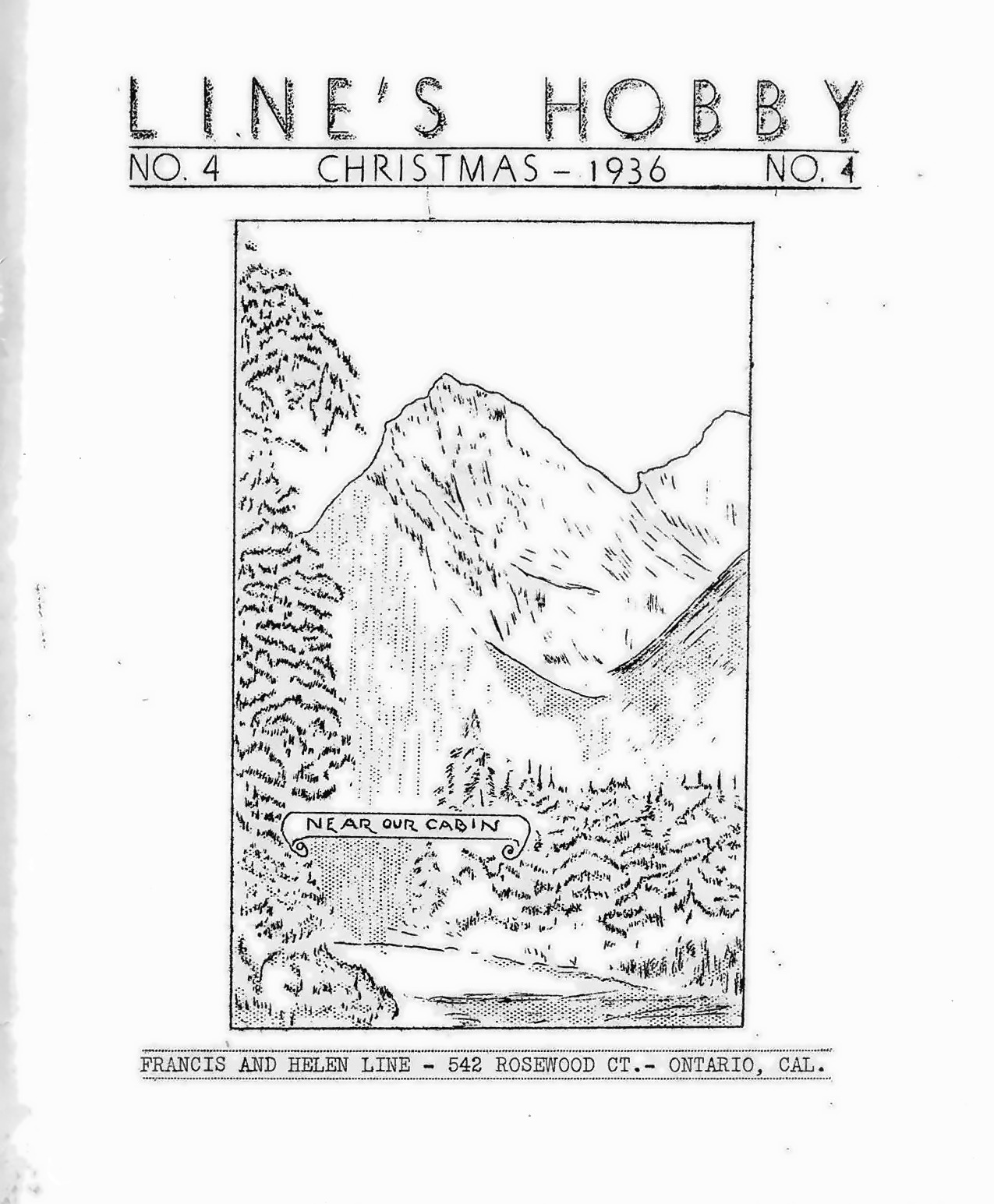
LINE’S HOBBY · NO. 4 · CHRISTMAS 1936
FRANCIS AND HELEN LINE · 542 ROSEWOOD ST. · ONTARIO, CAL.
[Cover drawing captioned “Near Our Cabin.”]
FROM THE SONG OF THE OPEN ROAD
"Afoot and light-hearted, I take to the open road,
Healthy, free, the world before me,
The long brown path before me, leading wherever I choose.

The earth—that is sufficient;
I do not want the constellations any nearer;
I know they are very well where they are;
I know they suffice for those who belong to them.

You road I enter upon and look around! I believe you are not all that is here.
I believe that much unseen is also here.

Here the profound lesson of reception, neither preference nor denial.
The black with his woolly head, the felon, the diseased, the illiterate person, are not denied;
The birth, the hasting after the physician, the beggar's tramp, the drunkard's stagger, the laughing party of mechanics,
The escaped youth, the rich person's carriage, the fop, the eloping couple,
The early market-man, the hearse, the moving of furniture into town, the return back from the town.
They pass—I also pass—anything passes—none can be interdicted;
None but are accepted—none but are dear to me.

The earth expanding right hand and left hand,
The picture alive, every part in its best light,
The music falling in where it is wanted, and stopping where it is not wanted,
The cheerful voice of the public road—the gay fresh sentiment of the road.

O public road! I say back, I am not afraid to leave you yet I love you;
You express me better than I can express myself;
You shall be more to me than my poem."
FRANCIS AND HELEN LINE
542 Rosewood Court
ONTARIO, CALIF.
Friends:
Does it seem to you, as to us, that Time rides each year in a speedier car? Christmas is rounding the bend again and the season is at hand for another of these annual pamphlet-greetings. Their publication has become an unbreakable habit with us—a Scotch habit if the truth were known.
For this folder serves, at each holiday time, a double purpose. It is our annual communication, without which we might (because of our negligence as letter-writers) lose all contact with our friends. It is our Christmas greeting card as well.
And this year, due to foresight and skilful planning, we have contrived to incorporate a third function. For this pamphlet serves—but that is a large story in itself which you can read in detail on page 17. Needless to say, it is a story which we’re delighted to tell. Our Christmas wish is that this news letter may convey to you some of the holiday joy that is ours.
We hope sincerely that you will write to us soon and tell us about yourselves and your activities during the past year. For, more than anything else, we like to hear from our friends.
A Joyous Christmas and a Bright New Year to you all!
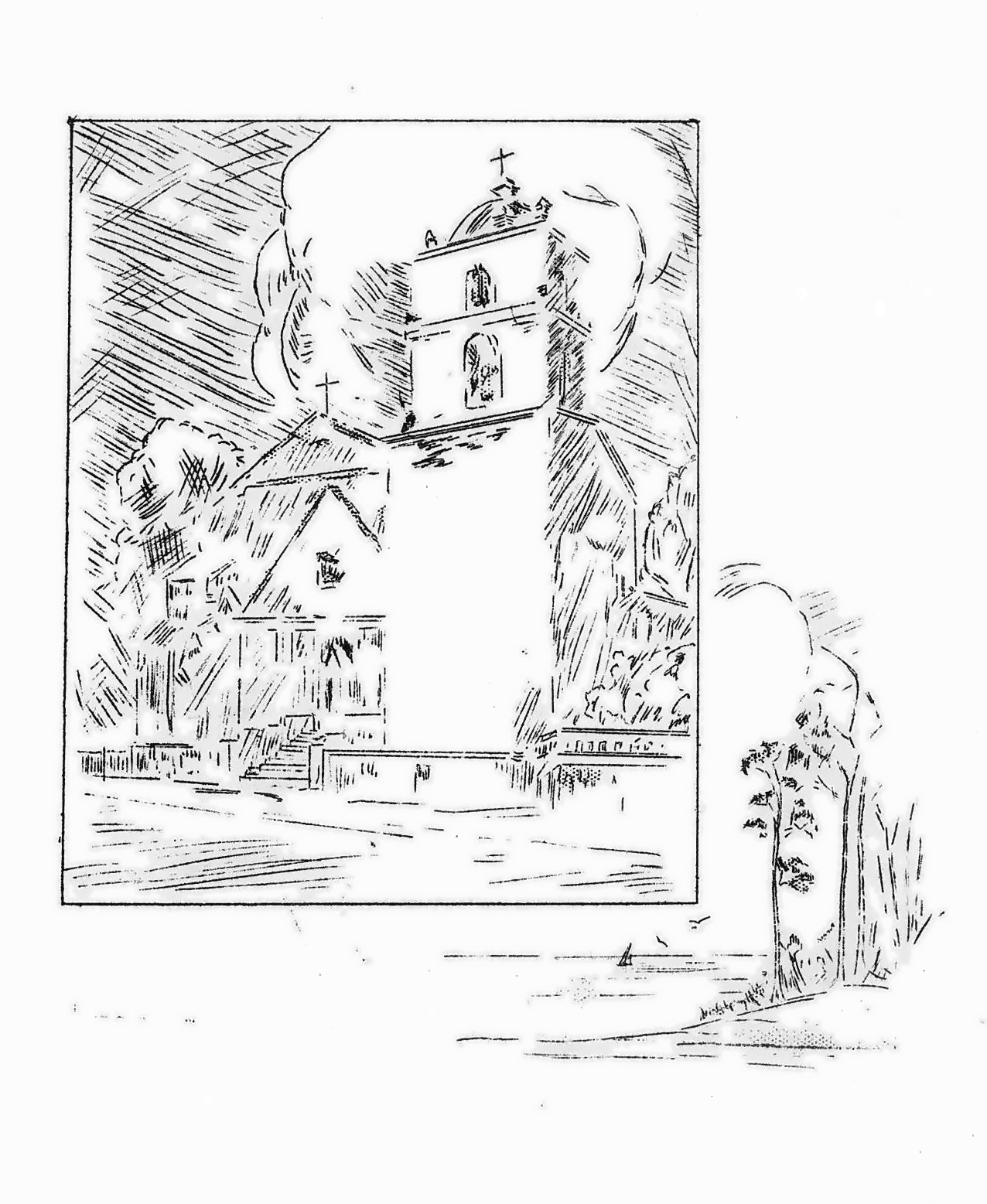
[Page 4: full-page drawing of a mission bell tower; no text (see scan)]
VACATION IN PILGRIM LAND
Some wise old scribbler once said of travel that “a sweet landscape must sometimes atone for an indifferent supper, and an interesting ruin charm away the remembrance of a hard bed.” Perhaps he was right. At all events, on the trip we took to Michigan, the East, and parts of Canada this summer, we saw many a hot day and missed many a night’s rest; yet forgot all about them in our elation at viewing new places and absorbing new experiences.
New York, we discovered, is more like a Jack and the Beanstalk each time we see it. Radio City had sprung up during our five-year absence; Pulaski Skyway had been built as a metropolitan approach from Jersey; the Tri-borough Bridge had been laid out—a huge traffic octopus—up near the Bronx. New York seems to be the easiest city in America in which to drive a car and we cruised the length of Manhattan three times in one day. Of all our fleeting impressions of this city, one in particular stands out. Barbara (whose uncle was foreman of a western cattle ranch) saw a mounted policeman in the thick of Fifth Avenue traffic. “Oh, Mamma,” she cried out. “There’s a cowboy.”
In Boston we took an apartment for two weeks and, in doing the city, spent the first week seeing the sights and the second week absorbing atmosphere. The former is a job, the latter is a pleasure. The former consists in not missing the plaque marking the site of Boston’s Tea Party or Franklin’s birthplace or the Old State House or the Old South Church. It consists of seeing places simply for the sake of seeing.
But the latter—that is real travel. It means jostling excited, voluble masses of humanity at the Saturday vegetable markets hard by historic Faneuil Hall. It means poking of an evening through narrow ‘Change Alley or floating in a swan boat on the moonlit lake in the Public Gardens by Boston Common. It means going back a third time just to sit for a long while before a grand picture which we especially liked in the art gallery. Best of all, it means strolling through tiny Louisburg Square on a Sunday afternoon.
Louisburg Square is a bit of old London tucked away in the Heart of Boston. It is but a block from the thick of traffic but as quiet as a mews near Earls Court. When we walked before the century-old doorways, shaded by trees in the parkway, it was thrilling to say: “Here at No. 4 William Dean Howells lived when he was editor of the Atlantic; here at No. 10 was the last home in Boston of Louisa Alcott—the house where her father died; and at No. 20 Jenny Lind was married.” We could point close by to the residences of Charles Francis Adams, Ellery Channing, Richard Henry Dana. Yes, Louisburg Square was the finest thing that Boston offered. Some day we hope to go back to live there for a while.
Cape Cod was like an old friend, for we had been there once, but Cape Anne was a new acquaintance. It is small; a 15-mile drive will encircle the whole cape. The road follows the rock-girded coast, to drop down into a charming harbor village one instant and the next to dodge back into a quiet weathered town with all the romance of centuries clinging to it. At the neck of the cape stands Gloucester, famed for its bronze statue to “The Men Who Go Down to the Sea in Ships.” Fishermen winding their nets, boats thick in the tiny harbor, smell of cod from the wharves and fish houses—that is Gloucester.
Maine was a mass of tourists, almost too crowded for full enjoyment; the White Mountains of New Hampshire were like the illustrations from a fairy story; Montreal was a hodge-podge of ugliness sitting in the lap of beauty.
One night, in the wooded country south of Ottawa, we came to a large river named the “Mississippi.” The name caught our fancy and we stopped for the night in a lodge at the river’s edge. The folks were friendly but not overburdened with this world’s knowledge; the owner of the lodge had grown to manhood before learning that there was any other Mississippi River in the world beside his own. We walked across the bridge to a primitive store which served the surrounding area as merchandise mart and post office. Within was a room dimly lit by a kerosene lamp, shedding its oily glow over the shelves of dusty goods. The postmistress, a woman whose hopes of beauty were lost in a frowse of unkempt hair, sat on a stool with a six-weeks baby in her lap. Child in arms, she sold us some post cards and we visited with her as we stooped near the lamp to write them. Then we returned to our room and were nursed to sleep by the sound of the waters in the rapids of Canada’s Mississippi.
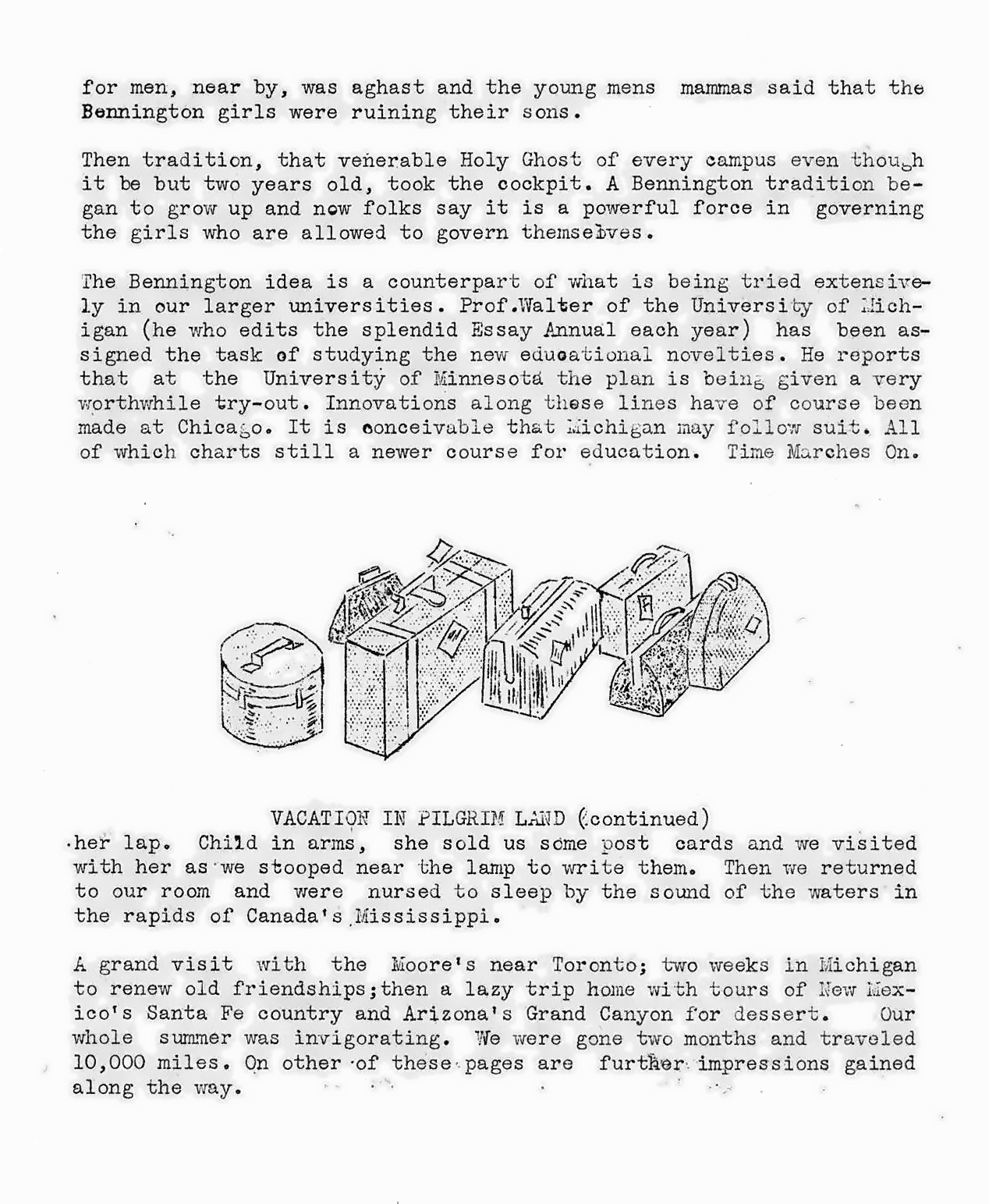
A grand visit with the Moore’s near Toronto; two weeks in Michigan to renew old friendships; then a lazy trip home with tours of New Mexico’s Santa Fe country and Arizona’s Grand Canyon for dessert. Our whole summer was invigorating. We were gone two months and traveled 10,000 miles. On other of these pages are further impressions gained along the way.
MONDAY MORNING GOSSIP
We had a splendid visit this summer with one of my teachers of high school days—Mrs. Agnes Moreland of Birmingham, Mich. We also called on another former Howell teacher, Katherine Ruggles, of Ruggles Beach, Ohio.
I am attending a Mens Bible Class in Upland under the leadership of Dr. Merton E. Hill, who is associated with the University of California. The discussion led by him each Sunday is a stimulant for [sentence breaks off here in the original]
The Berggrens of Long Beach are sporting a new car, a Christmas gift from her father…..Edith Line is attending school in Hollywood. Everytime her parents have been over from Phoenix to see her we have missed them…..But we were lucky in finding Charlie Line and his wife and four fine girls home in the east this summer.
We haven’t heard from Lewis Nooney for so long that we scarcely know what has become of him. That goes for Helen Case too, but I guess we are partly at fault in the latter instance. It is so hard to write letters!
But we did hear from Walter Noble and the news he told was good. His wife, librarian in the Santa Barbara library, is recovering nicely from a recent operation.
This pamphlet is written, set up, and run off by yours truly without assistance. We had been infanticipating our blessed event for a week later and the consequent rush has been considerable.
EDITORIAL: Last year any number of friends sent beautiful Christmas cards to us—but failed to include their addresses anywhere on the card or envelope. The principal purpose of a Christmas card is to let others know your whereabouts. An address is essential.
Rev. Moore of Youngs Point has a fine new river cottage. He built it himself…..The Foxes of Sepulveda are so busy at their building trade they can scarcely keep up with demands on them…..the Ray Jewells have sold their Michigan farm and will head west in the spring. We hear a rumor that the Nichols are likewise headed this way.
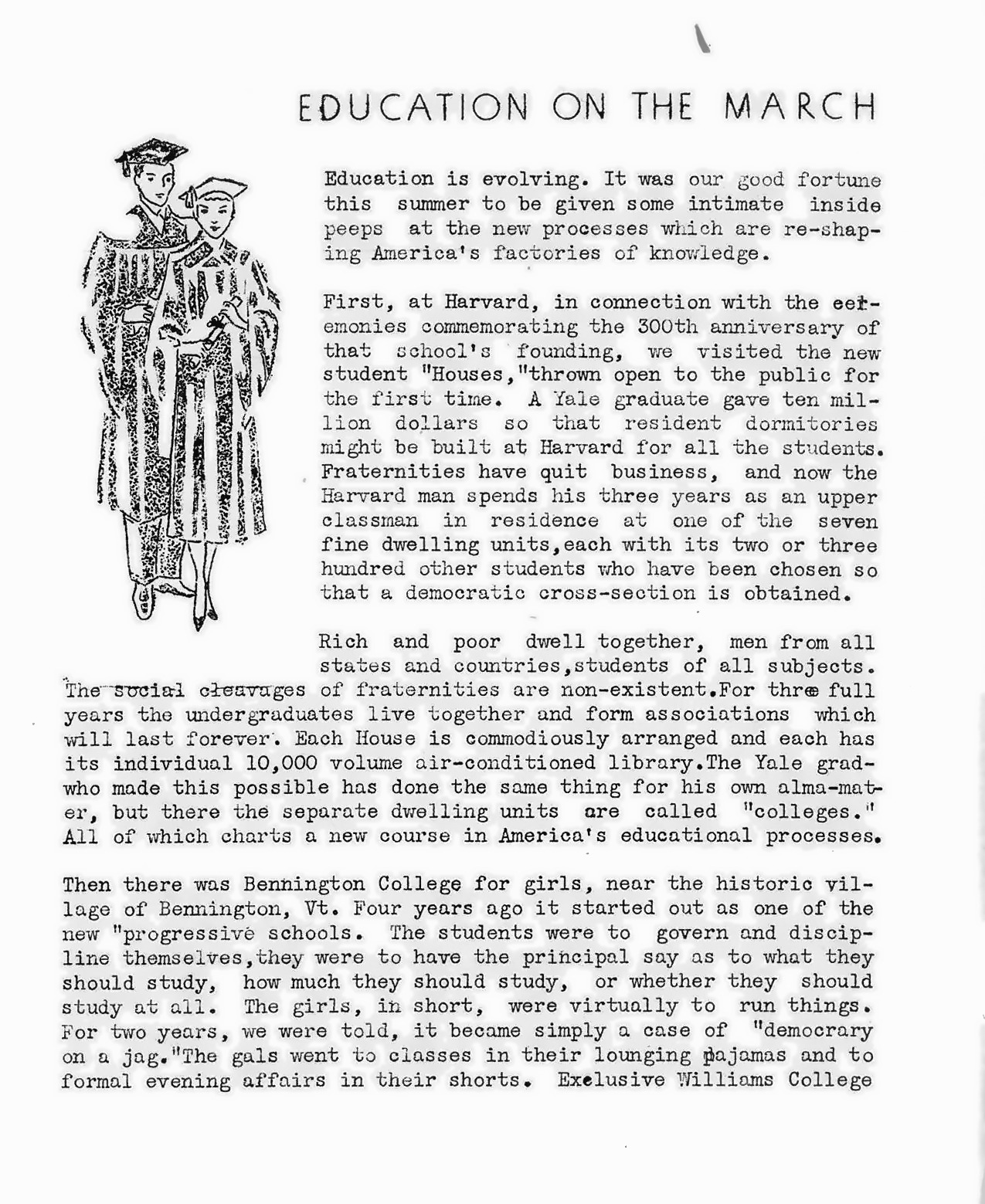
EDUCATION ON THE MARCH
Does it seem to you, as to us, that Time rides each year in a speedier car?
Education is evolving. It was our good fortune this summer to be given some intimate inside peeps at the new processes which are re-shaping America’s factories of knowledge.
First, at Harvard, in connection with the ceremonies commemorating the 300th anniversary of that school’s founding, we visited the new student “Houses,” thrown open to the public for the first time. A Yale graduate gave ten million dollars so that resident dormitories might be built at Harvard for all the students. Fraternities have quit business, and now the Harvard man spends his three years as an upper classman in residence at one of the seven fine dwelling units, each with its two or three hundred other students who have been chosen so that a democratic cross-section is obtained.
Rich and poor dwell together, men from all states and countries, students of all subjects. The social cleavages of fraternities are non-existent. For three full years the undergraduates live together and form associations which will last forever. Each House is commodiously arranged and each has its individual 10,000 volume air-conditioned library. The Yale grad who made this possible has done the same thing for his own alma-mater, but there the separate dwelling units are called “colleges.” All of which charts a new course in America’s educational processes.
Then there was Bennington College for girls, near the historic village of Bennington, Vt. Four years ago it started out as one of the new “progressive” schools. The students were to govern and discipline themselves, they were to have the principal say as to what they should study, how much they should study, or whether they should study at all. The girls, in short, were virtually to run things. For two years, we were told, it became simply a case of “democracy on a jag.” The gals went to classes in their lounging pajamas and to formal evening affairs in their shorts. Exclusive Williams College for men, near by, was aghast and the young mens mammas said that the Bennington girls were ruining their sons.
Then tradition, that venerable Holy Ghost of every campus even though it be but two years old, took the cockpit. A Bennington tradition began to grow up and now folks say it is a powerful force in governing the girls who are allowed to govern themselves.
The Bennington idea is a counterpart of what is being tried extensively in our larger universities. Prof. Walter of the University of Michigan (he who edits the splendid Essay Annual each year) has been assigned the task of studying the new educational novelties. He reports that at the University of Minnesota the plan is being given a very worthwhile try-out. Innovations along these lines have of course been made at Chicago. It is conceivable that Michigan may follow suit. All of which charts still a newer course for education. Time Marches On.
HIGHLIGHTS
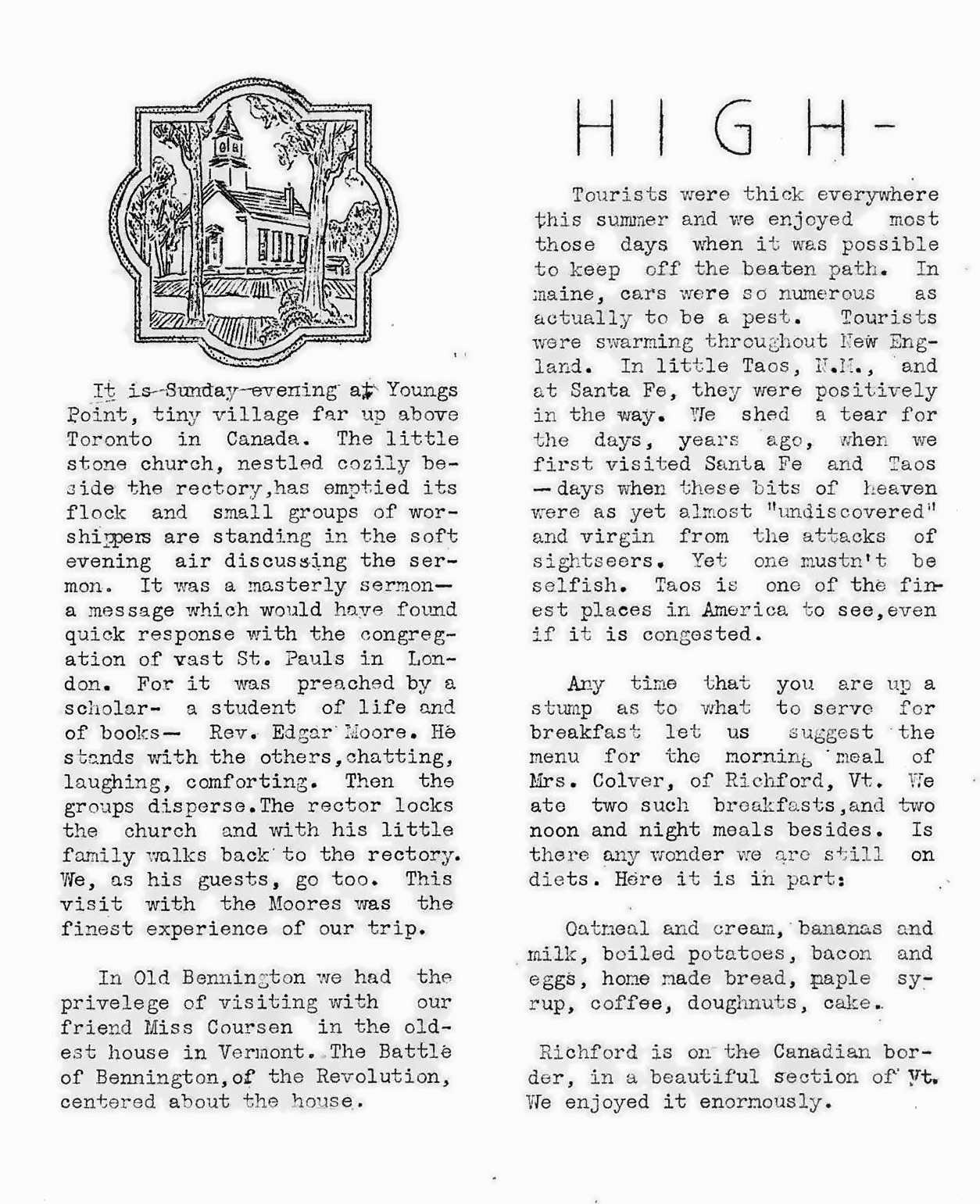
It is Sunday evening at Youngs Point, tiny village far up above Toronto in Canada. The little stone church, nestled cozily beside the rectory, has emptied its flock and small groups of worshippers are standing in the soft evening air discussing the sermon. It was a masterly sermon—a message which would have found quick response with the congregation of vast St. Pauls in London. For it was preached by a scholar—a student of life and of books—Rev. Edgar Moore. He stands with the others, chatting, laughing, comforting. Then the groups disperse. The rector locks the church and with his little family walks back to the rectory. We, as his guests, go too. This visit with the Moores was the finest experience of our trip.
In Old Bennington we had the privelege of visiting with our friend Miss Coursen in the oldest house in Vermont. The Battle of Bennington, of the Revolution, centered about the house.
Tourists were thick everywhere this summer and we enjoyed most those days when it was possible to keep off the beaten path. In Maine, cars were so numerous as actually to be a pest. Tourists were swarming throughout New England. In little Taos, N.M., and at Santa Fe, they were positively in the way. We shed a tear for the days, years ago, when we first visited Santa Fe and Taos—days when these bits of heaven were as yet almost “undiscovered” and virgin from the attacks of sightseers. Yet one mustn’t be selfish. Taos is one of the finest places in America to see, even if it is congested.
Any time that you are up a stump as to what to serve for breakfast let us suggest the menu for the morning meal of Mrs. Colver, of Richford, Vt. We ate two such breakfasts, and two noon and night meals besides. Is there any wonder we are still on diets. Here it is in part:
Oatmeal and cream, bananas and milk, boiled potatoes, bacon and eggs, home made bread, maple syrup, coffee, doughnuts, cake.
Richford is on the Canadian border, in a beautiful section of Vt. We enjoyed it enormously.
Things to see on the way to California…….Lincoln’s tomb at Springfield, Ill., with its collection of replicas of nearly every noted statue of Lincoln…..Hannibal, Mo., permeated with the never-fading atmosphere of Mark Twain, Huck Finn, and Mississippi River life…..Dodge City, Kansas, one-time toughest town in the west during the great days of the cattle drives. A statue of two steers bears on it this inscription: “My trails have become your highways. Seven million longhorns were marketed from Dodge City in the 70’s and 80’s.” Another statue, that of a jolly cowboy, reads: “On the ashes of my campfires this city was built.” And typical of the epitaphs on the graves of Boot Hill cemetery is this one: “Angel Face Kid. Ran for sheriff, 1871. Ran from sheriff, 1872. Shot in the back, 1872.”
Bethlehem, Pa. connotes steel mills to most folks, but it really has much more to make it interesting. The Moravians settled the city years ago and a church which they built in 1871 is as staunch as ever. In a cemetery by the church is buried Uncas, hero of Cooper’s Leather Stocking episodes. And at Bethlehem is Lehigh University.
Things which make Detroit one of America’s interesting tourist cities: Greenfield Village, Fords vast historical project in Dearborn; the Detroit “natural-life” zoo; Belle Isle; the great automobile factories.
Travel on the Union Pacific “Challenger” is always a high light. We went back by rail and picked up our car at Detroit. This is our second Challenger trip. Just picture clean, cool, air-conditioned coaches. No sign of dust or dirt, no noises of the rails, for the windows are double-sealed. Just imagine new soft reclining sponge-rubber seats. Visualize spacious rest rooms, separate cars for women, pretty stewardesses to wait on you. Smack your lips at the fine prospect of appetizing dining car meals for 25¢, 30¢, and 35¢. Breathe a Scotch sigh at thought of the cost of the trip—$34.50 from L.A. to Chicago. All this is the Challenger for you. Yes, railroads have seen the light.
NEWS NOTES ABOUT OUR FRIENDS
Mildred Pierce Wilkin had a water color hung in the L.A. exhibit of the California Water Color society.
Archie Fournier is now representative for Howell Red Band Motors for a vast district centering in Detroit.
Clare and Helen Gates write us from New Orleans. They attended a convention down there in line with Clare’s interesting extension work in public health at the Univ. of Mich.
Miss Claire Coursen had a quick, thrilling trip through Europe this fall. All this has happened since we saw her in Vermont in July.
Vera Wriggelsworth Ikens has a splendid new baby boy. It is one of the few babies I have ever seen that I thought was really attractive. We saw the fine three-year-old son, too, of Gus and Celia Nelson this summer. He’s a true Nordic, like his dad. Why don’t you write, Gus?
Spencer Jewell has been elected president of the L.A. County Christian Endeavor—one of the largest groups in the country. Spencer was married in June and the newlyweds had a honeymoon trip throughout the East. We have met the bride and she’s a dandy.
The Turners, our artist friends in Taos, are doing some fine modern symbolical paintings. If Mrs. Turner’s two pictures, “Horse Power” and “Spiral Nebulae” aren’t due for fame, we miss our guess.
Prof. and Mrs. Walter of Ann Arbor have purchased a new home on Michigan Avenue in that city. Its central feature is a book-lined study looking out onto the garden. We saw a number of Walter’s Essay Annuals, by the way, in the Upland, Calif. library recently.
Percy Jewell has been holding down three or four jobs all at one time with the Security-First National Bank of Glendale.
Our friend, Rev. Ralph Rohr, rector of the Ontario Episcopal Church, is to head the boys’ work at Voorhis Boys School near San Dimas. He takes the place of Jerry Voorhis who was recently elected to congress.
Ted Hornberger of the University of Michigan has a fellowship at Huntington Library near Pasadena. He and his fine family called on us the other day to reminisce on old times.
Winfield Line’s new air-conditioned, double-front store in Howell is one of the finest we have seen anywhere.
Mrs. Don Vowles—always active—is working for a master’s degree at Claremont Colleges. These colleges, incidentally, are due to be among the best in the West. Claremont is six miles from Ontario.
Joyce Berggren took a trip with her grandfather throughout the East this summer. Mighty splendid for a 9-year-old girl.
Frank and Vi Schroeder had a Yellowstone trip in June. Did we have a grand time at their place in New Jersey this summer? We did!
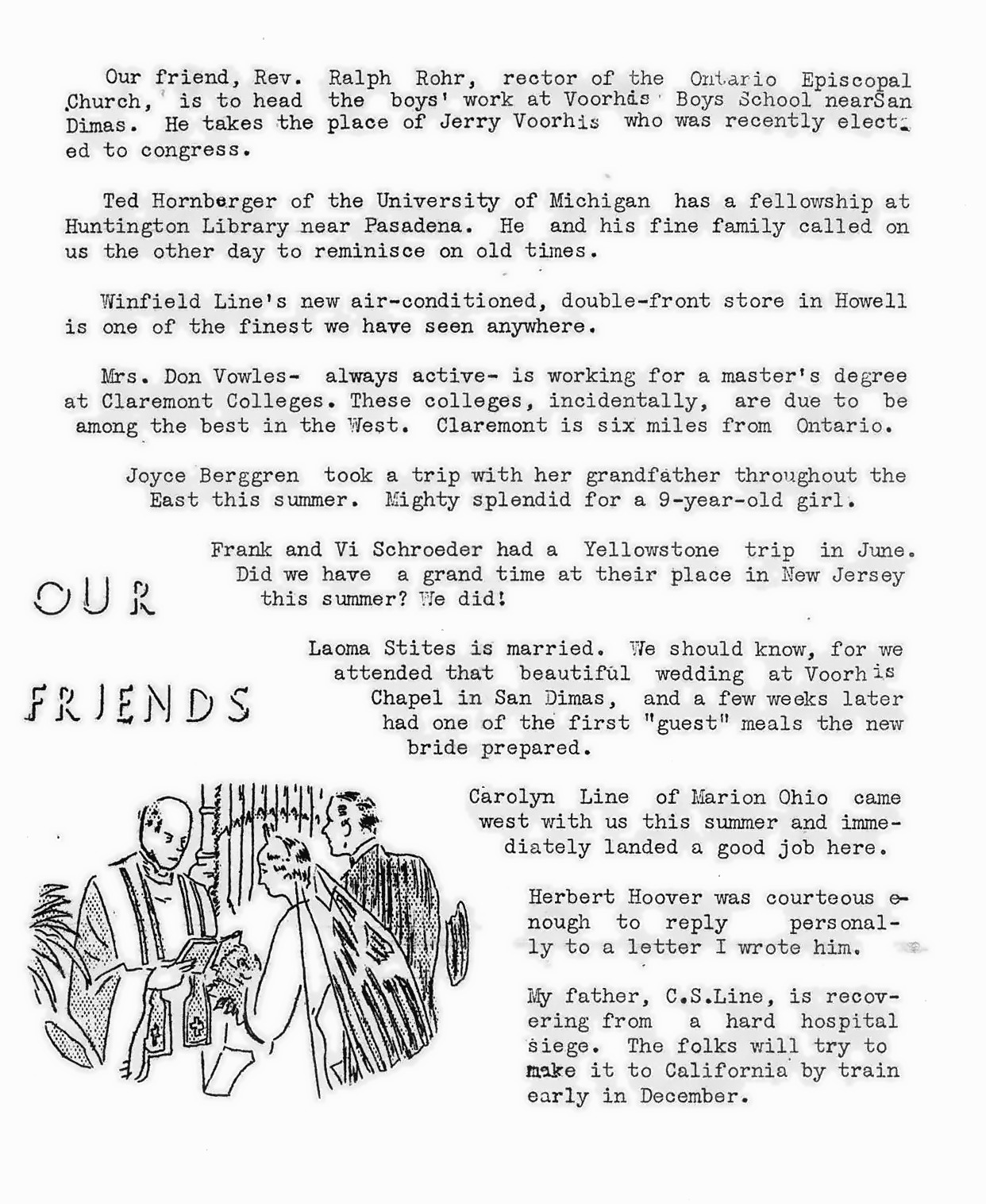
Laoma Stites is married. We should know, for we attended that beautiful wedding at Voorhis Chapel in San Dimas, and a few weeks later had one of the first “guest” meals the new bride prepared.
Carolyn Line of Marion Ohio came west with us this summer and immediately landed a good job here.
Herbert Hoover was courteous enough to reply personally to a letter I wrote him.
My father, C. S. Line, is recovering from a hard hospital siege. The folks will try to make it to California by train early in December.
WHAT’S YOUR HOBBY?
The name of this annual pamphlet has been changed from the hackneyed “Line-o-type,” under which it formerly sailed, to “Line’s Hobby.” For the publication of this folder, plus a variety of other local mimeograph adventures throughout the year, is really one of my principal hobbies or diversions.
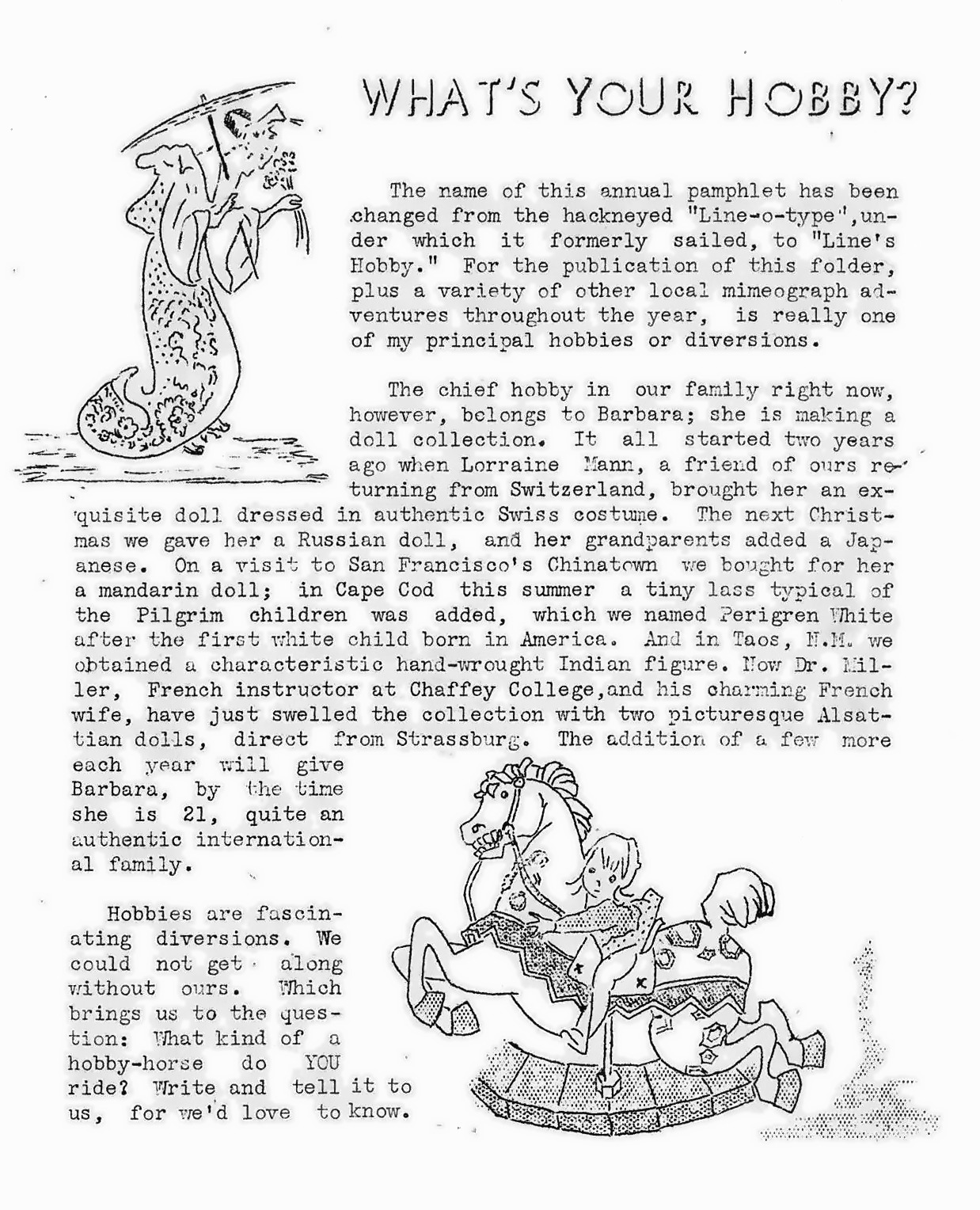
The chief hobby in our family right now, however, belongs to Barbara; she is making a doll collection. It all started two years ago when Lorraine Mann, a friend of ours returning from Switzerland, brought her an exquisite doll dressed in authentic Swiss costume. The next Christmas we gave her a Russian doll, and her grandparents added a Japanese. On a visit to San Francisco’s Chinatown we bought for her a mandarin doll; in Cape Cod this summer a tiny lass typical of the Pilgrim children was added, which we named Perigren White after the first white child born in America. And in Taos, N.M. we obtained a characteristic hand-wrought Indian figure. Now Dr. Miller, French instructor at Chaffey College, and his charming French wife, have just swelled the collection with two picturesque Alsatian dolls, direct from Strassburg. The addition of a few more each year will give Barbara, by the time she is 21, quite an authentic international family.
Hobbies are fascinating diversions. We could not get along without ours. Which brings us to the question: What kind of a hobby-horse do YOU ride? Write and tell it to us, for we’d love to know.
NEWCOMER NOTES
When we tell our friends that our second child is—like the first—a girl, many of them look embarrassed and seem hesitant to offer congratulations. To all of whom we reply, We are tickled to death that it is a girl. Before she arrived, we didn’t care which it was to be. But now that she is here, we wouldn’t trade Adrienne for a dozen boys. We are glad she is a girl.
At first, Barbara was disappointed. Everyone had told her she was going to have a baby brother, so upon hearing the news for the first time she cried bitterly. For she was worried that a little sister couldn’t use the room which had been set aside especially for a baby brother. But now she is supremely happy. She has seen Adrienne twice and says, “She surely is a darling, isn’t she Mamma.” And she promises to help her mother bathe and otherwise take care of her little sister.
Helen is doing splendidly. She entered the hospital at Upland on the 20th, so the 10-day stay there will be up by Nov. 30th. She will be up and around long before Christmas.
Three girls were born in the San Antonio Community Hospital at Upland on the night ours arrived. At the time of Barbara’s birth, four girls came in one night. That constituted something of a record for the local hospital and the story made the front-page.
During the 18-hours in the hospital when a newcomer arrives, mere man has a chance to see how brave a woman can really be.
Adrienne almost had a share in the big Roosevelt-Landon presidential campaign. So, as a hobby which she might like to adopt later, we have started for her a complete collection of campaign literature and stickers, both Republican and Democratic. It includes personal letters from Herbert Hoover, Alfred Landon, and Republican National Chairman John Hamilton. Such a collection, if kept up, is apt to be interesting in years to come.
We have made a traveler out of Barbara. Adrienne may be one too, at least if a 10,000 mile pre-natal journey by train and auto through 24 states has anything to do with it.
PERSONAL
The year 1936 has been a happy one for us. Chiefly it was marked by four centers of interest—our eastern trip, an extension to our house, Barbara’s continued development, and preparations for a new member of the family.
The eastern trip is described elsewhere. Our house enlargement consisted of the addition of two bedrooms. One of these I have made into a study for myself and the other Helen classifies as her sewing room; the wonder is that we ever struggled along without them in the past.
Barbara seems to have grown more during the past six months than during the whole previous year. She is now four (Nov. 28) and goes to music lessons five times weekly and dancing lessons four times a month. Her chief joys are to play hide-and-seek and to listen to the reading of poems. She is practicing her alphabet and jabbering nursery rhymes. I believe we have made a traveler of her—for she accompanies us on nearly all our trips.
The fourth center of interest has been largely Helen’s to deal with and she is becoming a slave to the knitting needles, having turned out this last two months a host of things for Barbara and the newcomer.
As to incidental diversions we have read little and been on the go a lot. Helen and Barbara have accompanied me on business trips throughout Southern California. We have taken in a number of the best movies, several art exhibits, the Landon rally and the Boulder Dam Light Festival in Los Angeles. We have found two fine new eating places—one in Riverside, the other in the city. Many of our friends have visited us and these occasions have been the most enjoyable events of the year. Nineteen thirty-six has been splendid; we are looking forward to ‘thirty-seven.
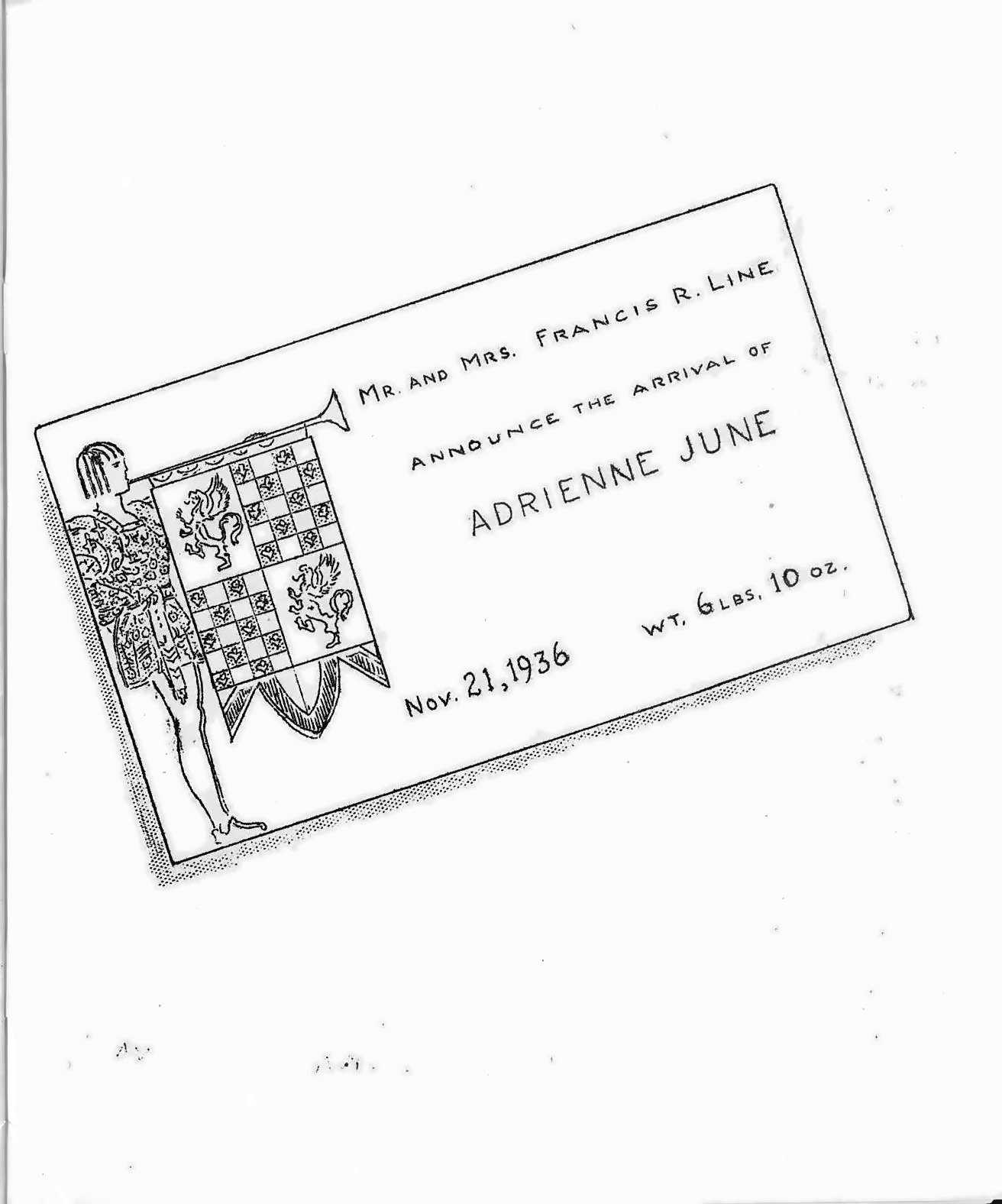
ANNOUNCEMENT
Mr. and Mrs. Francis R. Line announce the arrival of ADRIENNE JUNE
Nov. 21, 1936 · Wt. 6 lbs. 10 oz.
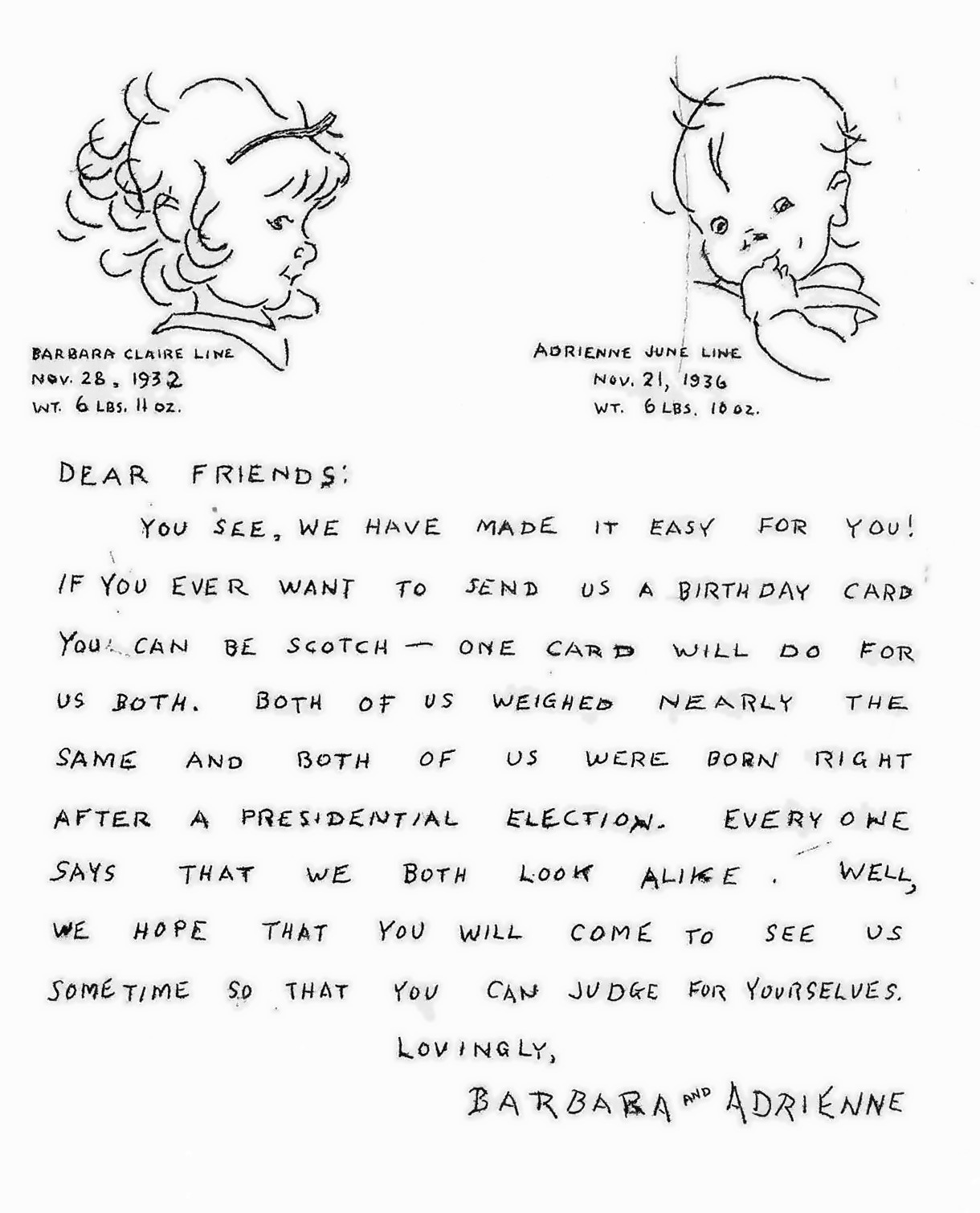
[Hand-lettered page with drawings of the two girls: “Barbara Claire Line, Nov. 28, 1932, Wt. 6 lbs. 11 oz.” and “Adrienne June Line, Nov. 21, 1936, Wt. 6 lbs. 10 oz.”]
DEAR FRIENDS:
You see, we have made it easy for you! If you ever want to send us a birthday card you can be Scotch—one card will do for us both. Both of us weighed nearly the same and both of us were born right after a presidential election. Everyone says that we both look alike. Well, we hope that you will come to see us sometime so that you can judge for yourselves.
Lovingly,
Barbara and Adrienne
THE DEW MAN
The Dew-man comes over the mountain wide,
Over the deserts of sand,
With his bag of clear drops
And his brush of feathers.
He scatters brightness.
The white bunnies beg him for dew.
He sprinkles their fur,
They shake themselves,
All the time he is singing
The unknown world is beautiful!
He polishes flowers,
Humming "Oh, beautiful!"
He sings in the soft light
That grows out of the dew,
Out of the misty dew-light that leans over him
He makes his song—
It is beautiful, the unknown world!
—A favorite with Barbara and me.
[Page 20: back page with a pen drawing of pine needles and cones; no text (see scan)]
About this issue
The first issue under the name “Line’s Hobby.” It covers a two-month, 10,000-mile trip east (New York, Boston’s Louisburg Square, Cape Ann, Maine, Montreal, Ontario’s Mississippi River), Harvard’s tercentenary and new student Houses, Bennington College, highlights from the road, news of friends, Barbara’s doll collection, and the announcement of Adrienne June Line’s birth. It opens with Whitman’s “Song of the Open Road” and closes with Hilda Conkling’s “The Dew Man.”