
Line’s Hobby 1937 Summer Edition
Number and date are inferred. The scan has no cover or masthead; the issue number and the summer 1937 date come from evidence inside the letter. The cover image is the letter’s first page.
1937
Summer 1937 (inferred)
Midsummer 1937 letter · cover missing from the scan
Line’s Hobby · Francis and Helen Line
A midsummer letter from Coronation year. It has a ninth wedding anniversary at the Brown Derby and “Tovarich,” Helen’s Coronation Dinner, Joe Louis in Ontario, movie-making in Chino, and a page of drawings of Barbara and Adrienne.
[The cover is missing from the surviving scan. The letter begins on the page headed “Dear Friends,” which appears fourth in the PDF; the pages are given here in reading order.]
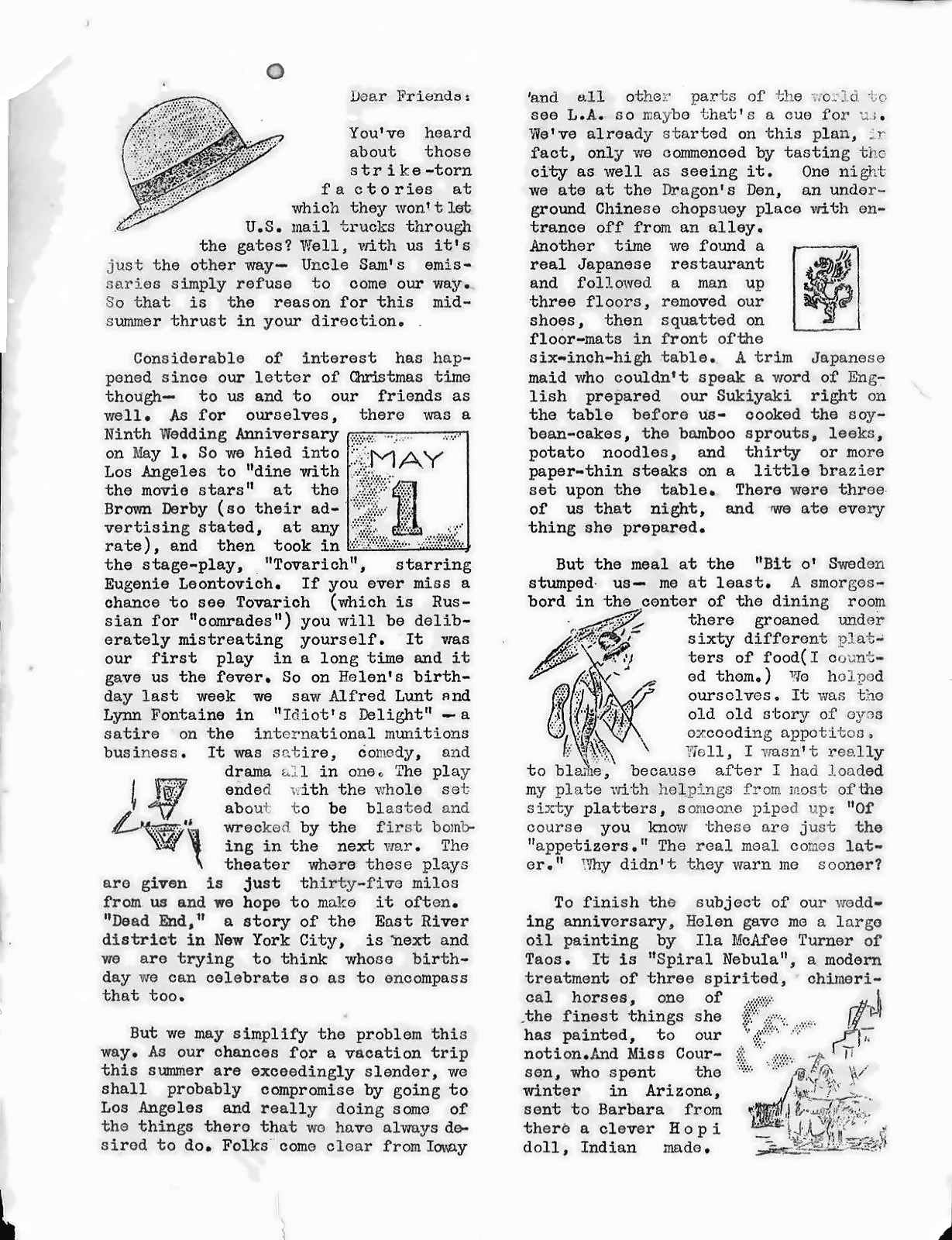
Dear Friends:
You’ve heard about those strike-torn factories at which they won’t let U.S. mail trucks through the gates? Well, with us it’s just the other way—Uncle Sam’s emissaries simply refuse to come our way. So that is the reason for this midsummer thrust in your direction.
Considerable of interest has happened since our letter of Christmas time though—to us and to our friends as well. As for ourselves, there was a Ninth Wedding Anniversary on May 1. So we hied into Los Angeles to “dine with the movie stars” at the Brown Derby (so their advertising stated, at any rate), and then took in the stage-play, “Tovarich”, starring Eugenie Leontovich. If you ever miss a chance to see Tovarich (which is Russian for “comrades”) you will be deliberately mistreating yourself. It was our first play in a long time and it gave us the fever. So on Helen’s birthday last week we saw Alfred Lunt and Lynn Fontaine in “Idiot’s Delight”—a satire on the international munitions business. It was satire, comedy, and drama all in one. The play ended with the whole set about to be blasted and wrecked by the first bombing in the next war. The theater where these plays are given is just thirty-five miles from us and we hope to make it often. “Dead End,” a story of the East River district in New York City, is next and we are trying to think whose birthday we can celebrate so as to encompass that too.
But we may simplify the problem this way. As our chances for a vacation trip this summer are exceedingly slender, we shall probably compromise by going to Los Angeles and really doing some of the things there that we have always desired to do. Folks come clear from Ioway and all other parts of the world to see L.A. so maybe that’s a cue for us. We’ve already started on this plan, in fact, only we commenced by tasting the city as well as seeing it. One night we ate at the Dragon’s Den, an underground Chinese chopsuey place with entrance off from an alley.
Another time we found a real Japanese restaurant and followed a man up three floors, removed our shoes, then squatted on floor-mats in front of the six-inch-high table. A trim Japanese maid who couldn’t speak a word of English prepared our Sukiyaki right on the table before us—cooked the soy-bean-cakes, the bamboo sprouts, leeks, potato noodles, and thirty or more paper-thin steaks on a little brazier set upon the table. There were three of us that night, and we ate every thing she prepared.
But the meal at the “Bit o’ Sweden” stumped us—me at least. A smorgasbord in the center of the dining room there groaned under sixty different platters of food (I counted them.) We helped ourselves. It was the old old story of eyes exceeding appetites. Well, I wasn’t really to blame, because after I had loaded my plate with helpings from most of the sixty platters, someone piped up: “Of course you know these are just the ‘appetizers.’ The real meal comes later.” Why didn’t they warn me sooner?
To finish the subject of our wedding anniversary, Helen gave me a large oil painting by Ila McAfee Turner of Taos. It is “Spiral Nebula”, a modern treatment of three spirited, chimerical horses, one of the finest things she has painted, to our notion. And Miss Coursen, who spent the winter in Arizona, sent to Barbara from there a clever Hopi doll, Indian made. Barbara is having to share her doll collection now with Helen, who wants to get a doll from every Indian tribe of the Southwest.
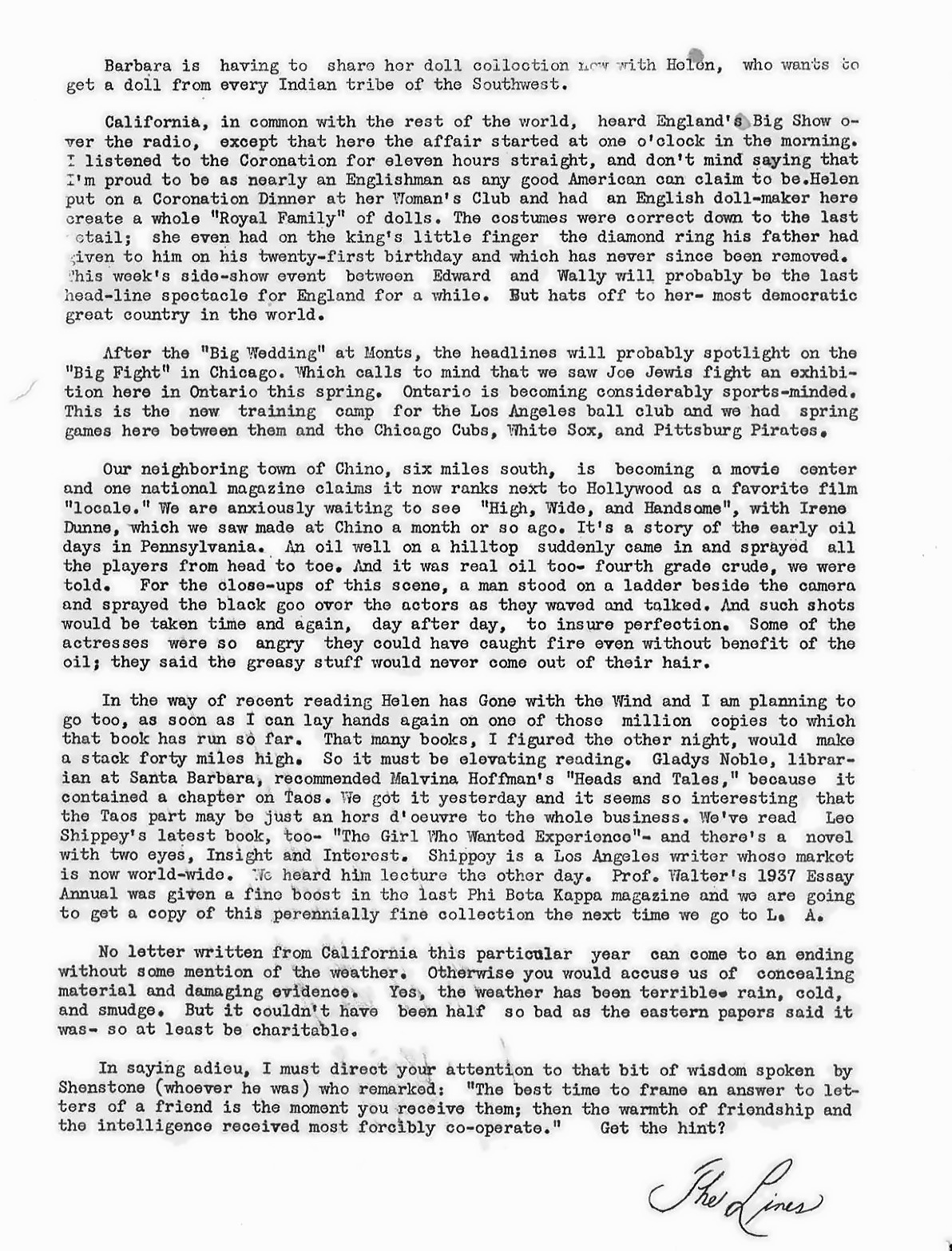
California, in common with the rest of the world, heard England’s Big Show over the radio, except that here the affair started at one o’clock in the morning. I listened to the Coronation for eleven hours straight, and don’t mind saying that I’m proud to be as nearly an Englishman as any good American can claim to be. Helen put on a Coronation Dinner at her Woman’s Club and had an English doll-maker here create a whole “Royal Family” of dolls. The costumes were correct down to the last detail; she even had on the king’s little finger the diamond ring his father had given to him on his twenty-first birthday and which has never since been removed. This week’s side-show event between Edward and Wally will probably be the last head-line spectacle for England for a while. But hats off to her—most democratic great country in the world.
After the “Big Wedding” at Monts, the headlines will probably spotlight on the “Big Fight” in Chicago. Which calls to mind that we saw Joe Louis fight an exhibition here in Ontario this spring. Ontario is becoming considerably sports-minded. This is the new training camp for the Los Angeles ball club and we had spring games here between them and the Chicago Cubs, White Sox, and Pittsburg Pirates.
Our neighboring town of Chino, six miles south, is becoming a movie center and one national magazine claims it now ranks next to Hollywood as a favorite film “locale.” We are anxiously waiting to see “High, Wide, and Handsome”, with Irene Dunne, which we saw made at Chino a month or so ago. It’s a story of the early oil days in Pennsylvania. An oil well on a hilltop suddenly came in and sprayed all the players from head to toe. And it was real oil too—fourth grade crude, we were told. For the close-ups of this scene, a man stood on a ladder beside the camera and sprayed the black goo over the actors as they waved and talked. And such shots would be taken time and again, day after day, to insure perfection. Some of the actresses were so angry they could have caught fire even without benefit of the oil; they said the greasy stuff would never come out of their hair.
In the way of recent reading Helen has Gone with the Wind and I am planning to go too, as soon as I can lay hands again on one of those million copies to which that book has run so far. That many books, I figured the other night, would make a stack forty miles high. So it must be elevating reading. Gladys Noble, librarian at Santa Barbara, recommended Malvina Hoffman’s “Heads and Tales,” because it contained a chapter on Taos. We got it yesterday and it seems so interesting that the Taos part may be just an hors d’oeuvre to the whole business. We’ve read Leo Shippey’s latest book, too—”The Girl Who Wanted Experience”—and there’s a novel with two eyes, Insight and Interest. Shippey is a Los Angeles writer whose market is now world-wide. We heard him lecture the other day. Prof. Walter’s 1937 Essay Annual was given a fine boost in the last Phi Beta Kappa magazine and we are going to get a copy of this perennially fine collection the next time we go to L. A.
No letter written from California this particular year can come to an ending without some mention of the weather. Otherwise you would accuse us of concealing material and damaging evidence. Yes, the weather has been terrible—rain, cold, and smudge. But it couldn’t have been half so bad as the eastern papers said it was—so at least be charitable.
In saying adieu, I must direct your attention to that bit of wisdom spoken by Shenstone (whoever he was) who remarked: “The best time to frame an answer to letters of a friend is the moment you receive them; then the warmth of friendship and the intelligence received most forcibly co-operate.” Get the hint?
The Lines
AQUATICS
It was our first play in a long time and it gave us the fever.
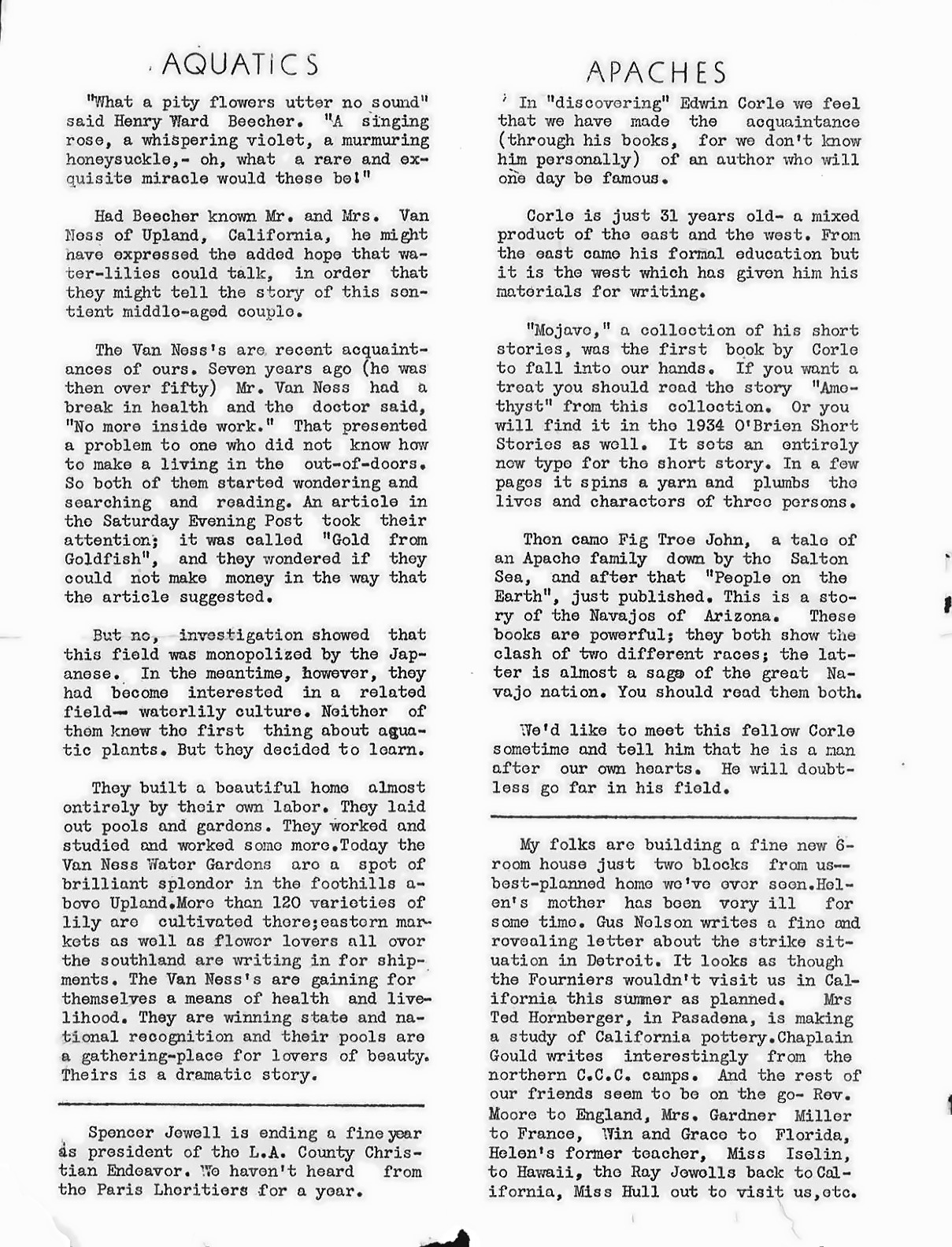
“What a pity flowers utter no sound” said Henry Ward Beecher. “A singing rose, a whispering violet, a murmuring honeysuckle,—oh, what a rare and exquisite miracle would these be!”
Had Beecher known Mr. and Mrs. Van Ness of Upland, California, he might have expressed the added hope that water-lilies could talk, in order that they might tell the story of this sentient middle-aged couple.
The Van Ness’s are recent acquaintances of ours. Seven years ago (he was then over fifty) Mr. Van Ness had a break in health and the doctor said, “No more inside work.” That presented a problem to one who did not know how to make a living in the out-of-doors. So both of them started wondering and searching and reading. An article in the Saturday Evening Post took their attention; it was called “Gold from Goldfish”, and they wondered if they could not make money in the way that the article suggested.
But no, investigation showed that this field was monopolized by the Japanese. In the meantime, however, they had become interested in a related field—waterlily culture. Neither of them knew the first thing about aquatic plants. But they decided to learn.
They built a beautiful home almost entirely by their own labor. They laid out pools and gardens. They worked and studied and worked some more. Today the Van Ness Water Gardens are a spot of brilliant splendor in the foothills above Upland. More than 120 varieties of lily are cultivated there; eastern markets as well as flower lovers all over the southland are writing in for shipments. The Van Ness’s are gaining for themselves a means of health and livelihood. They are winning state and national recognition and their pools are a gathering-place for lovers of beauty. Theirs is a dramatic story.
Spencer Jewell is ending a fine year as president of the L.A. County Christian Endeavor. We haven’t heard from the Paris Lhoritiers for a year.
APACHES
In “discovering” Edwin Corle we feel that we have made the acquaintance (through his books, for we don’t know him personally) of an author who will one day be famous.
Corle is just 31 years old—a mixed product of the east and the west. From the east came his formal education but it is the west which has given him his materials for writing.
“Mojave,” a collection of his short stories, was the first book by Corle to fall into our hands. If you want a treat you should read the story “Amethyst” from this collection. Or you will find it in the 1934 O’Brien Short Stories as well. It sets an entirely new type for the short story. In a few pages it spins a yarn and plumbs the lives and characters of three persons.
Then came Fig Tree John, a tale of an Apache family down by the Salton Sea, and after that “People on the Earth”, just published. This is a story of the Navajos of Arizona. These books are powerful; they both show the clash of two different races; the latter is almost a saga of the great Navajo nation. You should read them both.
We’d like to meet this fellow Corle sometime and tell him that he is a man after our own hearts. He will doubtless go far in his field.
My folks are building a fine new 6-room house just two blocks from us—best-planned home we’ve ever seen. Helen’s mother has been very ill for some time. Gus Nelson writes a fine and revealing letter about the strike situation in Detroit. It looks as though the Fourniers wouldn’t visit us in California this summer as planned. Mrs. Ted Hornberger, in Pasadena, is making a study of California pottery. Chaplain Gould writes interestingly from the northern C.C.C. camps. And the rest of our friends seem to be on the go—Rev. Moore to England, Mrs. Gardner Miller to France, Win and Grace to Florida, Helen’s former teacher, Miss Iselin, to Hawaii, the Ray Jewells back to California, Miss Hull out to visit us, etc.
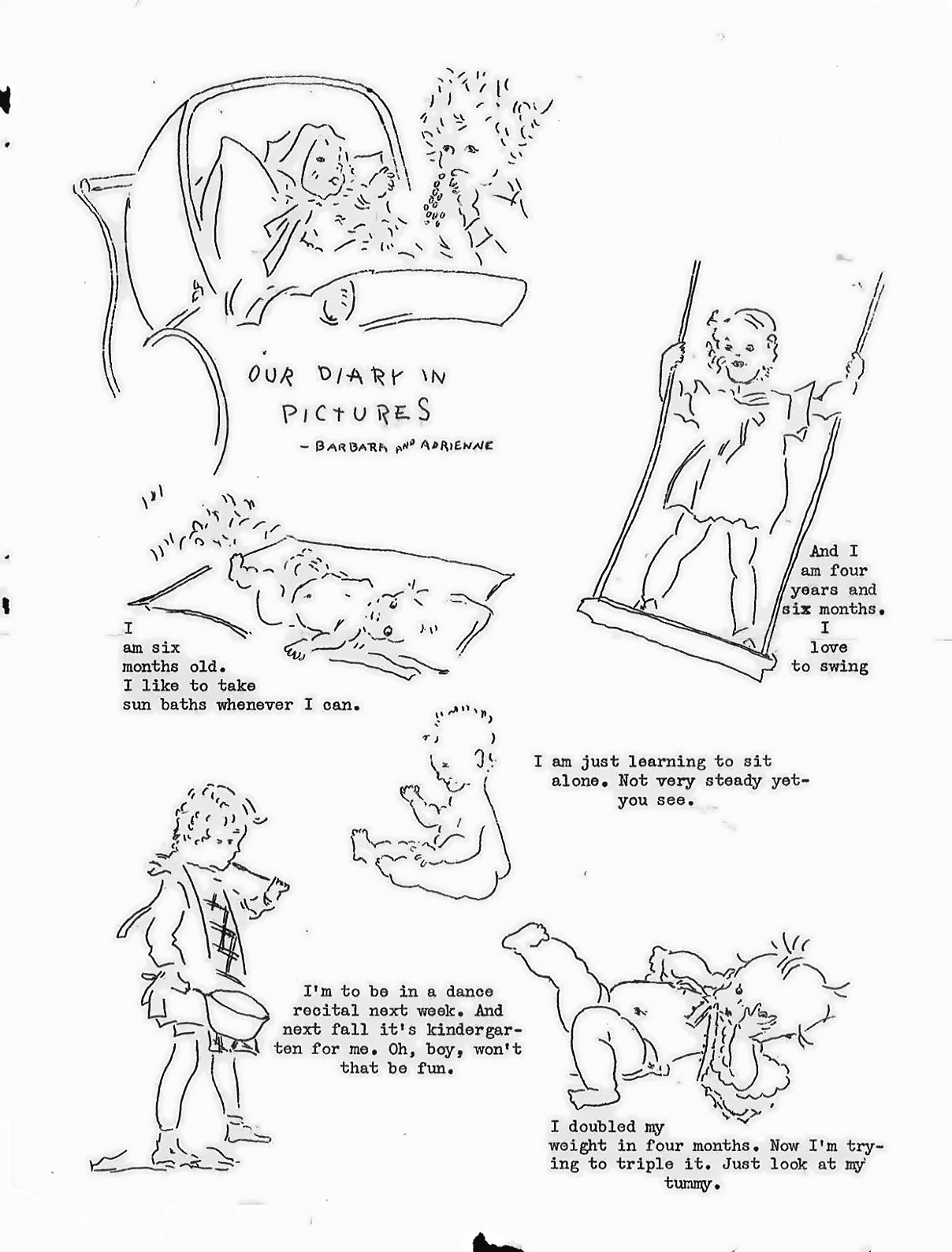
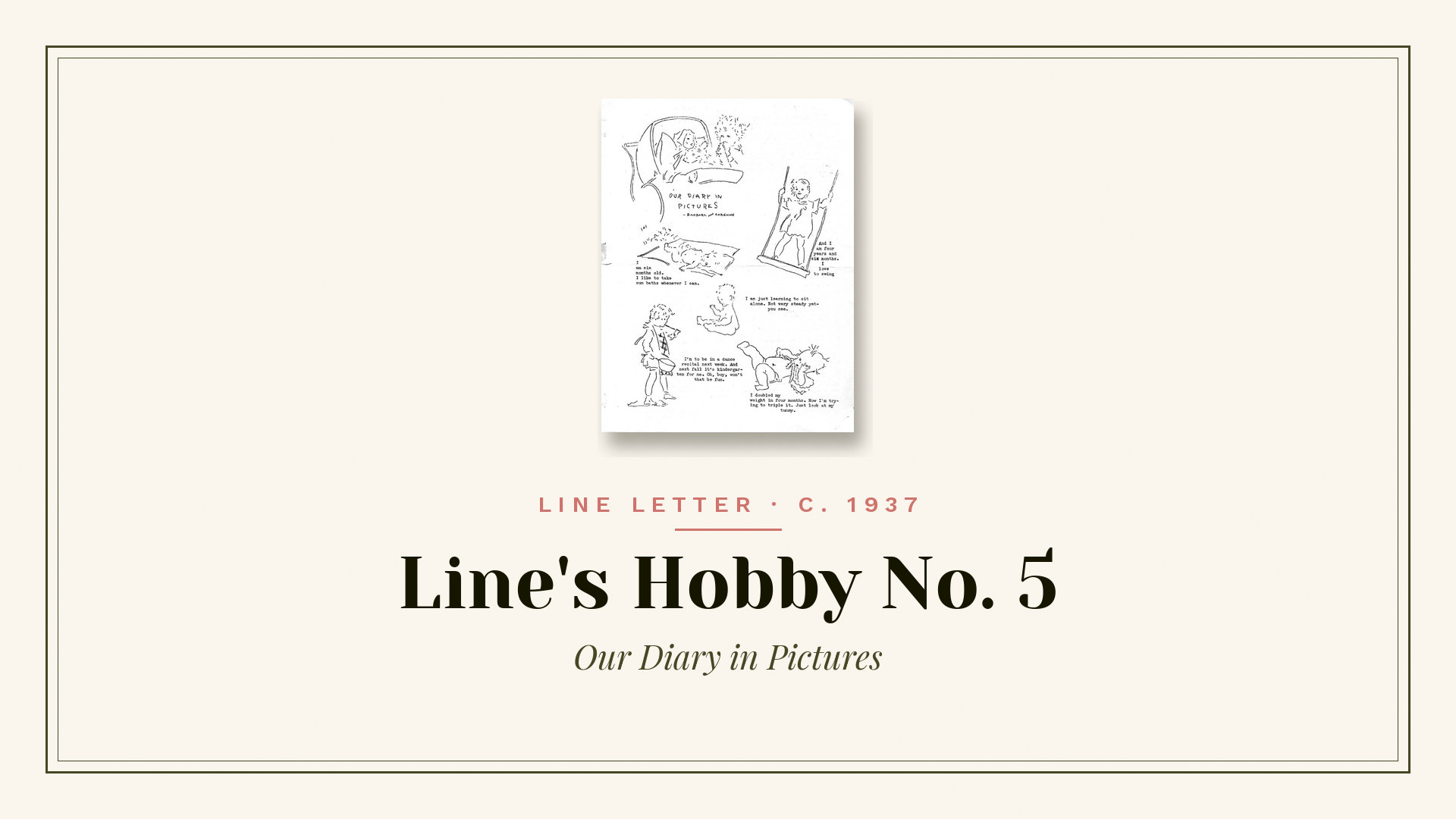
OUR DIARY IN PICTURES
[A page of line drawings of the two girls, with captions.]
- “I am six months old. I like to take sun baths whenever I can.”
- “And I am four years and six months. I love to swing.”
- “I am just learning to sit alone. Not very steady yet—you see.”
- “I’m to be in a dance recital next week. And next fall it’s kindergarten for me. Oh, boy, won’t that be fun.”
- “I doubled my weight in four months. Now I’m trying to triple it. Just look at my tummy.”
LIGHT SUMMER READING
Our friend’s cat was a sissy; not only did she run from dogs, but every other feline in the neighborhood caused her to buckle up with fear. Then our friend fed the kitty (this is a true story) on canned dog food for a couple of weeks. Now the cat can (and does) fight and whip every beast in the district, cat and canine. She rules the neighborhood as Tarzan rules the jungle. (Manufacturers of dog food may have testimonial names and details on request.)
Buried beneath ten feet of earth a couple of blocks from our home in Ontario is a two-hundred-million-dollar treasure. Fortune Magazine (one dollar per copy) is so inspired by this phenomenon that her editors, in the April issue, give it six pages of colored pictures and booming epithets. More costly than the Panama Canal. Greatest engineering feat in America, says Fortune. Have you guessed what the treasure is? It’s the famed Metropolitan Aqueduct, which will bring more water to Los Angeles every day than all Southern California is using at the present time.
In Ontario’s early pioneer days a great fountain was erected near the Southern Pacific station, to be turned on when trains passed through. This demonstrated to prospective home-seekers that a water supply was no problem here. It was just problem enough, however, to cause citizens to turn off the fountain when the train had departed. This fair city was once spoken of as “Chaffey’s Wild Experiment.” The colony was laid out in the midst of a desert and plenty of scoffers thought it would never succeed.
Young lad tried to sell us a newspaper. Failing in his first effort, he said: “If I tell you what state you were born in, and where you got your last haircut, will you buy a paper? And if I tell you wrong, you can have one free.” Of course that was an acceptable proposition. “You were born in the state of infancy,” he said, “and you got your last haircut in a barbershop.” We bought two papers.
Stumbled in my reading the other night onto three choice views of Life. (reference here to the eternal struggle, not the new picture magazine) “From the point of view of morals,” opined Will Durant, “life seems to be divided into two periods; in the first we indulge, in the second we preach.” To which Zona Gale added this reflection: “I don’t know a better preparation for life than a love of poetry and a good digestion.” While Josephine Peabody demurred with this gem: “One does not expect in this world; one hopes and pays carfares.”
After all of which it is hard to refrain from mentioning the plump woman who said it seemed as though everything she liked to do in this world was immoral, immodest, or fattening.
Our friend Don Vowles tells this story of the telephone company in his small home town in North Dakota. The company, due to scarcity of help in the early morning hours, ruled that patrons could not call “central” to ask the time of day before 8 a.m. Forgetting the new rule, a young farm lass phoned for the time as usual. “Sorry, Mamie,” came central’s reply, “I can’t give it to you until 8 o’clock.” “How long must I wait then?” asked the lass. And central replied: “Just twenty minutes.”
Trundling up to bed the other evening for a little belated reading I took by mistake, a Home Economics magazine, instead of the S. E. Post. Here is what I found: Eighty-seven percent of cow’s milk is water……A quart of milk is heavier than a quart of cream……Peanuts do not belong to the nut family. They are kin to the pea and the bean……Every time you open your refrigerator the temperature is raised one to three degrees……Ice cream was invented by Dolly Madison, wife of Pres. Madison….Salt added to water in cooking potatoes reduces the loss of mineral matter one-third…..An egg white added to cream will cause it to whip more easily.
All of which was perhaps just as interesting and valuable as a story by Bud Kelland in the Post.
About this issue
A coverless five-page letter, identified as Line’s Hobby No. 5 from internal evidence: the 1937 Coronation, the Edward-and-Wally wedding at Monts, and six-month-old Adrienne. It covers the Lines’ ninth anniversary and Los Angeles theatre and restaurant outings, the Coronation broadcast, sports and movie-making around Ontario and Chino, recent reading, “Aquatics” (the Van Ness Water Gardens), “Apaches” (the author Edwin Corle), “Our Diary in Pictures” by Barbara and Adrienne, and “Light Summer Reading.”