
Chapter 14: Mabel Hutchinson’s Treasures Are Created from Scraps
She Created Treasures from Scraps and Rediscovered Art at Age 86
“These pieces of wood are too beautiful to burn, Milon. We’re going to have to get our firewood some other way.”
Sixty-year-old Mabel Hutchinson held up two odd-shaped pieces of mahogany scraps which she had picked up from the floor by her husband’s workbench. Milon was a fine cabinet maker—creator of artistically designed chairs and chests and tables. Each day found a litter of exotic woods—teak, walnut, rosewood, African laurel, mahogany—around the shop where he and Mabel worked as a team. She was the artist and did most of the designing. From her designs he fashioned those rare woods into creations which found their way into the homes of Hollywood celebrities and into museum collections.
That evening Mabel and Milon didn’t take their scraps home for burning as they usually did. Mabel had an idea. During the next few days she began laying odd-shaped bits of wood on a small panel of plywood, creating an exotic design.
“Looks good,” said Milon encouragingly. “Glue them down and you’ll have a piece of art.”
They entered her creation in a sculpture show; it found a ready buyer. More exotic creations, more sales. The daily piles of scrap wood became the ingredients of a new challenge.
“Here are three of the best ever,” said Mabel one day to her husband. The three long narrow pieces of plywood were adorned with scraps that were not only beautiful in shape and color, but were arranged with the eye of a trained artist.
Milon admired them. Reaching down, he pushed the three pieces together, side by side. “They’re good individually. They’re even better as a unit.”
Suddenly the two of them looked at what lay before them. “It’s a door,” Milon exclaimed. “You can decorate one large piece of plywood and make a door.”
That discovery figuratively and literally opened a new door in Mabel’s life—opened it wide. She was on her way to being known as the “door lady.”
A craft fair was soon to open in Pasadena. Mabel created her first door from scraps and entered it. Art critics from eastern America and from Japan were at the show’s opening. Mabel’s door made art magazine headlines in New York and Tokyo.
Other periodicals began featuring Mabel and her doors. “Treasures from Scraps” was the theme that opened the door—again literally—to nearly every magazine that heard of her. Her work was featured in several art books.
Orders began flooding in. For those close at hand Mabel and Milon delivered the doors in person, and supervised their proper installation. One month it would be a delivery to Beverly Hills. Then Los Angeles or Long Beach or Bel Air. The inflooding door orders turned them into almost regular commuters to cities in the San Fernando Valley. Requests were coming in from other states. Their “door journeys” to Scottsdale and Prescott, in Arizona, were like vacation trips. Then a flight to Honolulu, Hawaii, with a set of Mabel’s double doors stashed away in the plane’s cargo section.
“This is fantastic,” exclaimed Milon one day. “I never knew art had such an outreach. From sea to shining sea.”
Mabel’s doors and other exotic wood creations from scraps eventually graced homes and business establishments in 22 states, providing enduring beauty in the lives of discerning people from Florida to Hawaii.
Milon’s cabinet work took on new dimensions of excellence; he too could not fill the flood of orders that swamped him. But he tried his hardest; Mabel needed all the scraps she could get.
Unable to have children, Milon and Mabel found their greatest joy in being together in whatever they undertook. This had been the pattern of their lives for 50 years.
Fifty years. The golden anniversary. It was celebrated at a party given by two couples who were their closest friends. Invitations went out and friends responded, from near and far. Almost more than an anniversary party, the celebration became a family reunion. Close relatives made the trip down from Idaho, where Mabel and Milon had been born and raised. Other former Idaho relatives drove or flew in from places in California and Arizona where they had moved. A panorama of their early Idaho lives on the very frontier of a frontier state unfolded during the conversations and reminiscences during that celebration marking their half century together.
Three months after that 50th anniversary celebration, Milon was dead. A heart attack. Sudden. Unexpected. At that moment Mabel almost died too. She did die—in spirit—completely.
Fifty years of togetherness can be an unbearable burden when that closeness is cut off—forever—overnight. Almost daily Mabel phoned her closest relative, a niece in Bakersfield. Almost weekly she pleaded, “Come and get me, Barbara. I need to tear away from these surroundings. These memories. They are haunting me like ghosts. Just a day or two with you would help.”
Barbara came—many times. But one day she came with a suggestion. Almost an ultimatum. “Aunt Mabel, you must get hold of yourself. Your memories are beautiful—not ghosts. Don’t let them haunt you. Let them help you. Those cherished memories can heal, not hurt. Write them down. Start at the beginning, back in that Idaho log cabin, right on the frontier, where you were born. Relive that frontier—with its hardships, yes, but with all its grace and beauty, too. Aunt Mabel, write the story of your life.”
Reluctantly, gradually—almost painfully at first—Mabel responded to that advice. She was 75. Three vital end products resulted from her reluctant response. Through four years in which she poured out her memories and emotions on paper, the healing process literally saved Mabel’s life. That was more than worth all the effort. But it resulted, also, in a vivid chronicle of pioneer frontier existence which has become a treasured part of the Idaho State Library’s valued historic collection.
There was a third result. In a beautiful manner, her story revealed the way that subtle influences, in remote pioneer surroundings, can produce the seeds for a fertile flowering of creativity in writing and in music, but especially in art. It became a study of the power of psychological and environmental forces in shaping a life.
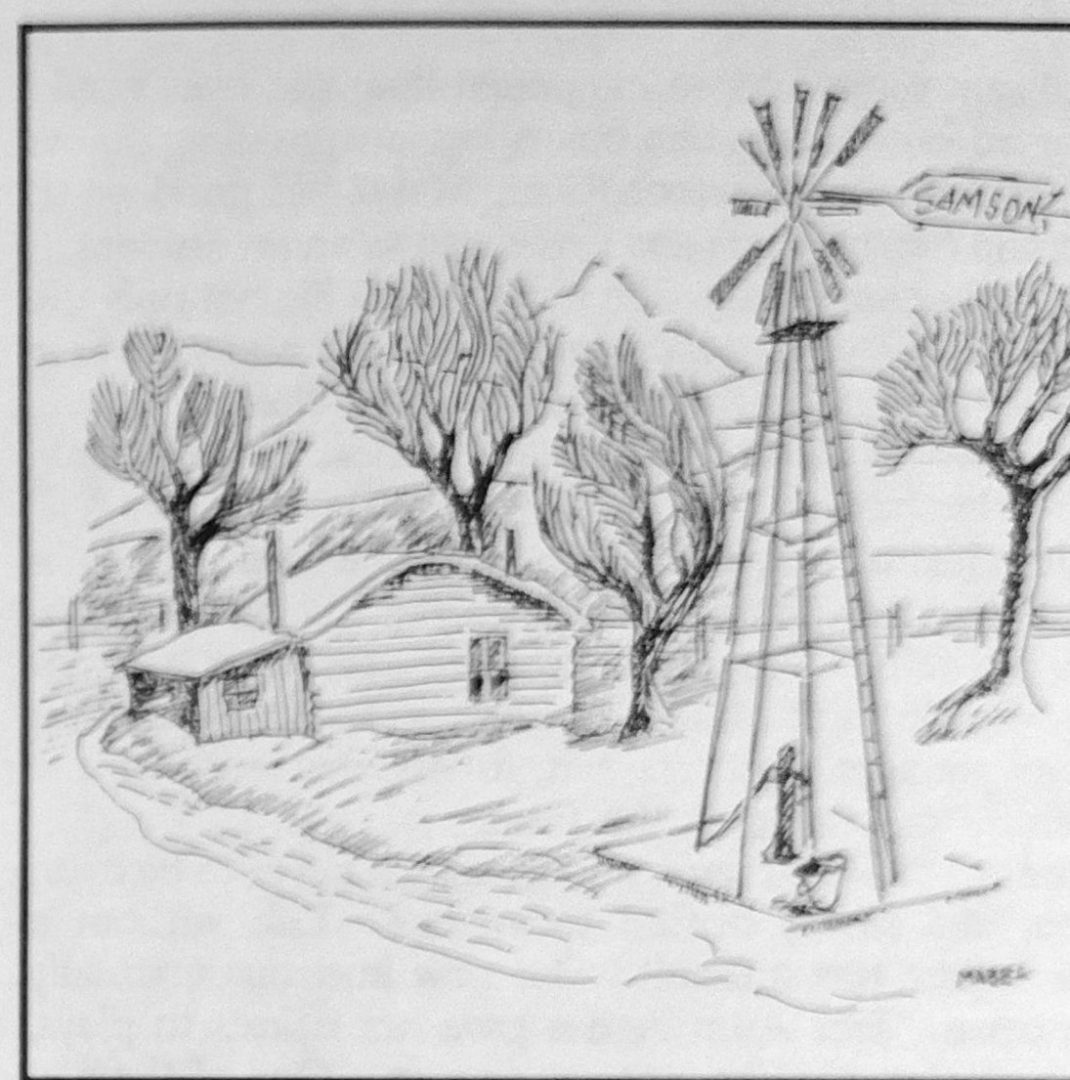
“The Log Cabin,” is the title of Chapter One in Mabel’s two-volume autobiography.
In a cabin with two rooms and a lean-to, surrounded by sagebrush and wildness in southern Idaho, she was born. The cabin home was 13 miles from the town of Blackfoot, four miles from Firth, where 200 people lived. In this isolated frontier setting a young country girl who would not see the outside world until she was 18 absorbed the life about her in such a way that a career which would become national in scope was laid for her in art.
“Some of my most vivid memories were of the year I started school,” Mabel recalls. “It was a one-room building, and all eight grades were in that one room.”
During that first year in school an incident occurred—seemingly small—that gave much more than a small clue as to the direction her life would take. One day an eighth-grade student, instead of going out to play at recess, stayed in his seat, busily guiding a pencil back and forth on a piece of paper. Mabel wondered; was he drawing a picture? She had often tried to make pictures with a pencil on pieces of wrapping paper in their log cabin home. Mabel strolled over and peeked. The boy was drawing a pine tree, putting every needle on every branch, just like real. It was beautiful, she thought. That was the sort of thing she wanted to do almost more than anything else in the world.
Mabel made a vow to start practicing, just as that boy was doing. She followed up on that vow, and drew at every opportunity at home, in school, or at her Aunt Agnes’s house, as she advanced from one grade to another.
Then came the time for high school, in Blackfoot, 13 miles away. That meant “boarding out” and working for her meals and lodging.
“What subjects do you want to take?” the teacher asked.
“Art,” came Mabel’s quick reply.
“We don’t teach art here,” was the answer. You can take English, ancient history, chemistry, and a foreign language. You have to take algebra.” Mabel didn’t even know what algebra was. She was not able to have an art class during her freshman, sophomore, or junior years.
The senior class in high school did have a course in art. There was also a yearbook, and Mabel did many of the drawings. What a thrill to see her own signed pictures in the annual. She spent her spare time by filling a sketch book—page after page of drawings, sketches of people, or farm life, or scenery—hundreds of them in all. Little did she realize that this sketch book would open a door to college.
Mabel had no hopes for such a thing. There wasn’t the money. Her dear mother had died and Mabel, at age 15, had to be the woman of the house at their farm home, not only working in the fields but doing the cooking and caring for her two younger brothers, Jack and Bear.
Quite by chance, a teacher from Logan, Utah, visiting in Mabel’s community, saw that sketch book. At once he became excited. He examined it painstakingly. Then, “Why are you not in college?” Scarcely giving Mabel a chance to reply he continued, “I am going to write a letter to the president of Utah State College in Logan. You must get some training. Utah State has an excellent art department.”
This man was so final in all he said. “You send your sketchbook of drawings along with my letter,” he continued. “Send them tomorrow. We’ll see what happens.”

Mabel sent them. More happened than she ever would have dreamed of. As autumn colors began spreading across the valley by Idaho’s Blackfoot River, Mabel bid goodbye to her father and two brothers and registered as an art student at the college in Logan, Utah. She was soon taking not only the routine college classes but, most important, she was absorbing instruction by skilled teachers in a full time class in art.
College life was surely opening new worlds. It all seemed too good to be true.
As things turned out, it was too good to be true. On February 29, 1924, after just half a year in her new world, word came that her father was dead. College days were over for Mabel; she had to return home, not only to become a mother to her two younger brothers but to assume most of the responsibilities of managing the farm.
The year of 1924 was hard, and it seemed never to be over. 1925 came, and slowly drifted to an end. Life without a mother or father was difficult. But new horizons gradually started to open. Her Aunt Agnes gave her tickets to plays, there were parties, and she met young men. One of them, a local boy, had just come back from a long trip to distant California, where he worked in a city called Riverside. His tales of the outside world were exciting. They met often. This young man was different from any of the others. Handsome, yes, but also intelligent; his English was perfect. He did not smoke. As Mabel wrote: “I was falling harder every minute. He was more than I had dreamed of.”
Mabel fell in love with Milon Hutchinson.
On March 19, 1927, a year after their first meeting, Milon and Mabel were married. It was not his idea. It was Mabel’s, almost completely. He had explained his financial situation to her many times. Marriage must wait some sort of steady job, some hope for a future that would be at least reasonably secure. For Mabel, security did not mean money. It meant Milon.
Of his weekly take-home pay, Milon paid ten dollars for the license, five dollars to the minister. With the trace of a smile mixed almost equally between humor and horror, Milon pulled two dollars from his pocket. “This is what we start married life on, including our honeymoon.”
On one thing Milon was insistent: there must be a honeymoon. “We’ll go to Idaho Falls and stay overnight in the hotel. All honeymooners from here do that. I’ll borrow the money.”
He borrowed two dollars for the hotel, an equal amount for a luxury meal, and an extra dollar for contingencies. It was an initial indication of how nearly every need of their future together would in some way be met. The very next week Mabel discovered that her grandmother had left a parcel of land to her father. The discovery came when a man showed up who wanted to buy it, for $1200, an unheard-of sum. The sale was made. Mabel and her two brothers, Jack and Bear, had $400 apiece. With her share of the fortune, Mabel and Milon started on their real honeymoon. Loading his car with all the personal possessions it would hold, they moved to Riverside, California, the city where Milon had visited and worked on his first California trip. He knew it well and had friends there.
Milon was able to get a job with the city fire department. And Mabel, a few years later, started back to college! Riverside had a junior college. In September 1936 Mabel enrolled there. “At 33,” she wrote, “I felt ancient compared to the 18-, 19-, and 20-year-old students swarming in the quad.”
She signed up for two art classes that, over a two-year period, gave her the professional training she had needed so much, and had yearned for.
Millard Sheets, Phil Dike, and Rex Brandt, rising young artists, were luminaries in the painting world. The instructor showed his students samples of their works. “We all knew we had a long, long way to go,” Mabel wrote. It would not be easy.
Graduation day came. “After many speeches the small documents of Associate of Arts degrees were handed out alphabetically,” Mabel wrote. “Milon was there watching and waiting in the front row. As my name was called and I was handed my tiny diploma, I left the stage clutching my prize and ran into his waiting arms. I possessed this small slip of paper that would carry such weight in the days to come.”
Next to Milon, art was still Mabel’s major passion. Rex Brandt, one of Riverside’s own sons, had just graduated as an art major from the University of California at Berkeley. He was organizing a summer class of freelance painters. Mabel joined his watercolor landscape painting class. Under expert instruction she wielded the brushes with ever increasing skills. She was even persuaded to send one of her paintings to the juried show of the California Watercolor Society in Los Angeles. It was accepted and became a part of the annual exhibit.
In 1941, America entered the war against Germany and Japan, and Milon and Mabel were affected in many ways. They were dismayed when all west coast Japanese were rounded up and sent to desolate relocation centers. Jack Horikawa, one of Mabel’s fellow art students, was among those sent off, with thousands of others, to the bleak desert camp at Poston, Arizona. Milon and Mabel loaded their car with art supplies—brushes, tubes of paint, sketch books, watercolor paper—all contributed by the Artists Guild, and headed off to Poston. Getting admitted to the camp was not easy, but they made it.
Jack Horikawa and all the other artists he knew in the camp were overcome with gratitude at those supplies, which would give them an opportunity for creative expression during their cruel internment.
The small city of Riverside was flooded with soldiers from March Air Base and from nearby Camp Haan, which had been built almost overnight. Mabel donated her services to make sketches of the servicemen at the USO. How glad they were to find someone, this far from home, who took such a deep interest in them. How thrilled they were to receive, as gifts from Mabel, the sketches she had made, to send home to their families and loved ones. In return, Mabel was thrilled that she had found a new outlet for her talents. This charity endeavor helped enhance her skills as an artist.
In the autumn of 1943 Milon had an emergency message from his father in Idaho, who couldn’t get farm help; all the young men were either in the army or in defense plants. Could Milon and Mabel come up and help for a while?
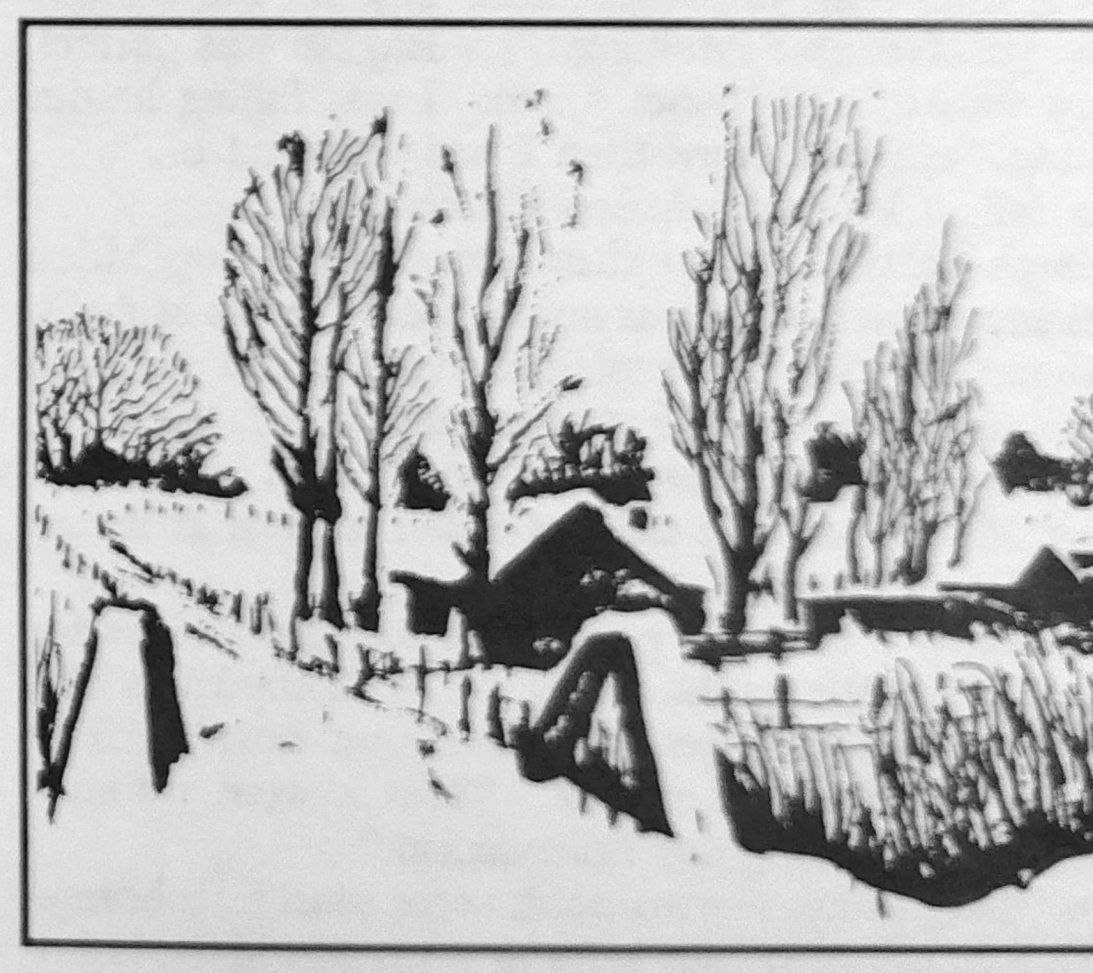
They could and they did. Mabel not only worked with farm tools in the fields; in the early dawns and late evenings—when the light was golden—she worked with brush and easel to paint all the scenes of her childhood. The snows came early that year and wintry landscapes added to the challenge.
“I spied an abandoned old wagon in an apple orchard . . . a perfect subject,” Mabel wrote. “The dark brown wheels half buried in snow, against the dark patterns of bare trees. It was a natural! Though it was cold enough to make ice crystals on the paper as I painted, inspiration took over. Who cared about how cold it was. Painting a snow scene was easy, just leave the white paper for snow, pale blue for shadows . . . burnt umber and yellow ochre . . . that was about all it took. In a few minutes I had my subject well in hand.” By the time they were ready to return to California Mabel had captured some rare memories of rural Idaho in her watercolor paintings.
During all the years that Mabel was finding wide possibilities for creative expression in the field of art, Milon was also reaching out in his quest for a type of work that would more fully satisfy his deepest needs for creative workmanship. He built a workshop and bought tools for fashioning objects in wood. He and Mabel discovered that a chair could be an object of art as well as something to sit on, an artistically designed and skillfully crafted cabinet could not only hold dishes or knickknacks, it could be aesthetically pleasing as well.
Mabel enjoyed painting and it was an outlet for her creativity. She received recognition, but not much more. Hers was not a famous name in the art world. A few relatives bought her watercolors, usually for $50, once a hundred. As Milon’s work in cabinets became more demanding, Mabel deserted her easel and became his helper in the workshop. Her artistic sense was important in designing the chairs and chests and cabinets that he made. They moved to Corona del Mar, then, after a few years, settled in Capistrano Beach, in each city building a better workshop than the one they left behind. In the closets of their home and in a large wall closet in the office of their workshop, all of Mabel’s paintings were stored and forgotten. Through 30 years they gathered dust. She almost forgot that she had ever stood before an easel.
At this point Helen and I became important in her life. For 29 years she has been our neighbor—just two blocks away in Capistrano Beach. On our morning walks, three times a week, for as long as we can remember we have stopped to say hello, and sometimes have a bite of breakfast. One or two of her paintings have always hung on the walls of her small but beautifully planned home.
“I really like that one,” Helen said one morning as we sipped coffee and munched toast at the table which Milon had made for their home. “Do you know what I wish you would do?” Helen continued.
Mabel knew that Helen and I had founded the Chaffey Community Art Association in Ontario, California, in memory of our eight-year-old daughter Barbara, who had died of leukemia. This had been the subject of our breakfast conversations. She was one of the first persons with whom we had shared the news when we learned that the association had at last, after more than 40 years, obtained a spacious gallery for hanging its ever-changing exhibits, and where its permanent collection could be displayed annually. It was a collection valued now at a million dollars or more.
“Mabel,” continued Helen, “our association is going to celebrate its 45th anniversary next month. You should be represented in it. Would you consider giving one of your paintings to CCAA?”
“Me? In a collection of noted artists like that? I don’t think they’d even take one of my things. But yes, if they want one, I’ll gladly give it.”
Mabel gave a large watercolor. It was part of the 45th anniversary celebration exhibit. The artist, Robert George, for a long time president of the association, took one look at the painting, and told us he had to see its creator.
On his next visit to us we took him over to Mabel’s home. At Robert’s insistence, she began pulling her long forgotten works out of closets.
Soon we were standing in the middle of half a dozen old paintings that surrounded us on all sides.
“They’ve been gathering dust for years,” said Mabel apologetically. “I’ve really been ashamed to hang them.”
“Ashamed?” exclaimed Robert. “Mabel, you don’t know what you have here. These paintings are treasures.”
Robert George, where art is concerned, is not only an authority, but a highly regarded artist himself, whose works command high prices. He had become president of the art association Helen and I had founded when it was at a low point in its life, and had helped build it back into one of the most important such associations in the western United States. From that first visit in Mabel’s home, which resulted because of the gift of a painting to the association, Robert George took charge of Mabel’s career.
“Do you have any more paintings?” he wanted to know.
“Well, yes, some down at the shop. After Milon’s death I’ve rented the workshop but I still keep the office there, to write in.”
Within ten minutes, Robert George and Mabel were at the workshop office. We tagged along. Mabel began pulling old watercolors from a closet. “These are the dregs,” she explained. “I haven’t even dared hang them, or show them to anyone. They’re just good for collecting dust.”
Robert George wiped them off, studied each one with a professional eye, then literally exploded.
“Have you ever sold any? Are there any that might be loaned to us if we put on a one-man show?”
“A one-woman show,” interrupted Helen.
“I stand corrected,” came Robert’s reply.
Within a few months, Robert had entered some of Mabel’s works in a Santa Barbara exhibit. A wealthy art collector had seen the painting Mabel had given to the Chaffey Association at the time of its 45th anniversary celebration. He came to her home to see and study all of her works. Here was an artist whose paintings, professional in quality, came largely out of a pioneer background. He came again, and ended up buying every painting she had. Robert began planning a display of all her available works at the Chaffey Art Association’s gallery, from September 7 to November 5, 1989. The catalog for that show is one of the finest the association has ever produced, paid for by the art collector. An exhibit is in the planning stage for the prestigious Laguna Art Gallery. A showing of her works in Riverside—Mabel and Milon’s former hometown—is scheduled. More exhibits are in the offing. This is a climax in a creative and expansive lifetime.
Mabel Hutchinson is now 86 years old. Her life in the field of art has begun anew.
[See After Words at back.]