
Chapter 4: Lillian Bronson Was a Super Senior Even as a Girl
For a quarter of a century Helen and I owned the large 12-million-year-old Eagle Rock natural landmark which lends its name to the community—a part of Los Angeles—stretching from its base. Our home was beside the rock; just behind the great landmark we had fashioned a garden which community groups often requested permission to use. The setting was historical and beautiful; the fame of the rock itself lent importance to any occasion.
“The Southern California Herbal Society wants to hold its first Herb Fair here,” I explained to Helen as I responded to a phone call. “They want to raise money to help with the opening of the Arboretum.”
“Wonderful!” was her reply. “Tell them we will be delighted. I love herbs. Maybe I’ll get acquainted with some new varieties.”
She did. The fair was a success. Members and visitors came from Pasadena, Pomona, San Diego, Hollywood. Helen became acquainted with new herbs. I became acquainted with a new friend.
“Lillian Bronson? Why, I know you. Not personally perhaps. But haven’t Helen and I met you on the screen?”
My response on being introduced to this Hollywood movie actress had been more than enthusiastic. “But your age—I thought you were an elderly woman.”
My new friend smiled. “I am—on the screen. Always have been. Even back when I was in plays in Ann Arbor, more often than not I was cast in some elderly part. I guess it became a habit.”
“Ann Arbor? The University of Michigan, you mean? Did you go there?”
To her affirmative response I told her that I also was a University of Michigan graduate.
“What year?”
“Class of ’28.”
“I was ahead of you,” she replied. “I was class of ’27.”
“Quite often I went to the campus plays,” I told her. “They were open to the public, you know. One of those plays—I don’t recall its name—was among the finest things in drama I have ever seen, even to this day. The girl who took the lead was so good I went home that night and wrote her a ‘thank you’ letter. I just had to tell her how much she impressed me. She was really good.”
A strange look came over Miss Bronson’s face. “Do you remember how you signed that letter?” Her question came swiftly as an incredulous expression spread over her features.
“Did … did you just sign it ‘A Freshman Boy?’ ”
Now it was my voice which expressed incredulity. “Why, yes. I often wrote anonymous letters that way. Too bashful, maybe. But … how did you know? It can’t be … Miss Bronson, you don’t mean? …”
In the exchange which followed, Lillian and I realized that we had not only attended the University of Michigan together but she was the budding young actress to whom I had written a letter of deep appreciation. A letter unanswered, because I had not signed it with my name.
“Miss Bronson, I can’t believe it.”
“Please call me Lillian. ‘Miss Bronson’ is only for strangers. We’ve been friends for years. Without even knowing it.”
Lillian Bronson’s interest in herbs expanded. Herbs are not much to look at, but, oh, the fragrances they exude. Laden with all the herbs she could carry, she often went to the Sawtelle Veterans Hospital where she gave talks to the blind men there.
“Can you recognize this one by its fragrance?” she would ask. “Or this one? Its scent fairly fills the room.” The men loved to scrunch the fresh herb leaves.
For the next two years ‘scenting parties’ became a part of her life. She encouraged other actors, such as Jim Whitmore, to visit the men at Sawtelle.
Years flowed gently by. Lillian was becoming older, beginning to approach the age of some of the characters she portrayed on the screen. Her hometown in upstate New York wanted to honor her; she returned to Lockport for a “Lillian Bronson Day,” was given the key to the city, and became the honored guest of those who had, on the screen, literally watched her career unfold.
Then—the unexpected happened. Lillian Bronson’s horizons expanded in ways she could never have dreamed.
Freeway murals are now commonplace in Los Angeles. They blossomed widely to greet those who came from around the world to see the 1984 Olympic Games.
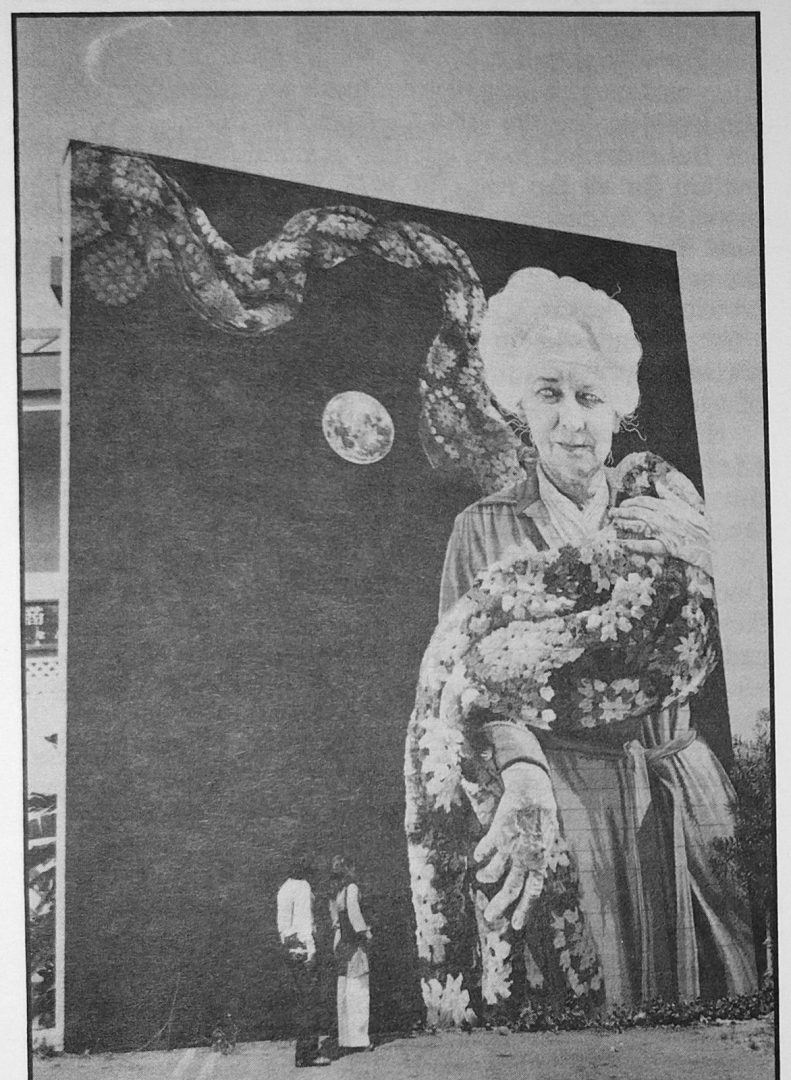
But there had to be a “first,” a mural that would set the pattern for all the rest. In 1974, Lillian Bronson was the model for the first-ever Los Angeles Freeway Mural. Muralist Kent Twitchell wanted to do something in an important way to honor his grandmother as he had remembered her back in his growing-up days in Michigan. Also, he wanted to impress on viewers’ minds the importance and dignity of the elderly, in a city where youth culture has a tendency to crowd out thoughts of aging.
He needed a model. Who else but the lady who portrayed elderly characters on the screen? As a location he chose the wall of a building on the Hollywood Freeway just beyond the four-level interchange, at the very center of L.A.
The Old Woman of the Freeway became a reality. Uncounted millions of viewers glanced at it affectionately as they drove by. As one social commentator stated, “Unlike in pedestrian-oriented cities, the middle class in Los Angeles can successfully avoid . . . the elderly in the routine and rituals of daily living.”
They could not avoid Lillian. Her beautiful elderly presence radiated a blessing, day and night, to all who passed. She became a stately and endearing symbol of this City of the Angels.
Then suddenly, in 1986, the mural disappeared. People were aghast. It had been painted over. That location, so accessible to the millions of viewers, was too valuable. An advertising sign would replace it.
So the owner of the building thought. He did not count on the public outcry. Newspaper headlines leaped out of the news racks. Editorials pleaded for the return of Lillian. Television newscasts made “The Old Woman of the Freeway” a household phrase. The Los Angeles Mural Conservancy was organized to bring the Freeway Lady back, and to preserve all of the other important outdoor murals in the city. As this is being written, progress is being made in restoring The Old Woman of the Freeway.
Lillian Bronson has now definitely reached the age of the characters she once portrayed on the motion picture screen. On October 22, 1988, Helen and I attended her 86th birthday party in nearby Laguna Niguel.
One or two former movie actresses were at the party. Lillian’s niece from back east was there; she had spent the summer promoting a play about Bronson Alcott in Concord, Massachusetts. Lillian has connections with Louisa Alcott, author of Little Women.
Perhaps of most importance, muralist Kent Twitchell had come out from Los Angeles to attend the party, bringing with him for each guest a beautiful poster-sized color copy of the famous Old Woman of the Freeway.
Lillian was quite frail, and had been so ever since a fire in her former home. A neighbor of hers, who was also at the party, had literally dragged a blackened and ash-covered Lillian to safety.
Her frailty was evident as the party began. She greeted the guests but was reticent to take much part in the conversation. Then a metamorphosis occurred such as we have never experienced. Lillian became a transformed person. Her frailty seemed to drop away. Her voice—now enlivened and firm—captivated us all. She began reliving her past, recapturing the lives and accomplishments of her cherished friends. She explained her positive philosophy of life and what it had meant to her, coming as an unknown young actress to Hollywood. She had persevered and won out.
Lillian’s eyes sparkled with a new intensity. Her complexion glowed. The fragility was fading. Her gestures, her voice, her expression were those of a rejuvenated person. None of us had ever seen a transformation like this. Lillian herself commented: “Fifteen minutes ago I could not have talked for two minutes. Now I can’t stop. This shows what the mind can do.”
She revealed some background about the painting of the Freeway mural that we had never known before, which emphasized her positive philosophy. “Kent Twitchell took snapshots of me in preparation for painting the mural,” she explained, “and I would think various thoughts to give myself the expression I wanted. The snapshot Kent picked for the mural was one in which I was thinking and projecting an intensity of determination.” Lillian feels this is an important reason for the mural’s success and effect on people. The expression of sheer determination came through the gentle grandmotherly face, and touched all who saw it.
For an hour-and-a-half she held us spellbound. All the guests at that 86th birthday party of Lillian’s left with the feeling that they had experienced a high moment of living.
For Lillian, it was not only a high moment; it was a climax. She had relived almost her entire life.
On our way home from the party I said to Helen, “How glad I am I wrote that letter of praise to a young actress back in Ann Arbor 63 years ago.”