
Chapter 6: These Artists Have Touched our Lives with Brightness
1. Millard Sheets, Artist, Teacher, Muralist, Planner
Havelock Ellis once said that “art is its creator’s autobiography.” If that is true, Millard Sheets painted his autobiography, becoming known as the father of the California Watercolor School. But he also created murals and mosaics and tapestries that are part of that autobiography. He designed important buildings and planned intricate projects.
He had a full career as a teacher of art. He wrote books. He has been an entrepreneur and businessman. Midst all of that he found time to paint the face of tragedy in India and Burma and Ceylon as a war correspondent for Life magazine during World War II.
Millard lived a full life of 81 years and he and his wife celebrated their 58th wedding anniversary. Their three sons have achieved success in art, design, and business careers; their daughter is an ordained minister. There are grandchildren.
One has taken art lessons from his grandfather and, according to that proud teacher, has a natural feeling for art.
Millard once said that “to become an artist one must become a total person.” According to that concept he has possessed and given to the world the talents of half a dozen persons rolled into one. Of Millard, his sister-in-law says:
“There’s no one like him and there’s not likely to be soon.”
As I began writing this, in 1989, Millard was beset with a recurring illness. He had been in and out of a sick bed, in and out of hospitals. When he was in, he had dreams of painting, or creating in other ways. As soon as he was out, he painted, or created in other ways. It was my prediction, which I put down in writing, that he would die at his easel, and I think he would have liked this. Millard died in his sleep at 11:25 p.m. on March 31, 1989, after I had written this chapter and sent it to him and his family for review. Except for the changes from present to past tense in the paragraphs above, I leave the chapter just as I wrote it, in the weeks before his death.
In taking a sweeping glance at the varied facets of Millard’s career, one can well start at the Chouinard School of Art in Los Angeles. There the seedbed was laid for much of the phenomenal growth that made his entire life so fruitful. In his youth Millard had determined he would follow art as a career and in 1925, at the age of 18, he took the bus from his Pomona home into Los Angeles, intent on looking for an art school to attend. He settled on Chouinard.
One of his instructors there was F. Tolles Chamberlain, an authority on mural painting. Under this gifted and dedicated man he studied and worked with the intensity that was to direct his whole life. As a result, in a few years, important mural commissions began coming his way. In his lifetime he would create more than 100 murals and mosaics, at such places as the Mayo Clinic in Minnesota and Notre Dame in South Bend.
Dalzall Hatfield had an art gallery nearby. One day in 1917 he phoned the 20-year-old Millard, busy at his art study at Chouinard. Saying he’d seen and admired Millard’s work, Hatfield asked the young student to come see him at the gallery.
Hatfield said he would like to represent Millard, explaining that a young artist, no matter how good he was, first needed to make many sales of his works in order to get himself established and accepted. Millard knew of Hatfield’s fine reputation; he jumped at the offer. Their association lasted for just four years less than half a century; Dalzall Hatfield and his wife Ruth sold more than 3,600 of Millard Sheets’s paintings.
In 1926 Hatfield sponsored the first Sheets one-man show, and the laudatory criticism of Los Angeles art critics gave the young 22-year-old artist a new impetus to forge ahead in his chosen career.
In that same year Millard received an invitation to enter a highly important competition in a San Antonio museum. In error, Ruth Hatfield sent the wrong painting. What the fate of the right painting might have been, no one knows. The wrong one took second prize. Sheets received a $1,750 award, which paid his way on a career-shaping trip to explore galleries and meet well-known artists in Europe. He virtually painted his way there, travelling by ship which stopped at 17 different Central and South American ports. He painted at nearly every stop, including Cartagena, Colombia.
Millard had heard of the desirability of exhibiting in a Paris Salon show. Brashly he submitted an oil he had done enroute, Women of Cartagena. It was accepted!
Just before the start of his European safari something of lifelong importance happened, and Chouinard had a small part in that. Beth Baskerville was a student at Chouinard and through her Millard met Beth’s sister, Mary. It may not have been love at first sight, but it was certainly “deep attraction.”
Millard went ahead with his overseas trip, leaving June 1, 1929. On December 16 he was back in Los Angeles. The stock market had crashed, the Great Depression was on its way, but that did not matter. Just over four months later, on April 25, 1930, the team of Millard and Mary began married life together.
That marriage was no gamble; it was built on love and mutual respect, and lasted almost 59 years [until Millard’s death].
Millard did take a gamble, however, in that same year of 1930, a gamble which, at age 23, would put his name high on the list of American artists. The prestigious Carnegie International Watercolor Exhibition in Pittsburgh had never accepted the work of an artist west of the Rockies. “Why not take a chance?” Millard wondered, and Mary concurred.
The Women of Cartagena, which he painted in a Colombian port on his way by ship to Europe, had been accepted in a French Salon show. Paris had taken it with open arms, so why not Pittsburgh? This confident young artist built a wooden box for the 40- by 50-inch painting and shipped it off to its destiny.
The verdict issued from the juried show was unanimous.
Its decision to accept his painting not only gave an impetus to Millard’s career but proved to be an initial wedge in opening the door for other artists of the West.
One more all-important aspect of his multifaceted career had its beginnings at Chouinard. As a 20-year-old student, with no teaching experience, Millard became a teacher of watercolor painting. Nelbert Chouinard said she hired him because she saw in him, despite his youth, an artist with an innate knowledge that transcended his years.
Five years later, as a result of his Chouinard teaching experience, he was asked to fill in during a semester at Scripps College in Claremont, California, while the head of the art department was on leave. This initial one-semester assignment extended through 26 years. He became head of the department at age 29, and during his tenure his influence in the fields of painting, architectural planning, and design extended worldwide.
His influence on students took on equal scope. Among them were men and women who were to become noted artists in their own right: Milford Zornes, Tom Craig, David Scott, Douglas McClellan, Jack Zajac, Susan Lautmann, Robert George, and many more.
The influence of the now-famous Women of Cartagena popped up again at Scripps. Mrs. Josephine Everett had bought it and she asked Millard to show some of his other paintings at her home and speak about them. Among the guests was Florence Rand Lang, from New Jersey. Florence Lang liked what Millard Sheets said. Next day she showed up at the Scripps Art Department and asked him to show her around. The building and facilities of the department were run down and poor. Suddenly she asked what would be the cost of a new art building. Millard gave an estimate; then and there she pledged the money for it. A few years later she paid for the construction of a second such structure, and still later matched dollar for dollar the cost of a third building, all of which made the Scripps Art Department the most functional in the entire area.
Scripps was generous with Millard in granting leaves of absence. He was given several weeks each year to lecture at colleges throughout the country. Then came international trips, with leaves of absence granted by Scripps. First to Turkey, on assignment by the State Department. Millard paid Mary’s way so she could accompany him.
Then to the USSR. Again he paid Mary’s way. Moscow, Leningrad, Armenia, Samarkand were just a few of the places visited. He lectured and, as always, painted, bringing back new impressions of Russia and new paintings for his exhibits.
The State Department had him come to Washington to speak about his Soviet experiences before 2500 of its members.
Most significant of all his leaves of absence from Scripps came during World War II. The War Department brought 20 artists to Washington, giving them the assignment of going into battle zones to record the war on canvas. Sheets was given the rank of colonel. There were some bureaucratic hitches and eventually he went to the war zone as an artist correspondent for Life. He chose India, Burma, and Ceylon as his field of operations.
That assignment lasted nearly a year and was perhaps the most sobering of his life. In Calcutta, he saw streets cluttered with the bodies of men and women who had starved to death.
His Famine paintings appeared in the November 22, 1943 and the April 30, 1945 issues of Life.
In the Burmese jungles he found himself surrounded by combat. The tank in which he was traveling was struck by a bomb. The tank commander was decapitated but by some miracle Millard escaped harm. He escaped physical harm but the mental and psychological scars resulting from what he saw and endured had a sobering effect on his life.
Volumes could be written about Millard’s career as a designer of buildings. For lovers of art it is not necessary to visit art galleries to enjoy his creations. The Home Savings and Loan structures throughout Southern California are examples of artistically and functionally designed facilities planned by him; the facades of nearly all of them are the background for a Sheets mural, usually massive in extent and exciting in concept.
Both the exterior and the interior of the Los Angeles Masonic Temple, which Millard designed, have great sweeping murals depicting Masonic history and concepts. So too with the San Francisco Scottish Rite Temple.
Artist, teacher, muralist, war correspondent, architectural designer—all have been the subjects of chapters in the Millard Sheets “autobiography” that he has created with brush and easel and designing board.
Helen and I were included in part of one page of his life story, for which we are deeply grateful. Millard was a friend of ours for 48 years, but we met up with his work long before we met or knew him.
One of his early exhibits was on display at the Laguna Beach Art Gallery; some paintings and drawings were listed for sale.
“Look at this one.” Helen motioned to me as she studied a work which was small but appealing. “It isn’t large but the price isn’t either. Do you suppose we could afford the ten dollars?”
Those were in the lean times shortly after our marriage.
Ten dollars was half a week’s wages. We did not make the purchase. Many years later, through our friends Dalzall and Ruth Hatfield of the Hatfield Galleries in the now-closed Ambassador Hotel, we did buy a fine Sheets watercolor, which has hung over the fireplace of our home for 29 years.
Achievement in art is not measured in monetary terms, yet the price a painting commands is an indication of the artist’s success. Three years ago a man walked into an exhibit of Sheets’s paintings, considered their value, and purchased the entire exhibit for $450,000. Those paintings have enhanced in value considerably since then.
It was in 1941 that we first met Millard and Mary Sheets.
Helen and I had just founded the Chaffey Community Art Association in Ontario, California, in memory of our eight-year-old daughter Barbara who had died of leukemia. Millard was head of the art department at Scripps College in nearby Claremont. He became greatly interested in our project.
Two of his paintings were part of our first Purchase Prize Annual Exhibit. He gave us encouragement. He offered helpful advice. Often we called on him to give talks or art lectures to our association and he gladly did so. That continued through the years. Even though he had moved from the Claremont area he was in the receiving line and part of the program at the association’s 25th anniversary. He presented one of his fine paintings to our permanent collection on the 45th anniversary, and drew a standing-room-only attendance at an art talk he gave for us that year. If his health would permit it, he promised to write the foreword to the comprehensive book the association is planning for the 50th anniversary. Health permitting, he said he would be there to participate at that occasion.
The 1988 year-end brochure of the Stary-Sheets Gallery, operated by Millard’s son and daughter-in-law, carried this announcement: “For August 1989 we have arranged a special exhibition of the most recent paintings by Millard Sheets, which will be held at the Claremont Graduate School Galleries. This collection of work was completed in 1988, and thus comprises the most current work of this incredible painter . . . that will enhance the walls of the world for time to come.
The pain that he endured through the creation of these masterpieces is conquered in the results of each one. The love of life and nature depicted is haunting and brilliant. Perhaps his greatest personal effort ever is included in this heartrending group of paintings …”
Millard Sheets, Super Senior, Super artist, and Super human being, has completed the portion of his autobiography that was his to write. As the years enhance his reputation, the future will see many chapters added to the story of his greatness.
[See After Words at back]
2. Jan de Swart, an Artist in Every Medium
Jan de Swart turned nearly everything he touched into an art creation. If he did not turn it into art he made of it a practical invention. He was active almost until the time of his death in April of 1987, just two days short of his 79th birthday.
How fortunate it was that the prestigious Laguna Beach Art Museum, after its complete remodeling, chose to open its new galleries with an exhibit of de Swart’s life works in wood, lucite, aluminum, and bronze. Although recovering from a stroke, Jan fought off the illness so he could attend the exhibit.
His great secret was that creativity is the most healing power available, so, after his stroke, when he could barely walk, he recovered his vitality and skill by deep involvement in his creative work. In his own particular way, Jan de Swart was a genius.
It is not too often one can hire a creative artist of this caliber for a modest fee. Helen and I did that in the early 1950s. Jan was a close neighbor of ours in the Eagle Rock area of Los Angeles. His genius had not been recognized then and we all thought we were paying him a handsome wage.
In return for it, he gave us some handsome results.
We were creating a scenic garden back of the Eagle Rock, beside which our home was located. All materials involved were to be natural as much as could be, and discards whenever possible. Rangers of the Angeles National Forest up on the mountaintop 20 miles from our home told us we would be doing them a favor by cutting down the large evergreen trees that had become infested with disease. We cut down such trees, loaded them on a truck we rented, and hauled them to the nearest sawmill, in Monrovia. How we accomplished it all, physically, I’ll never know; he and I were both short in stature. Jan directed how the logs should be cut, then with his own tools he fashioned wooden seats, or totem poles, or graceful long wooden “natural” tables for our garden.
The Edison Company had old cedar poles they wanted to get rid of; we took them off their hands. One day, after work in our garden, Jan spied a six-foot piece of a bulky pole remaining after our work.
“Just a moment,” he said. “I can’t leave just yet. This will not take long.” Grabbing his tools he began sawing, and shaving, and shaping that old cedar pole. Before our eyes a lovely statue of Francis of Assisi came to life. Another piece of the pole was shaped into an outstretched arm of St. Francis.
This arm, affixed to the body of the statue, was for birds to light on. For many years that St. Francis statue graced our Eagle Rock garden. Doubleday and Co. used a color photo of it for the cover of our book Man With A Song, which Helen and I wrote about Francis of Assisi and which they published.
For 29 years it has graced our garden in Capistrano Beach, overlooking the ocean.
In those early days Jan and I would tour the back alleys of industrial streets in Los Angeles, looking for discarded items of beauty. We found strips of aluminum from which he fashioned art creations. We found pieces of plastic which he reshaped into delicate vases. One day he imbedded old nails and stones into a square of poured cement and a Christ With Crown of Thorns resulted.
By the time we moved down to Capistrano Beach, in 1960, Jan had become famous. Our St. Andrew’s by the Sea United Methodist Church, in San Clemente, wanted an unusual cross for its new church building. We recommended Jan. The great wooden cross which he designed and made still graces the church, a gift of the Marvin Browns.
Examples of Jan’s creative works are found in such varied locations as the Winrock Shopping Center in Albuquerque and the Kaiser Center in Oakland. When entrepreneur James Real bought the great Eagle Rock from us and built his unique studio there he quite naturally chose Jan de Swart to create exterior wood screens, sculptures, and free flowing designs.
Jan’s young son also became an artist and received $60,000 for a hanging lacework web, made from two miles of blue and red mountain climber’s rope, suspended high above ground level in a shopping center of a Westminster, California mall.
When Jan was not creating art he was inventing something.
Nearly a hundred patents are registered in his name. John D. Entenza, Director of the Graham Foundation for Advanced Studies in the Fine Arts, says of him: “One is constantly and unendingly amazed at the sense of expanding growth inherent in the broad, rich talents of Jan de Swart.”
His home is the supreme example of his creativity. He and his lovely wife Ursula lived together there for almost 50 years.
She now lets all its haunting beauty bring back the memories of what Jan created in every room of the house and in every available nook of its surroundings. Every table, each chair, or the beds or the stools or the wall hangings—everything is of Jan’s design and workmanship.
Ursula has turned his workshop into a gallery where some of his finest creations may be viewed. The home and gallery are living proof of the fact that whatever Jan touched turned to art. He gave the world lasting messages in wood and plastic and aluminum and bronze.
3. Anders Aldrin Can Be an Inspiration to Other Artists
If an artist knows his paintings are superior, but he does not find enough buyers to provide support, that artist may find some consolation in studying the life of Vincent van Gogh.
During his lifetime van Gogh made only meager sales but in the late 1980s his Sunflowers brought 39.9 million dollars and his Irises sold for 52.9 million. Armand Hammer, who owns his Hospital at Saint-Remy declares: “Some people say I could get 150 million for it.”
The 20th century painter, Anders Aldrin, who was born in 1889, the year before van Gogh died, has several things in common with the great Dutch painter. Anders knew himself to be a superior painter, but his works did not sell. In his case, as contrasted with van Gogh’s, other artists also knew his paintings were superior. As far back as the early 1940s, Millard Sheets had said of Aldrin:
“The work of this man is a declaration of independence from the styles and manners of his contemporaries and is the most forthright work I have seen in California. Strong poetry—flavored with color—free from imitation—solid construction—make his painting as honest as the man is himself. His work [is] outstanding.” Forty years later, in 1983, Sheets added:
“Today I realize even more clearly the importance of his work.”
In 1941 Aldrin, with his wife and three young children, lived in a small house close to the channel of the Los Angeles River.
He had leveled a lot with pick and shovel and built the house and a small studio with his own hands. In that studio Helen and I first met Anders Aldrin and saw his works. It was one of the most interesting art experiences of our lives.
He pulled paintings from closet shelves to show us. A partly completed work was on his easel. The studio also served as an extra bedroom. Reaching under the bed, Anders pulled out more paintings. We went into the house and met his wife, two small daughters, Betty and Inez, and his son Vincent, named, incidentally, after Vincent van Gogh. In the house we saw more of his works. Of all those we viewed that day, most were superior creations. On that first visit we became Aldrin addicts.
We had recently organized the Chaffey Community Art Association in Ontario, California, with the idea that there would be a purchase prize exhibit each year, displaying the best works of both western and eastern American artists. For several years Helen and I selected the paintings to be exhibited, and for the first year included both an oil and a watercolor by Aldrin. For the second annual exhibit we featured one painter as a special “guest artist.” It was Aldrin, and eight of his finest oils graced that show.
There was no regular exhibit the third year—1943. World War II made it impossible to ship paintings from the East or to collect works of western artists. Our fine exhibit hall, which was the spacious Chaffey College gymnasium, was being used by troops. In place of a regular exhibit our association invited eight different artists to come out to our area to paint a “Portrait of a Community.”
Anders Aldrin stayed at our home for a week. We took him to the Chaffey campus where he did paintings of the students and the troops drilling. He painted with swift, deft brush strokes and captured the troop movements on canvas.
An entire block of quaint 19th century brick buildings still stood in Ontario. He did an oil painting of these. We took him out to the grape vineyards, to the mountains, to interesting scenes throughout the area. He captured aspects of them all in oil or watercolor.
Aldrin did two portraits of our young daughter, Adrienne, one of the three of us together, and an unusual oil portrait of me which is one of our prized possessions to this day.
People liked his paintings, other artists openly expressed envy at his skills, competent critics praised his works. Many of them were accepted for display in important exhibits. But they found few buyers. He went through frequent spells of despondency. Once, in a mad symbolic outcry of despair, over a three-day period he burned several hundred of his creations. His family stood by him through thick and thin, though thinness seemingly became the daily fare. His wife worked to help support them. When she died, conditions became even harder.
Helen and I seriously discussed what we might do to help, and ended up purchasing some fifty of his works for our own collection. By having them on view in our home, by exhibiting them in various art galleries when we could, we felt others might be induced to recognize the inherent worth of his watercolors and oils. People saw the paintings, but our plan had little effect. As years passed the children grew to adulthood and found well-paying occupations.
In 1951 Aldrin visited Varmland, Sweden, where he had been born in 1889 and where he had begun work in a paper mill at the age of ten. As a boy there he had taken a correspondence course in drawing and painting. “But I had to work in secret,” he once said. “My father was opposed to such impractical pursuits.”
On that 1951 visit and on a second trip to his native land ten years later he roamed and painted widely, catching wide-open Swedish landscapes in watercolor. And they sold! He wrote: “It is most unusual this, that an artist sells his work, something that never happens in the U.S. I was in many exhibitions in Stockholm and in several practically every picture was sold.”
Aldrin would not accept financial aid from his children but Betty’s husband, who was a pilot for Japan Airlines, arranged for him to take a trip to the Far East in 1958. He spent seven months painting in Japan and other Far East countries. An American from New Jersey, Margaret Cromer, saw an exhibit of his in Japan and fell in love with his works. She and her husband bought many of them and encouraged their friends to do likewise, easing Aldrin’s financial situation temporarily.
Back in the United States, Aldrin continued to paint with undiminished zeal and his unsold works continued to mount.
Vincent built an attractive home for his father on the acreage where his own home was located near Fallbrook. He constructed special facilities for storing completed paintings, as well as space for the new ones his father was constantly creating.
About six months before Anders Aldrin died at age 80, he was painting in the new home Vincent had built for him, looking out the window at the spring colors. He was working on an eight-foot high by six-foot wide “canvas,” actually two doors that covered a closet.
He had been there for hours. A bit concerned, Vincent’s wife went to check on him, only to find him on his knees, but still painting. His left arm hung limp and useless. He had had a stroke—his left side was paralyzed—but he kept right on painting. He had been able to lift the heavy paint box off the stand down onto the floor, then pushed it up to the doors so he could continue with his work.
Anders painted till the day of his death in 1970. A beautiful memorial service was held at the First Baptist Church in Los Angeles. Helen and I attended and were rewarded in two remarkable ways.
His son and daughters had arranged an exhibit of their father’s finest works in the large social hall of the church.
Following the service we spent much of the afternoon viewing that exhibit and visiting with friends of the family.
Vincent came up to Helen and me. “I want you to meet my cousin,” he said, and led us over to meet Anders’s nephew, Buzz Aldrin, who had just recently become the first person in world history, along with Neil Armstrong, to walk on the moon. One gets a definite vicarious thrill in sharing that moon experience with one of the few persons in the world who can describe, from personal experience, what it is really like.
That was in 1970. Anders Aldrin’s paintings languished in storage in Vincent’s home and the special building constructed to store them. They found a most limited market. Until 1988.
Helen and I had annually given one of our Aldrin paintings to the permanent collection of the Chaffey Community Art Association. Once a year the entire collection of the association is put on display in the fine new gallery now available to them.
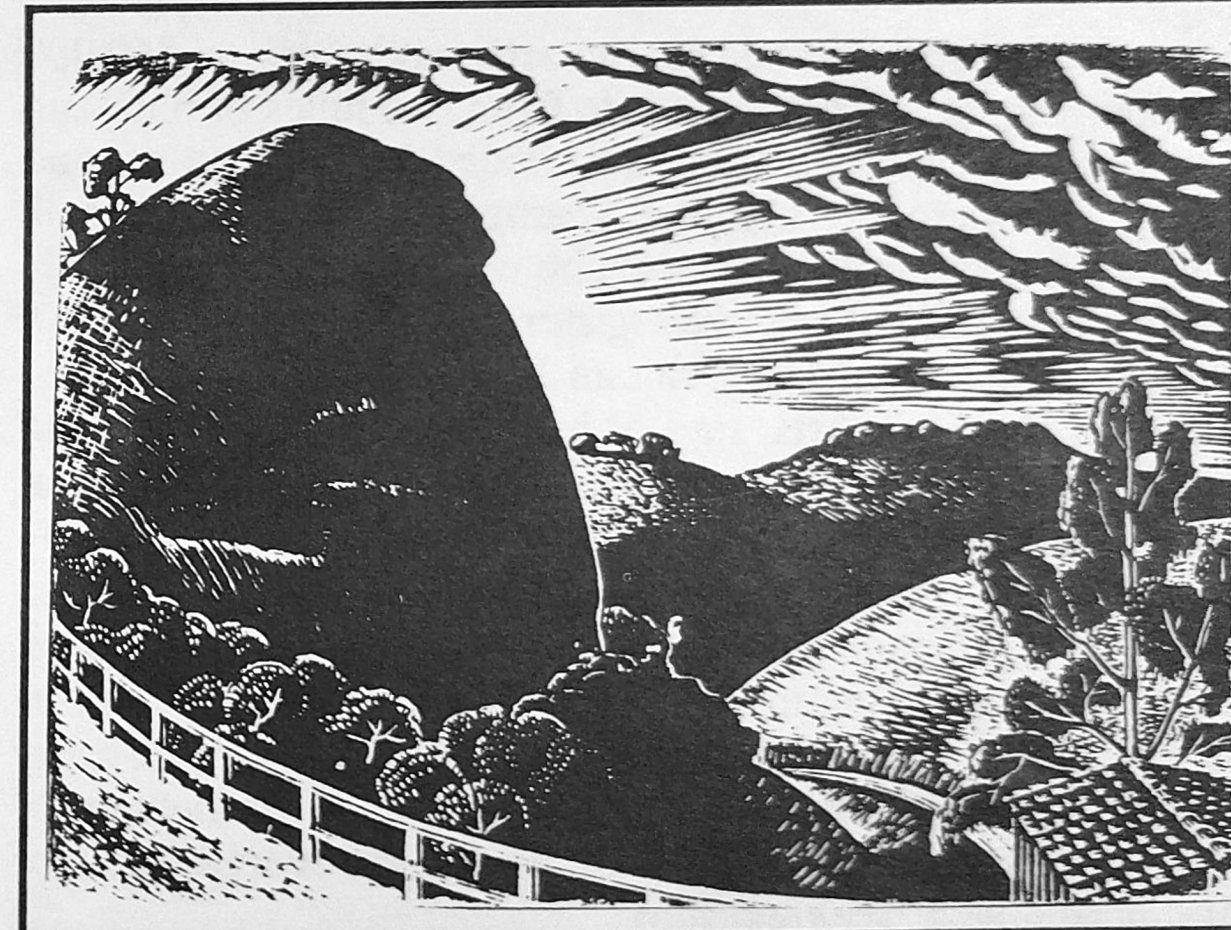
A wealthy art collector visited that annual display in 1988 and saw all the Aldrin works we had given through the years. He was captivated. He and his wife came down to our home to see the 44 Aldrin paintings we still have left in our own collection, and in early 1989 went down to Vincent Aldrin’s home to see the many hundreds of Aldrin paintings there. At once he purchased all 15 of Anders’s woodblock prints and a number of oils. In May he and his wife spent 12 hours at Vincent’s, going over the paintings again. They bought 25 oils, eight pastels, and six watercolors. He plans to arrange exhibits of them in prominent galleries before they become a part of his own collection in a spacious gallery at his own home. The enthusiasm of this noted collector has opened the door for other buyers.
Anders Aldrin, whose life overlapped van Gogh’s by one year, whose son Vincent was named after Vincent van Gogh, and who knew—as did the great Dutch artist—that his works were superior—is at last coming into his own.