
Chapter 8: Thumbnail Sketches of Some Super Friends
Mary Erickson, Her Drive Made Her a Champion
With a powerful drive and discerning eye Mary served the ball into the opposite court, wearing down her opponent and winning the game. That drive and the ability to direct the ball exactly where she wanted it won her the tennis championship of Washtenaw County, Michigan, where she was born and where she attended the teachers’ college at Ypsilanti.
Forty years later, in the Orange County city of San Clemente in California, her ability to aim directly at her goals and her powerful drive in furthering those goals wore down city and county opponents of affordable housing and human rights and brought permanent social changes in conservative Orange County.
Mary Erickson has had a passion for helping to provide affordable housing for those who needed it. She petitioned San Clemente council members. She wrote letters on the subject to individuals and to newspapers and insisted that her friends and acquaintances do the same. She used the phone endlessly to promote her objectives.
When her husband died she threw herself with even added zeal into the cause.
She had been in poor health and an injury to her left knee, caused by a fall, meant hospitalization. But she was able to leave the hospital in time to attend the opening of a Senior Citizen housing project that she had helped bring to fruition.
Then the right knee required another hospital stay. After that she used a cane as she made her way to the council chambers to speak at their meetings.
Mary’s health continued to be a problem; there were indications of cancer. Despite this she did not lessen her activities but actually broadened them, reaching out to work for affordable housing and better living conditions in other parts of Orange County.
Her crusades made progress. An award came to her from the Orange County Board of Supervisors. That was followed by an award from the San Clemente City Council. She put them on the shelf, along with her health concerns, and kept on fighting. Her 78th birthday came and went. The event was celebrated by an extra heavy day’s work promoting the projects that would bring help to so many in need.
In March of 1989, in a symbolic and a real sense, Mary went to her reward, just two days before her 79th birthday. At the service of celebration in her memory, in a sanctuary filled to overflowing, one person after another arose to express heartfelt thanks for her achievements that touched the lives of so many in such vital ways. Whatever life served her, she had volleyed back and had faced all her challenges confidently.
Back in her tennis days, the word “love” meant “no score; zero.” Mary’s life completely metamorphosed that term.
Through her, love has not only zeroed in on Orange County, but it has also overflowed into the hearts of untold numbers of grateful people who are thankful for what Mary did with her life.
The Pashgians Are Still Reaching Out
The first time Helen and I ever knew about Margaret and Aram Pashgian was when we saw Margaret on her knees in a Pasadena, California, parking lot, packing boxes with clothing.
Through her we soon met Aram. This was just three years after the end of World War II. Those boxes were being packed for shipment to Pasadena’s recently adopted sister city, over in Europe. Not a city in England, or in France, or in any of the other allied countries. Pasadena had adopted a war-torn city in the country of our recent enemy—Ludwigshafen, Germany, which had been bombed 107 times during the war.
“Why Ludwigshafen? Why any city in Germany?” some people asked. And others, including the Pashgians, had an explanation for this “reaching out” in peaceful ways across the sea. “If the people of Pasadena can share in a way like this, there is really some hope for eventual peace in the world.”
That was 40 years ago. The Pashgians—he is now 86 and she 83—have moved to Santa Barbara. A visitor to their home today might not find Margaret on her knees, as she was when Helen and I first met her. But Aram is apt to be—or at least on a stool, crouched over a ham radio set, “reaching out” across the seas to almost every part of the world. “I just talked with a young man in Armenia,” Aram told me, following the devastating quake in that country. Aram’s father came from what was once a part of Armenia in 1889, just 100 years ago. The Pashgians are “reaching out” to that land in tangible ways.
“I often pick up people in the Soviet Union by radio,”
Aram told me on another occasion. “Just yesterday I chatted with a ham in Peking, China, at the university there. A few years ago we traveled widely in those lands. It is good to keep in actual touch by radio.” Aram related how he had once talked with King Hussein of Jordan who is also a radio ham.
“We’ve traveled in Israel, and Egypt, and the countries of Europe. To talk with people personally over the airwaves in those countries keeps us in touch with the world.”
At this point Margaret interrupted. “Tell them about our 1966 world trip, when we met 28 hams in person.” Aram did so. “I’d become acquainted with every one of those 28 over the air. Then we met them face to face, in Damascas, Katmandu, Singapore—all over the globe. It’s a great feeling to put a voice to a face and also to meet their families.”
For the Pashgians, ham radio operation is more than a hobby: it’s a continual “reaching out.”
[See After Words at back]
Ernest Brown
Ernest Brown, at 86, is the oldest person in the St. Andrew’s by the Sea church choir in San Clemente, California.
He plays golf regularly and is the oldest of all his golf buddies.
Recently he made a hole in one—the only person of any age that I have ever known, personally, to accomplish that goal.
Ernest’s mind runs to figures; he is elected treasurer of almost every group of which he becomes a member.
Ernest and his wife Annamarie leave sunny Southern California to take winter trips up to their former home in Wyoming, or to a relative’s ranch in Montana. “I like cold weather,” he claims. Even when they became snowed in and eventually had to fight drifts to get back home, Ernest said he enjoyed it.
A later trip to Idaho was for the 100th birthday party of his mother; relatives had gathered from across the country to attend. Four days after that party word came of his mother’s death. “She was looking forward to that 100th anniversary; she set herself to live until it was accomplished,” he says.
Ernest Brown may very well emulate his mother’s accomplishment.
Floyd Faust’s Ministry May Last a Long Time
The Rev. Dr. Floyd Faust, who plays the accordion with a zest that makes people want to dance, has retired from the ministry but not from ministering. Recently the phone rang at his home in Columbus, Ohio.
“This is the Monterey Nursing Home,” came a voice over the wire. “Someone has told us you play an accordion. Will you come out? Will you play and sing? We’re going to have a luncheon for our old men.”
So Floyd went out. “The old fellows came creeping in,”
Floyd explained. “I walked down the line and said to the first one, ‘How old are you?’ ‘Oh, I’m 77.’ To the next one: ‘How old are you?’ ‘79.’ One man was 82. I found I was the oldest one there.” Floyd Faust is 85.
Floyd also makes audio tapes for shut-ins. Such a tape may offer an uplifting greeting, a word of cheer, a sprinkling of humor, some accordion music, a spiritual sharing of his Christian faith. Every tape is different and every one releases a refreshing breeze into the lives of those who listen. Helen and I know; such a tape came from him on the occasion of our 60th wedding anniversary.
In his taped greeting to us, Floyd led off with a veritable barrage of humor about aging. “The other day I saw a picture in the paper of a 91-year-old man. He had just bought a new car. The agent tried to sell him a used one. ‘No way,’ the 91-year-oldster replied. ‘I want it to last.’ ”
“If we can have that kind of spirit,” Floyd said to us over the tape, “we’re apt to last a long time.”
Floyd continued on the tape: “I heard a reporter talking to George Burns. ‘George, when you put your money in the bank do you take out a two-year or a four-year CD?’ George replied, ‘Four-year? At my age I don’t even buy green bananas.’ ”
Floyd sang a song for us over the tape. He serenaded us with his accordion music. As we absorbed the joy that he was bringing to us in this unique yet practical way we thought of all the hundreds of other men and women and boys and girls to whom Floyd Faust has brought moments of uplift through his music and his tapes. If he carries on with that kind of spirit he and his ministry of joy and love are apt to last a long time.
Lt. Col. S.G. Weller Gets His Wish
Back in the 1950s Lt. Col. S.G. Weller was dissatisfied with his job as an officer in the Army National Guard. Working conscientiously at his military assignments, he nevertheless yearned for a different outlet for his talents.
Although a young man himself, his consuming interest was in older people. He spent his spare time visiting his elderly friends, helping them with their problems. More often than not, his conversations would drift to concerns about the elderly. They seemed to be almost an obsession with him.
Then—the axe fell. The National Guard was cutting back; S.G.’s unit was abolished. He was out of a job.
Imagine our surprise when he and his wife Faurot burst into our living room one evening bubbling over with joy.
“What’s happened?” I asked, almost incredulous.
“Look at this,” came S.G.’s reply. He handed me a letter from Presbyterian Apartments, Inc. in Nashville, Tennessee.
“Their manager has just retired. They’ve contacted me about taking over. They heard about me from a friend. We are to go back at once for an interview.”
That was a quarter of a century ago. S.G. became the most “caring” manager that retirement home ever had.
Faurot, although not on the payroll, “adopted” first one person after another among those retirees, looking after their needs as a loving daughter would have done.
Eight years ago S.G. reached 70, time for retirement.
They “retired” in the home where he had served so long. He is now 78 and she is 76. In informal ways they continue to look after their loved ones, not as managers but as caring friends.
You May Have a Hard Time Keeping up with the Claypools
Kenneth Claypool, at age 90, leads tour groups over much of the world. In September of 1988 it was a group trip to Australia and New Zealand. When he was a mere 89 his group tour to China was a highlight. Autumn tours to the Northeast are taken frequently to drink in the beauty of the fall colors. For 14 years he has maneuvered his groups through the crowds in Pasadena, California on his annual tour trips to the New Year’s Rose Parade. In September of 1989 he leads a group to Montreal, Canada, and a voyage on the St. Lawrence River. His wife Neva always accompanies him and does much to help along the way. They met at a Methodist Epworth League Camp Meeting in California. They have now been married for 68 years. She is only 88.
Kenneth was born in Missouri in 1898. His father, a construction man, went to San Francisco to help rebuild that city after the earthquake and fire of 1906. Two railroads were competing for business and the trip to California cost his father just five dollars. Following the San Francisco job his father settled in Orange, California, where Kenneth grew up.
Ninety-year-old Kenneth Claypool, when not on tour, bowls regularly and has a rather good score. He does all his own yard work.
“He really has an upbeat attitude toward life,” his daughter, Virginia Lingren, explains. “That helps enormously to keep him active and always looking ahead.”
Kenneth’s first important job—the one that would affect his future more than anything else—was with the Standard Oil Company where he was trained as an accountant before the office had an adding machine. Calculators were unheard of.
“Dad always had a good memory,” his daughter explained.
“He can even remember the street names and the patrons on his paper route when he was a boy. But in that Standard Oil job he honed his memory to perfection. When he began leading tours after formal retirement, his memory was a Godsend.”
Kenneth Claypool fell into the tour-leading avocation quite by chance. Following retirement he and his wife had begun traveling and had covered much of the world. “In April of 1970,” he told me, “as we had traveled so much, our minister, Dick Kendall, asked me to be the escort for the XYZ Club—that is the ‘Xtra Years of Zest’ Club. Neva is the hostess.”
“Counting our one-day trips,” Kenneth continued, “we have escorted the XYZ members on 635 trips and tours. We have been to Leningrad, Budapest, Guatemala, the old forgotten city of ‘Amkar Wat,’ the Passion Play at Oberammergau, Singapore, Bali, Australia, New Zealand, the Holy Land, Ephesus, Alaska five times, Hawaii 17 times. And of course close-by bus trips to Vancouver, Canada, Lake Tahoe, Bryce National Park, Lake Powell, Grand Canyon. I do it all myself, get the rooms, charter the bus, and all.”
Kenneth guides the entire process. He remembers what the costs are, how many have paid and how much, who may have cancelled. He gets replacements as needed. All this bookkeeping takes place in his head. His memory is a huge asset on the tours. That Standard Oil job in the days before adding machines is really paying off.
Tour-leading takes up most of Kenneth’s time, yet it is not a paid job. It is an avocation. Kenneth and Neva like to travel, and help others to travel also. Their plans for 1990, among many other trips, include another trip to the Passion Play at Oberammergau.
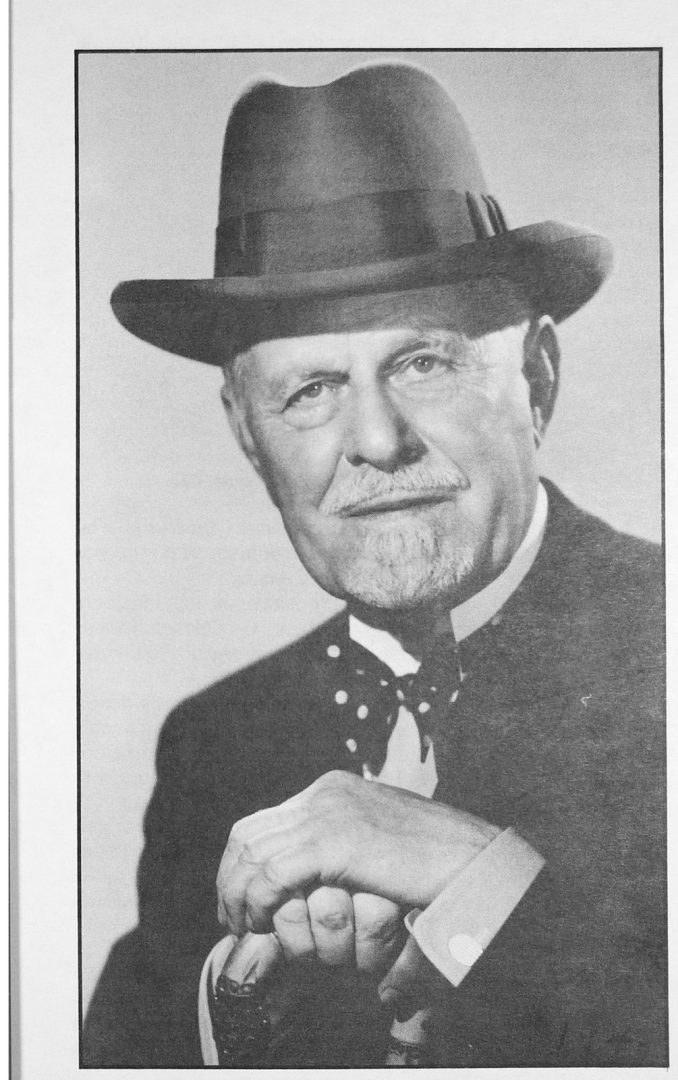
Burton Holmes, Dean of the “Travelogue” Seniors
Two reasonably reliable tests are available to determine whether an individual is of the younger or the older generation.
If one sees a penny on the sidewalk and stops to pick it up, that person probably lived during the Great Depression. If the penny is passed by, that person is one to whom the Depression is just ancient history, something grandma talks about.
The second test, although not quite as reliable, is nonetheless revealing. If you were brought up in the TV age or the era of VCRs, you probably never heard of Burton Holmes. On the other hand, if you learned about the great outside world by attending “travelogues” or adventure slide or movie shows on the local lecture course, you probably know who Burton Holmes was, and might even have attended one of his presentations that made him both famous and rich.
Burton Holmes presented the world’s first travelogue—although that name had not yet been coined—in Chicago back in 1897, 20 years before I had ever heard of him and 40 years before I got to know him in person. He and I both followed the same profession. His was a “lantern-slide” show and remained so until many of us youngsters entered the field showing 16mm color motion pictures.
He was on the American platform for 58 years, gave over 8,000 illustrated lectures, never missed an engagement, and grossed over five million dollars—a huge sum of money for his times.
After his retirement in 1948 his home was in the hills above Hollywood, where we visited him often. Helen and I had started the practice of having noted men and women plant trees in our garden by the large Eagle Rock, where we lived. We invited Holmes to plant such a tree. He died in 1958, at age 88. That “Burton Holmes” tree is a memorial to the “Super Senior” of travelogues.
Amy Adsit: for Her, Life Began at 101
In November of 1988 the grand old lady of Linesville, who had started writing a weekly newspaper column when she was 101, wrote “–30–” to her life of 102 years.
Linesville, Pennsylvania, is the town of my heritage, founded by my great-great-grandfather. Our closest friends there through the years have been Amy Adsit’s daughter Dorothy Lowing and Dorothy’s husband Larry.
Larry’s letter of November 8, 1988, told of Amy’s death.
“We had noticed that Amy’s handwriting (which had been a thing of beauty) had started to waver about the time of her 102nd birthday last January. She gradually became less communicative as time passed. Six weeks ago she was especially bad. Her main concern the day we visited was that the copy she had prepared for her column in the weekly paper was delivered. Her handwriting was hardly legible, but I noticed that she had edited out one period and substituted a semicolon—correctly.”
I had not known that this 102-year-old lady was writing a column for a paper. This was unheard of. At once I called the Lowings. “Oh yes,” explained Larry. “Years ago, when she lived in Conneaut Lake, Amy had written a regular column for the Village Weekly.”
Larry went on to explain that Amy had spent the last several years in a nursing home. “Life was a trifle boring for her there,” he said. “She occupied herself by writing dozens of letters and sending cards to a list of about 75 friends far and near. But apparently that wasn’t enough. She started writing a regular weekly column for the Conneautville Courier about the happenings at Rolling Fields, the nursing home.
That is the job she tackled at age 101 and continued till her death.”
There is something deeply symbolic about the final editing act on her column; with a hand that was weak but determined she had edited out a period and substituted a semicolon. A period is an ending; a semicolon signifies that more is still to come. Amy wasn’t about to call it quits just yet.
Over the phone, Larry told me some of Amy’s last words.
A few days before she died she looked up into their eyes and said, “I know I’m going to die. It’s awfully boring.”
Death was boring to Amy. Life, and thoughts of life, were her nourishment. She savored them almost to the last—until nearly three years past the century mark. That is true living.
The Lowings Represent the Best in America
Larry and Dorothy Lowing, both 75, are representative of the type of couple that are responsible for the greatness of this nation. Couples like them can occasionally be found in many of the small towns across the land, and their inclusion as Super Seniors is meant as a tribute, not only to them, but to others like them who make up the backbone of America.
The Lowings have devoted most of their adult lives to their family and to the community of Linesville, Pennsylvania.
Larry was born there and Dorothy moved to a neighboring town at the age of six. They were married in Linesville over 53 years ago. Except for one eight-year period, Larry has lived in this small community all his life. He was born into printing and became a fourth generation publisher of the weekly Linesville Herald, founded 108 years ago by his great-grandfather, the Rev. Henry D. Lowing. Dorothy was a reporter for the Herald, and then editor.
As publishers of the town’s only newspaper, the Lowings played a leading role in promoting their community. Dorothy was a regular chair for its Homecoming celebration, and headed the big one, Linesville’s Centennial in 1966. After they sold the newspaper in 1971, the couple spearheaded a drive that resulted in the founding of the Linesville Historical Society in 1980 and the Linesville Community Public Library in 1983.
Dorothy and Larry have raised two highly accomplished sons. There are six grandchildren, and two great-grandchildren.
One of the grandchildren, Sarah, age 16, was a soloist with a troupe selected from her dance school for an exchange with dancers in Russia and Poland. Her father, of the Millersville (PA) University art faculty, covered the event with his camera, obtaining some award-winning photos.
Linesville is on the shore of Pymatuning Reservoir, whose 16,000-acre surface straddles the border between Ohio and Pennsylvania. This great body of water—the largest in either state—is the site of a 10,000-acre wildlife refuge. Here 3.5 million tourists from all over the world have come to see the unusual sight of fish so numerous that ducks actually walk on their backs. Over the years, three generations of Lowings have had much to do with promoting and publicizing this unusual feature of their community.
John and Ann Rush Continue Peace Pilgrim’s Work
On January 1, 1953 a woman known as “Peace Pilgrim” began walking across the United States. Carrying her only possessions in the pockets of her tunic, she vowed to be a wanderer “until mankind had learned the way of peace, walking until given shelter, fasting until given food.” She walked prayerfully and as an opportunity to meet people and share her peace message: “This is the way of peace—overcome evil with good, falsehood with truth, and hatred with love.”
She spoke to thousands of individuals and groups along the way, discussing peace within and without. Her attainment of inner peace combined with action for world peace inspired people everywhere.
On four different occasions Peace Pilgrim stayed several days at our home in Capistrano Beach, leading retreats here and in our church.
She had walked more than 25,000 miles when her pilgrimage ended in July, 1981, at the age of 73. She made what she liked to call “the glorious transition to a freer life” while being driven to a speaking engagement.
Many friends of Peace Pilgrim felt her message was so vital and important they wanted it to continue to be spread across the land. John and Ann Rush, both 72, and three friends gathered her writings together and compiled the book, Peace Pilgrim, Her Life and Work in Her Own Words, and a smaller booklet containing her Steps Toward Inner Peace.
The Rushes turned their home into a Peace Pilgrim Center and have filled requests for more than 100,000 Peace Pilgrim books and 400,000 of her Steps Toward Inner Peace booklets.
Requests have come flooding in from 103 countries.
The Steps booklet has been translated into five languages; the Peace Pilgrim book has been published in German and is now being translated for printing in Spanish, Russian, and Chinese. The books are sent out free, and those who are inspired send gifts to help in printing more.
When Helen and I last visited the Rushes in their Hemet home, which has been transformed into the center for distributing these hundreds of thousands of books, we marveled at their dedication. They are devoting their lives to this work on a volunteer basis. The answer as to why can be found in a letter another volunteer, who spent a year at the center, wrote: “It didn’t take me long to figure out why they are willing to work so hard for no pay. It is the mail. The mail that comes in is truly incredible in quantity and quality.
Every day we receive letters telling of the wonderful results people are experiencing in transforming their lives and their relationships as a result of Peace Pilgrim’s message. We also receive news of various activities and projects she has inspired, which are making the world a more peaceful place.”
It is a deeply moving experience to be, in St. Francis’s words, “an instrument of peace.”
Peace Pilgrim would be delighted and perhaps a little bit amazed to realize that the pilgrimage she started in 1953 is now encircling the globe.
The Rushes and many others give free Peace Pilgrim presentations, showing videos of her speaking on various occasions. Free copies of her books may be received by writing to FRIENDS OF PEACE PILGRIM, 43480 Cedar Ave., Hemet, CA 92344, or calling (714) 927-7678.
Phyllis Case, a First Lady and a Dedicated Mother
At 84, Phyllis Case has lived a full lifetime of service to the community, to the nation, and—in a very special way—to her family.
For 16 years, as First Lady of Boston University where her husband Dr. Harold Case was president from 1951 until his death in 1967, she and Harold carried on a personal relationship with the students that directed and changed the lives of thousands. At the presidential home, “the Castle,” they held regular personalized sessions with the students at which they had far-reaching deep give-and-take discussions. One of those whom they befriended in a special way was a young student at the BU School of Theology, Martin Luther King, Jr.
Phyllis’s outreach was broad, and in November of 1987 she was honored by the Boston University Women’s Council for her achievements. She has served as vice-chair and member of the executive committee of the National Committee of UNESCO. She was a member of the National Board of Directors of the United Cerebral Palsy Association and of the National Board of United Church Women of America. The National Conference of Christians and Jews had her as a regional board member. She was the first woman ever elected to the Board of Directors of William Filene’s Sons Company. She has been active in the Browning Society, the Friends of Albert Schweitzer and other vital organizations.
Her role as a mother took precedence over everything else.
The Case’s son Robert was born deaf. Phyllis devoted most of her early years as a mother to teaching her son not only lipreading but how to talk. She instilled in him a confidence that has carried him high in his chosen profession as a photographer.
He has traveled at his profession in 28 foreign lands and has won high photographic awards. Without Phyllis’s early efforts to shape his life this could not have happened. Robert says “No one should ever attempt to state what the deaf cannot do, because there is probably a deaf person who has done it!” He goes on to give dozens of examples.
The Case’s daughter, Rosanna Kazanjian, made headlines over much of the world in April of 1989 when she and her son—the Case’s grandson—became the first mother-and-son priests to co-officiate as Episcopal rectors at a worship service of Holy Communion. After Rosanna’s husband, an Episcopalian, died, she received her Master of Divinity. The church Rosanna serves is in a mixed socioeconomic, interracial Boston neighborhood surrounded by the stresses of life. She is working to supply an answer to a question Martin Luther King, Jr. used to ask: “What would it take for the human race to become the human family?”
Helen and I have known Phyllis, Rosanna and Bob for 45 years. Many times we visited the “Castle” at Boston University where Phyllis and Harold guided the lives of so many students.
In June of 1989 we had our latest letter from Phyllis saying “My health is stable. I am active in my faith. I write on my video processor two days a week. We love our earth, our world, our Cosmos.”