
Chapter 15: Nature Lovers Who Plant Trees and Grow Flowers
John Cummings, A Modern Day Johnny Appleseed
Johnny Appleseed—his real name was John Chapman—was the inspired individual who filled the valleys of Ohio and neighboring states with the flowering beauty and fruitful nourishment of apple trees, which grew from the seeds he gave away or planted.
Johnny of Johnny’s Tree Farm in Oak Glen, California—his real name is John Cummings—is the inspired individual who, on his 40 acres in the mountains above Redlands, has created a “God’s Backyard” of varied beauty and fragrance that all who come may see and scent and share. Many of those who come to share, and learn about trees personally, are young people on weekend visits to the nearby Pilgrim Pines Camp, a Retreat Center of the United Church of Christ.
They learn about the firs and pines and stately redwoods, and since the Tree Farm is a mile high, they also get to see dogwoods, redbuds, maples, and other colorful trees that cannot be grown in the lowlands where most of the youths live.
Adults also come to enjoy. Easterners feel a nostalgic touch of homesickness when they walk under the shade of trees that are native to their homelands back east. Johnny’s Tree Farm is a jewel which embraces the wooded grandeur of all America.
This Tree Farm, at the back, adjoins the large orchards of the Los Rios Apple Company. The owner of the apple ranch had died but his widow, Ruth, still lived there. Johnny’s wife had also died. Literally, over the back fence between their two properties, Johnny and Ruth became firm friends. One day, as a friendly gesture, she gave him a copy of The Living Bible. He started reading it; he could not put it down. From Genesis to Revelations, he absorbed its messages.
“It changed my life,” he says, and he relates a homespun incident to amplify that statement.
“My house is close to the road. Quite often a car will pull up and stop, a man will come to the door and exclaim, ‘I am lost.’ ” “You’re not lost at all,” is Johnny’s quick reply. “I know where you are.” The tension eases as Johnny gives the stranger directions to his desired destination.
“Something very much like that happened to me,” Johnny explains. “I went through nearly 60 years of my life feeling I was lost. That Bible was like a guidebook. I realized that I wasn’t lost at all. God knew where I was and He let me know He had been with me all the time. When I was ready to ask, He began giving me directions.
“This is what I found: I found I was an important person.
I had never realized that before. I found I loved land and trees that grew on it. I found because of this love, God had given me two hands to do something about it. As God has no hands, I was to use mine to do the work He wanted and the work I loved. It was then I realized that because of my love for land, trees, and plants, He had put me here to be its caretaker. I found that if I shared this land and trees with others all kinds of blessings would flow back to me. I found new love for people because of this sharing. I found that every bit of love I gave to God was returned twofold.”
Johnny began sharing. But first, he began more planting and nurturing and beautifying—creating a paradise of trees—so he would have real treasures to share.
Ruth and John, in 1983, were married—right there in the natural grandeur of the trees.
More and more boys and girls from the Pilgrim Pines retreats came to enjoy it all and almost unconsciously learned new lessons about nature. Adults came, and absorbed the grandeur.
Three years ago Johnny wrote: “I am still strong, can do a fair day’s work and have spent a minimum of time being bedridden. Each day I try to walk through ‘God’s Back Yard’ to see the miracle that has taken place there.”
John Cummings is now 80 years old. Ruth is 79. The Tree Farm, whether as a park or as prime acreage for potential development, is worth hundreds of thousands of dollars.
John has just taken the ultimate step in sharing. He has given the entire Tree Farm to Pilgrim Pines, to be administered by the United Church of Christ, which Johnny likes to refer to by its former name, the Congregational Church. The gift includes not only “God’s Back Yard,” but their home as well, and also the quaint red “barn” which has its own living quarters. Many developers wanted to acquire this choice land but he adamantly refused.
A beautiful natural stream, fed by springs which bubble up on the farm, flows through the growth of stately trees. The Native Americans had an expression used in binding an agreement: “As long as the streams shall flow.”
As long as the bubbling, sparkling stream flows through the grandeur of its evergreens and dogwoods and maples, and its redwoods and firs and red buds, this Johnny’s Tree Farm will be nurturing the lives of boys and girls, and men and women, who come for retreat and re-creation from Pilgrim Pines.
[See After Words at back]
Theodore Payne Gives Helen A Surprise
Two methods are available for making a lasting impact on the future. The first is to influence young children, from the nursery on up. The second is to plant or distribute seeds.
Theodore Payne was a seed person and here again it started in a nursery, but of a different kind. Both types of nurseries are seedbeds for growth. Theodore Payne, the nurseryman and seedman, died in 1963 at age 92, but he has left a legacy that will carry on as long as seeds grow.
Payne was born in England and had a love of flowers even as a small boy. At 12 he was sent to the Ackworth School in Yorkshire, where he studied botany, became active in conservation and horticulture, and made a collection of pressed flowers which won him a first prize.
The scene shifts. At age 21 Theodore Payne moved to California and secured a job as gardener for the famous Polish actress, Helena Modjeska, at her country estate in Santiago Canyon, Orange County. Ten years later he started his own nursery on Broadway, in what is now the heart of the Los Angeles business district. As the city grew the nursery had to be moved twice, ending up as a ten-acre plot on Los Feliz Boulevard, where it remained until Payne’s retirement two years before his death. From that nursery he wrought an influence on the Los Angeles area, on Southern California, and to some degree on the entire world.
From the moment he had arrived in California Theodore Payne had fallen in love with the wildflowers that colored the fields and hillsides in those early days, but was distressed as he saw them disappearing as development encroached on their domain. He began sowing wildflower seeds in Hollywood’s vacant lots, in similar Pasadena lots, and wherever he could find open space. The Los Angeles City Council hired him to create a five-acre “wildflower garden” in Exposition Park.
He and a partner, Ralph Cornell, did landscaping and seed planting at Torrey Pines Park in San Diego County and on the campus of Occidental College. He helped select the site of the famous Rancho Santa Ana Botanic Garden and served as an advisor there for 20 years, until it was moved to Claremont.
He developed five acres in the Descanso Gardens as a wildflower haven.
In his early California days Payne had made a study of eucalyptus trees. A worldwide “eucalyptus boom” occurred and his nursery became the United States headquarters for eucalyptus seeds. Hundreds of pounds of those seeds were shipped by him, not only in this country but to South and Central America and Europe.
It is estimated that Mr. Payne introduced in California between four and five hundred species of wildflowers and native plants and made them available for general use. He wrote magazine and newspaper articles about them and gave talks in nearly every town in Southern California on preserving wildflowers. Honors and awards flooded in on him from the United States and from Europe. A 320-acre Theodore Payne Wildlife Sanctuary was created near Llano in the Mojave Desert and dedicated in 1961.
As development encroached more and more across the southland, many of Payne’s efforts were erased. But symbolically he had planted the seed; in actuality he had gathered and raised the seeds, the descendents of which are still spreading color and beauty throughout the world. Three years before his death the Theodore Payne Foundation for Wild Flowers and Native Plants was incorporated as a nonprofit organization to carry on his work and make wild plants and flower seeds available for sale to the public. From the nursery maintained by the Foundation such seeds are being distributed nationwide. Theodore Payne’s influence grows with every seed that is planted.
Helen knew this man of nature better than I did, at least to begin with. His Los Feliz Boulevard nursery was only a few miles from our home beside the great natural Eagle Rock landmark, which we had purchased in 1943. At that time the 13 acres surrounding our home and the rock was a pristine area covered with wildflowers and native chaparral. Helen was determined to keep things that way. One species of flower was so beautiful she hoped that more could be propagated around the rock.
One day, down at the Theodore Payne nursery, she described it to Mr. Payne. “If I could get new seeds for that flower…” Even before she finished he recognized what she needed and was able to fill the order.
About to leave, Helen turned back. “I’m wondering, where on earth do you get those particular seeds?”
Theodore Payne’s response was something that has brought smiles to our faces for years. “Oh, those,” he replied.
“There are not many places to find them. I get those I need from around the large Eagle Rock. It’s not too far from here.”
Helen introduced herself as owner of the rock. She admired Theodore Payne, because he loved the native plants as much as we. She knew he would treat everything lovingly, and she expressed her gratitude to him. That incident solidified our friendship. As long as we lived by the Eagle Rock that friendship continued. Almost till the day of his death, Theodore Payne was nursing and nurturing Southern California’s wildflowers and native growth.
The Theodore Payne Foundation address is 10459 Tuxford Street, Sun Valley, CA 91352 and the phone number is (818)
768-1802. They have a catalog which lists hundreds of wildflower seeds and native plants. Perhaps you who read this can also help carry on Theodore Payne’s work by sowing some seeds. It is one way to beautify the future.
A Tree Grows in Eagle Rock; Ernest Seton Planted It
In 1910 Ernest Thompson Seton, naturalist and nature-writer, “was instrumental in founding the Boy Scouts of America, serving as chief scout until December 1915, when he resigned in protest to Theodore Roosevelt’s idea that the scouts should be ‘trained to arms.’ Scouting for Seton had less to do with uniforms and mottoes than with camping, woodcraft, and Indian lore.” That is the entry regarding Seton in the Dictionary of American Biography, published by Charles Scribner’s Sons. Seton had founded the Woodcraft Indians in 1902, which greatly influenced the Boy Scout movement.
It was because of his rank as a naturalist that we first became acquainted with this man who wrote such books as Wild Animals I Have Known, Biography of a Grizzly, and Biography of a Silver Fox. His Lives of Game Animals won him the John Burroughs Memorial Medal.
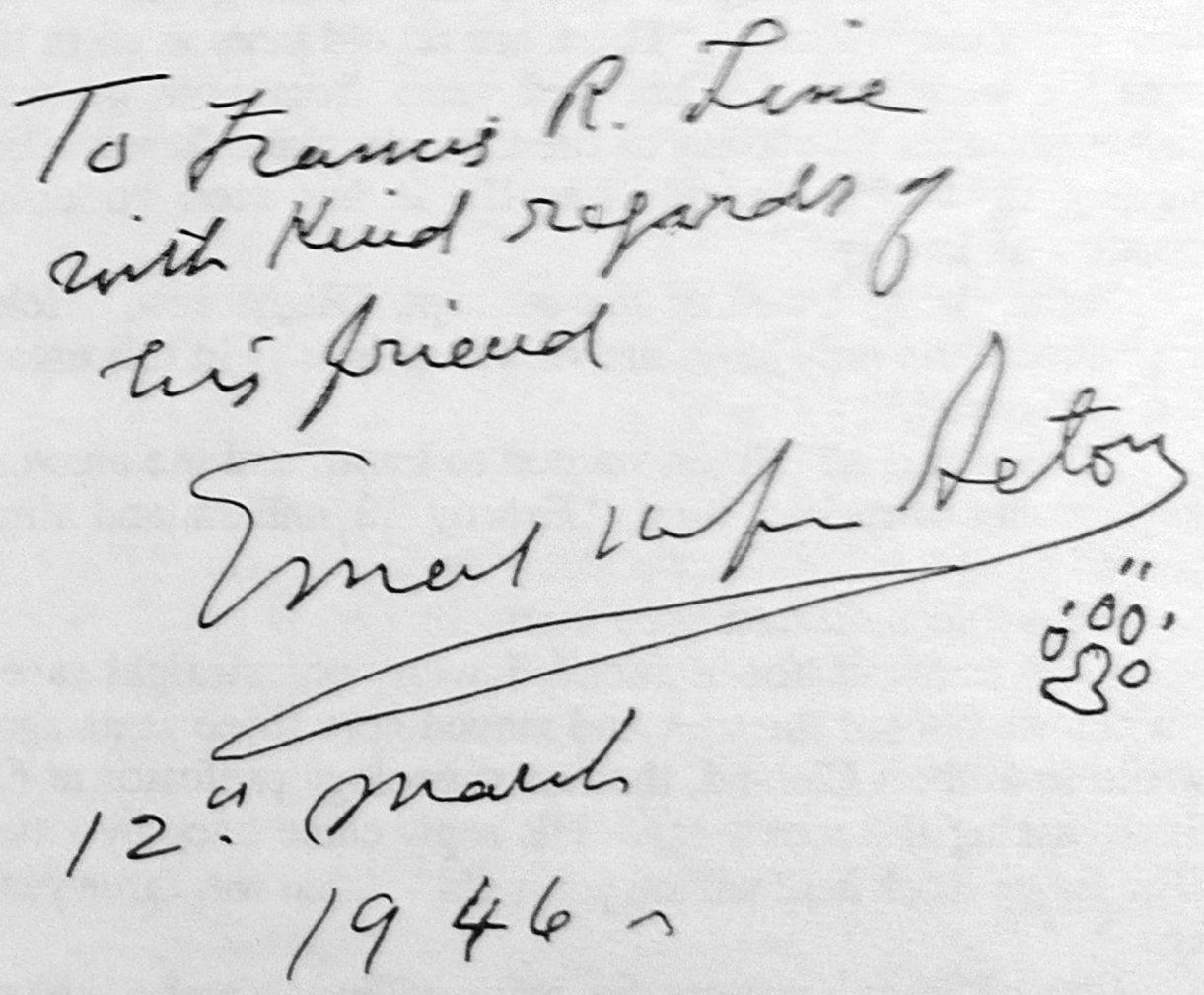
In our garden beside Eagle Rock, the great natural landmark on the boundary between Los Angeles and Pasadena, Helen and I were having trees planted by significant men and women, each such tree to be named after the one who planted it. We wanted Seton to plant such a tree. After extended correspondence a date was set for midsummer, 1946. He stayed with us a couple of days.
“A tree is a memorial,” I said to him in explaining our motivation, “not only to the person who may have planted it, but as a reminder of the history through which it has lived.”
We were standing in our patio, looking out at the enormous Eagle Rock. “There are no old trees at all in this area,” I went on. “A hundred years from now we want someone to be able to say of the tree you plant: ‘It was a tiny sapling right after World War II. It has seen an entire century of history.’ ”
Seton thought well of the concept. “Right now,” Helen explained, “the only longtime viewer of history in this area is the rock itself.”
“How old is it?” Seton wanted to know, and the answer I gave rather surprised him. “Exactly 12 million and three years.”
His smile indicated skepticism.
“We know it for a fact,” I went on, straight-faced.
“When we bought the rock and moved here three years ago I wrote to Robert Cleland, the noted geology professor at Cal Tech, asking the rock’s age. His reply came back by letter:
‘The Eagle Rock is 12 million years old.’ That was three years ago.”
One of Seton’s reasons for being willing to make the trip to California to plant the tree was because of his interest in the rock itself. We continued to discuss it at length.
“What that rock has looked down on and seen for most of its long life only a geologist could speculate on,” I continued.
“But since the first Indians came this way, it has seen a lot of human history.”
We had many of Seton’s books and we brought them out to discuss, especially the ones about nature and animals. This led to some animal stories we told him that perhaps matched a few he had written about. The area surrounding the Eagle Rock, we had discovered shortly after moving there, was virtually a wild animal sanctuary. Not a sanctuary, actually, so much as the natural home and habitat of animals.
“We’ve seen nearly every native wild animal you can mention,” Helen boasted. “Foxes, wild cats, deer by the dozens, even two mountain lions. Once a deer had made its way right up to the very top of the rock. It was shortly after a rain and some water had gathered in a shallow place. The deer had gone up for a drink.”
“And perhaps a view,” I added. “But, Helen, you haven’t mentioned our most interesting animal experiences of all.”
We told our nature guest about our experiences with skunks.
“At first we were actually afraid of them,” I explained.
“But we soon found that, if we were calm and showed no fear, they responded accordingly. Eventually we let them wander through our house, with never a problem.”
We had provided a small eucalyptus sapling for Seton to plant. Helen and I and this 86-year-old man walked up the hill to our garden area adjoining the rock directly beside and behind it. Firmly, without the help that I offered, he forced the spade into the soil, dug out spadeful after spadeful, all by himself, then planted the tree. He even helped us water it.
We had more long conversations that night, then next day he departed.
There was a letter of inquiry upon his return to his home near Santa Fe, New Mexico, for his interest in the tree did not end with its planting. Just three months later, in October 1946, Ernest Thompson Seton died. We corresponded with his widow, for she too had a concern for the tree he had planted.
The minuscule eucalyptus which Seton had started on its history-observing career grew into a large tree, providing shade for those who often sat beneath it to rest or meditate, providing nesting places for birds that Seton would have loved so much. Our acquaintance with this grand old man of nature had been short, but fruitful.
How Dorothy Richards Saved a Barnful of Horses
Dorothy Richards, age 75, makes “Nature Notes by dorothy”—beautiful note cards faced with delicate pressed flowers, which she sells at her home or by mail to discerning purchasers. We had never associated her with horses so a line about saving a whole barnful of those animals leaped out at us from the 1988 Christmas letter we received from her.
We read on:
My close neighbor, Ron Brooks, owned a horse which he kept in a barn around the corner on Boone Road, where 26 other horses were stabled. Late one afternoon back in April he called me frantically. “The horses are ill. One’s in real danger,” he was saying. “We think it’s a dried weed in the hay they ate. We’ve called the vet.
We’ve got to find out what that weed is before he arrives.
Can you help?”
“Bring it over. I’ll surely try,” was my quick reply.
Yes, it was a plant I’d seen growing on the edge of a field near the West Branch of Rocky River—a “horse nettle,” a member of the nightshade family easily identified by the flowers and the small barbs on the mid-rib on the under side of the leaf.
I didn’t go into details with Ron. “It’s horse nettle,” I said. “Tell the vet it’s an alkaloid poison.”
Ron made it back to the barn just before the veterinarian arrived. An anti-alkaloid serum was administered to the horse, no more infected hay was fed and a barnful of horses was saved by a bit of plant knowledge from an aging wanderer of the fields and woods.
Dorothy Richards has been wandering the fields and woods all her life. “I was born and brought up on a farm and married a farmer,” she explains. “Except for my college years, I have enjoyed country living all my life. This Ohio farmstead where I now live has been my home for nearly fifty years. I treasure the woodlot on this place. One ancient white oak is over 350 years old.” She went on to explain further. “This home had belonged to my deceased husband’s father. My husband was born here and he died here. He had lived here all his 74 years.” Her son and his wife and three children live nearby in a 115-year-old home that had been a schoolhouse where Dorothy attended first, second, and third grades.
In this day and age when such large numbers of Americans move from one house to another, and one city to another, almost yearly, Dorothy’s case is exceptional. She has put down roots as deep and strong as those of the great oak she admires so much.
Wild flowers are abundant in the woods and meadows and along the roadsides where Dorothy loves to wander. But when she goes to gather those flowers for “Nature Notes by dorothy,” she does not wander. Her method is quite different, as amazing as it is interesting. She drives out in a small vehicle equipped with a box loaded with paperback novels and books. She is not about to spend a spring or summer afternoon reading murder mysteries or love stories out in the woods. Those novels are a part of her occupation. Carefully picking a wild flower, she places it between the leaves of a paperback. Twenty or thirty pages of the book are turned, another blossom is carefully picked, which finds its place probably somewhere in chapter four or five. A 200-page novel will accommodate perhaps eight or ten blooms, and a rubber band around each book assures that no flower will fall out. On a good afternoon Dorothy may go through a small collection of books.
At home the flower-filled paperbacks are stored in a warm place and weighted down with cement blocks. In several weeks—now flat and dry yet as delicate and delightful as the day they were gathered—each flower is ready to be mounted on note paper under clear adhesive. The result—dozens of “Nature Notes by dorothy,” no two notes alike, each one a special creation carrying the feel of the meadows and woods.
Dorothy has in her home a herbarium collection which she has made of some 200 wild flowers, each one card-mounted with clear adhesive, and labeled with the common and scientific names.
One of those mounted cards displays the “horse nettle.” Because of Dorothy’s knowledge of that flower and plant, 26 horses are alive and prancing today. This fact makes her more delighted than ever that wild flowers are such a large part of her life.
“I have a wellstone in my front yard,” she says “with ‘Richard’s Refuge’ painted on it. This home and its surroundings of woods and meadows is indeed a refuge for me and a welcome to all who would come to enjoy a small piece of God’s wonders.”