
Chapter 5: Through Marion Downs We Met Super Seniors Galore
For years, when anyone would ask Marion Downs’s age she would coyly reply, “39 and holding.” Later it became “49 and holding.” Now, in 1989, she has confessed, “I am 73 years old.” Marion is still active, but not in the professional role as a singer that brought her fame. This chapter is not only about her, but about other Super Seniors we were able to know, largely because of Marion.
In 1955, Pasadena, California, was an interracial city without an outstanding interracial church, and United Methodist Bishop Gerald Kennedy determined to do something about it. He appointed the professional black Los Angeles Rams football player “Deacon Dan” Towler as senior pastor at Pasadena’s Lincoln Avenue United Methodist Church. Helen and I attended the largely all-white First Methodist.
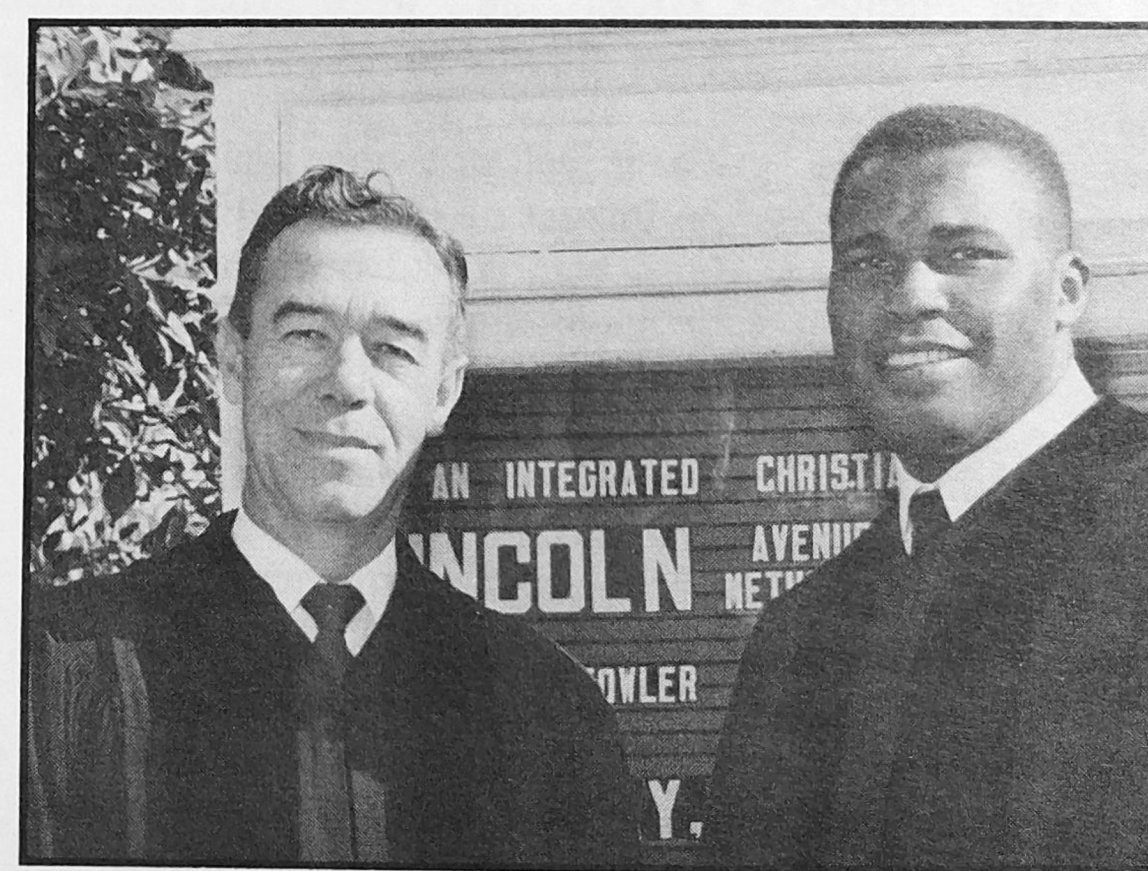
“Helen,” I said to her after hearing of the Rev. Towler’s appointment, “I want to go join Dan’s church.”
“I’ve been thinking much the same thing,” Helen responded. “If you join, then I’m certainly going with you.”
With the blessing of Dr. Morgan Edwards, we left First Methodist and became a part of Deacon Dan’s congregation.
Helen and I decided we should ask our black friend, professional singer Marion Downs, if she would not transfer her membership from Pasadena’s all-black church and join Lincoln with us. Marion agreed. She and Helen and I became members of the church together. In so doing we helped initiate an era that revolutionized that church and, to some degree, the entire city.
Marion was not only a professional singer, she was a go-getter. In her early years she had come to Pasadena as the young bride of the Rev. Karl Downs, who took over the pastorate of the city’s black church. Those were history-making times in Pasadena.
“You better come down to the police station; some of your kids are in trouble,” was the telephone message the Rev. Downs received shortly after he took over his new pastorate.
He went down to the police station as requested. Six young black youths were in custody; they had been drag racing up and down Pasadena’s streets, and were arrested for speeding. After considerable discussion, the boys were released to Karl Downs.
That seemingly insignificant act not only changed the history of Pasadena, it had an impact on changing the history of the United States. If those youths had been put in jail, without benefit of counseling and guidance, it might well have started them on a long downhill route. Instead, although it was far after midnight, Rev. Downs took them to his home—all six of them. One of those boys was Jackie Robinson.
“I fixed breakfast for them,” Marion related, in telling us about that eventful time. “We had a warm period of soul searching with prayers. The night ended with those young men promising to become active in the church, starting the next Sunday.”
Jackie kept his promise. Years passed. He attended church and later became a Sunday School teacher. Marion’s husband coached him in making his first speech. More time passed. Jackie Robinson became the first black baseball player in major league history. He broke the color barrier. Often, wherever he was with his team, he would call Rev. Downs to discuss pressing problems. Breaking that color barrier was not easy. Rev. Downs attended some of those first critical games. A warm, powerful friendship existed between them. Karl Downs was Jackie’s stabilizer. Marion explains, “No wonder this brilliant athlete was able to ignore the epithets from the bleachers, to not hear the slurs, to endure the lonely role of being the only black on an all-white team.”
“If it weren’t for Jackie Robinson,” Deacon Dan Towler once said to me, “I wouldn’t ever have been able to play football for the L.A. Rams. Jackie opened gates in sports for all of us.”
Marion’s husband was appointed president of Sam Huston College in Austin, Texas (named after Samuel Huston of Iowa) and they moved to Austin. After Jackie’s stint in the army he came to Austin and for a brief time coached the college basketball team.
While in Texas Marion’s husband died. To drown her grief she plunged into a career as a singer, taking instruction at New York’s Julliard School of Music and receiving a master’s degree in music at Columbia University. She was the recipient of a Fulbright Grant for study at the Verdi Conservatory in Milan, Italy and the Atkinson Foundation award for study of opera and folk music. To put her talents to the test she began concertizing widely in Scandinavia, Italy, and Mexico, and across America from New York to Hawaii. “The singer with a soul,” people called her.
At Lincoln Avenue Methodist Church Helen became Dan Towler’s secretary on a volunteer basis. She and Marion proceeded to make history. They organized once-a-month “Sunday Evening Sings.” When the side wings of the church were opened it could seat a huge congregation; on those Sunday nights every seat was taken and people often had to listen from outside. Helen did the organizational spadework; Marion led the singing and, because of her fame in the music world, brought in great church choirs from all over the Los Angeles area, free of charge. Not only choirs but noted individual singers participated. John Raitt had a free Sunday evening when he was not taking the lead role in Oklahoma or some other musical; he sang on two different occasions. The church overflowed. Raitt had a strong social consciousness and was glad to take part in the activities of this exciting new interracial church.
One Sunday evening Jester Hairston brought a choir and led the singing. Helen and I had the opportunity to meet this great man, a Super Super Senior who is now 88. His grandmother had been a slave and he himself once played the part of a slave in a John Wayne movie. He became one of the great choir directors and musicians of the West. He and Marion often argued good-naturedly as to whether it was he or she who created the now famous song, “Amen.” We on the sidelines do not much care who created it: we are always thrilled when one or the other of them gives us the pleasure of enjoying it.
Jester Hairston’s appearance at Lincoln was back in the late 1950s. I must here make a confession. For one hour I sneaked away from Jester’s evening of song. I went down to Cal Tech and heard the last few minutes of a speech being given by Martin Luther King, Jr. As soon as it was over I was the first one up to grasp his hand in appreciation; I thanked him for what he was doing, then back I rushed to Lincoln Church. Almost no one missed me.
This book is about Super people, but the actual building that housed Lincoln Avenue Church was Super in its own right. When the church was built, in 1898, William McKinley was president. Theodore Roosevelt, who was later to create a national furor by inviting Booker T. Washington to dine at the White House, was little known. The Wright Brothers were busy making bicycles. Lincoln Church had hitching posts instead of a parking lot, for there were no cars; oil lamps lighted the sanctuary, for there was no electricity. The office had no phone.
When the ground on which it stood was sold, the congregation was merged with another church and the structure itself was moved. That enormous building was cut in half, its steeple removed, and transported ten miles down the Pasadena Freeway to Heritage Square, to be preserved for posterity along with other noted 19th century structures. Now 91 years old, it is being refurbished. Helen and I have a hope that someday, when the refurbishing is complete, Marion Downs will lead another memorable Sunday Evening Sing in that historic church.
Marion’s mother, Mrs. Lillie Mae Jackson, who often came out on visits from Baltimore, was not only a Super Senior, she was a superior person in three dramatic ways that made us proud to know her. First of all, she was the mother of three daughters and a son, who made up the Jackson family. Ebony magazine said of them:
“Measured by the yardstick of resolute, unswerving dedication to the Negro’s crusade for civil rights, Baltimore’s remarkable Jackson clan must certainly be rated one of the foremost Negro families of America.”
It all really began when “Fearless Lil,” as she became known, selected a blouse at one of Baltimore’s largest department stores, then was refused service.
“I want to see the manager,” she demanded. The manager, she found, was Jewish. Lillie almost broke into laughter. “This is ridiculous,” was her initial comment. “We Negroes are persecuted in some areas, and you Jews are persecuted in others. Why don’t we get together and fight to change things?”
That manager and that fearless woman did get together. He ordered the store clerk to sell her the blouse. His store became desegregated. The first battle had been won.
The Baltimore branch of the National Association for the Advancement of Colored People, of which Mrs. Jackson was president and which she continued to head for 21 years, became the second largest branch in the nation, under her leadership.
The quality that made Lillie Mae Jackson a truly superior person has yet to be told here. In 1919 the right side of her face became paralyzed when a surgeon accidentally cut through a nerve during an operation. Seen from that side, her face was so misshapen and blemished that at first one was almost afraid to look at her. It took rare courage to overcome a handicap like that but Lillie Mae Jackson never let it stop her even for a moment. “God made me in his image,” she told those who stared at her. “Man did this.”
Marion’s mother was deeply religious. Helen and I made frequent visits to Marion’s home, at first in Pasadena and then later when she remarried and moved to Los Angeles. (She is now Marion Downs Smith.) Sometimes we talked with Mrs. Jackson by the hour when she was visiting her daughter. I was at first secretly amused, then amazed, then deeply moved, at the way she would sprinkle apt Bible quotations throughout her entire conversation.
Ebony said that, on occasion when a meeting got off on an angry note, she would stop the meeting, then, in her booming voice, start singing the hymn, “God Will Take Care of You.”
“Christ had only 12 men and one of them was the devil,” she was quoted, “yet he changed the course of history.”
Lillie Mae Jackson died at age 87, fighting for human rights to the very last. She changed the course of history in Baltimore. A museum in that city, named after her, chronicles her work.
Dozens of international students from around the world attended Pasadena Junior College and other similar colleges near by. At Lincoln Church we decided to promote an annual International Student Dinner. As a result, Helen and I made a lasting friendship with an unusual man, Augustin E. Turner—a true Super Senior—who helped us with those international get-togethers.
The Pasadena Rotary Club and the YMCA, of which he was a member, published a book about this great man. It opened with this appraisal: “Only occasionally does a human being arrive on earth who is, at one and the same time, durable as steel and soft as drifting snow. Augustin Elmer Turner was such a person.”
We at Lincoln would have had difficulty staging the international dinners without his help. His life work, before retirement, had been to carry on peace and humanitarian activities throughout the world as a roving ambassador for the YMCA. He visited most of the countries of South America and Asia in this capacity, although South America was his principal stamping ground. For 32 years he served the YMCA in Valparaiso, Chile. Much of his work brought him into contact with students.
Upon retiring in Pasadena, he and his wife, Dell, devoted the rest of their lives to helping the international college students who came to the city. He became known as Pasadena’s “Citizen of the World.”
He knew, and helped, every international student in the city, visiting them in their homes, arranging events for them to attend, addressing himself to their needs. Wherever he went, he walked—25 miles a week, someone figured. He once won a Rotary contest by walking, in one day, to the places of business of each of the 270 members of the club.
He would arise at six, have an oatmeal and dry toast breakfast, then, before starting his walking visits throughout the city, would write letters to friends in many lands. During the holiday season that meant personally answering many hundreds of letters from students and admirers around the world. At a “ritzy” birthday breakfast given him by the Rotary and Y’s Men’s Clubs at the prestigious Huntington Hotel everyone had oatmeal, dry toast, and coffee. Everyone except Augustin. He substituted a cup of hot water for the coffee.
In connection with the Lincoln Church International Dinners, Augustin and Dell Turner, along with Marion Downs, Dan Towler, and many others involved, held planning meetings in the spacious living room of our Eagle Rock home.
Augustin rose to speak. He was tall and stood straight as a soldier at attention. Some of us had been talking privately about the endurance it took to walk everywhere he went, every day. I thought he must be in his late 70s, although he scarcely looked it.
“Augustin,” I said, “I am curious, and several others here in this room are also. We want to ask you: How old are you?”
Augustin was taken aback. He did not answer directly. Instead, he related a story. “One night at a dinner a young girl looked at me wide-eyed, and said: ‘Seventy; that’s awfully old.’ ”
Augustin paused. “I didn’t tell her I was 88. That was four years ago.”
This international ambassador of goodwill was 92! His wife and helpmate, Dell, was also certainly a Super Senior. As part of our planning that night we scheduled Augustin Turner to give a speech at the International Dinner. As it turned out, the short talk which he delivered was an inspirational gem. But that was only one of the reasons the students gave him an applause that must have registered at least eight on the Richter Scale. Everyone of them knew him personally, and knew what he had done for them, just as he had done for students who had come to Pasadena from 60 different countries. Those students were applauding a life.
As the ovation finally subsided, Marion Downs jumped to her feet. “Let’s all thank Mr. Turner with our voices. This song is dedicated to him. Let’s all join in singing ‘Amen.’ ”
Augustin Turner lived to merit similar rafter-shaking applause, and continued making his walking rounds daily, until nearly the time of his death at the age of 97.